Showing posts with label Burma. Show all posts

Wednesday, September 24, 2014

Links Roundup: Calcutta to Ledo; Naga and Burma Tribes

One soldier whose story is up on China - Burma - India is Jack Thomas, who was in the 191st Signal Repair Company, stationed in Ledo in 1945.  One set of photos features Ledo and scenes of convoy from Calcutta to Dibrougarh to Ledo.  Here are a few:

Jack Thomas's photo of Dibrougarh in 1945.

Jack Thomas gave this the caption:
"Typical Naga tribesmen."

Jack Thomas's photo of Burmese girl
in Ledo, 1945.

Jack Thomas's photo: Ledo, 1945.


Walter Orey, an aviation engineer, built airstrips in Burma just a few months before Gene's group arrived.  We've referenced his memoir in an earlier post.  This section of his memoir describes the Kachin and the Shan:
"No country of its size had a greater variety of tribal and racial groups than Burma. More than a hundred languages and dialects were spoken in Burma. The two tribal groups that we became most familiar with were the Kachins and the Shans. The Kachins lived in the higher elevations of northern Burma. They lived by cultivating rice and they traded with the Shans. The Shans lived in settlements along river valleys in northern Burma. The Kachins were smiling hill people who were very friendly to the Americans. They helped the Americans because they expected that once the Japanese had been cleared out they would be able to live their lives as before. Some Kachins irregulars had assisted with the capture of Myitkyina and Kachin guerrilla forces worked with the Office of Strategic Services (OSS) behind the Japanese lines. Hundreds of redbrick pagodas and shrines, were scattered on the low lands along the Irrawaddy River. They always seemed more fascinating from a distance then when they were seen close-up. We were told that Buddhists had constructed the temples and shrines many centuries ago. An unusual sight for us was watching the Burmese women puffing on huge cigars, made of tobacco leaves and stems, and rolled in the cornhusks and tied with thread. They called these oversized cigars "cheroots." Most of the civilian homes and buildings in Myitkyina were destroyed in the battle to capture the town. Replacing them was a problem easily solved. Most homes were made of woven bamboo. It was not difficult to harvest an inexhaustible supply of bamboo from the jungle. The 1891st Engineer Aviation Battalion had constructed two airfields in northern Burma from October 1944 to March 1945."


He drove in the first convoy, 1,000 miles from Bhamo, Burma, to Kunming, seeing on the way returning Chinese who had been trained - presumeably to fight and to conduct sabotage operations agains Japanese supply and communications lines - in Assam:

 "The steepness of the grades and the thousands of hairpin curves were the causes of the convoy moving so slowly. We averaged less than 90 miles a day. Now and then we would see Chinese soldiers who had been trained in India, fought in Burma, and were now returning to China on foot."


LIFE Magazine published on the first convoy on the Ledo Road, with photos by Jack Wilkes.

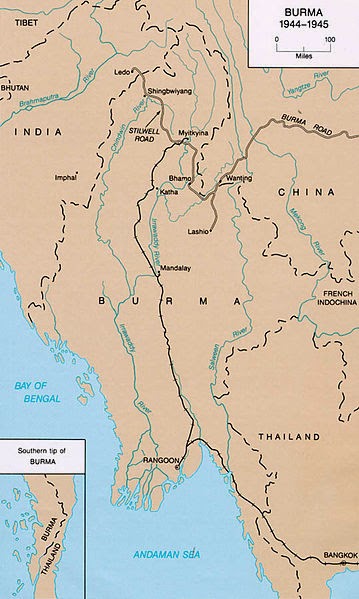
The map below is one of several excellent maps in a highly-recommended overview essay on Warren Weidenburger's CBI site:


The pictures coming up next in the Zdrojewski collection look like China, but include people of various hill tribes.  Perhaps they had a camp inside China but near the Burma border, well to the west of Kunming, which was and is a big city.

We know how Dad traveled back over the hump at the end of the war: we have the color film footage from the transport plane, and we have a story about how the Japanese kept shooting at them.

How did he travel east over the hump into China?  Wouldn't his group have taken a truck convoy or a transport plane?  There are no photos in the collection to give us a clue.  But we do have two stories, heard in childhood.

One was about "riding a Chinese pony through Burma."  It started stumbling and generally acting distressed.  Gene dismounted and removed the saddle and blanket, to reveal a great big fresh saddle sore.  There was not a great deal he could do right away to help the animal, and his own distress at that was evident right there in the Marilla kitchen in the 1960s.

Another story was about "a Chinese pony stepped on my foot, and that is why the nail looks wrong and always will."

He never mentioned mules or horses; it was always "a Chinese pony."


Z

Friday, June 20, 2014

Mules in Burma as per Life Magazine

China - Burma - India includes Life magazine articles collected and reformatted by the site owner, C.W. Weidenburner.  One such is "Mules of Myitkyina," from August 7, 1944.

This photo from the Life article almost makes it look like a walk in the woods.  Google images as "mules Burma World War 2" and you will see a little of how bad it in fact could be.


An excerpt:

"Any good Marauder mule skinner defends mules vigorously against any of the usual charges made against them. A mule is not stubborn, he is practical. A mule doesn't want to be disagreeable unless he has to. He just sensibly follows the line of least resistance. If he balks or kicks, he has a reason. Caught in a tight spot, a mule never kicks himself to death or flounders as a horse often does. He sensibly waits for help. A mule doesn't fret and give way to nerves as men and horses do, he makes the beat of things. He is well-behaved under fire and bombing. He never gets shell shock. He has much more endurance than a horse and, unlike the horse, he has too much sense to overeat and overdrink. A mule is in fact, say Merrill's Marauders, a pretty savvy creature all round. As Colonel R.W. Mohri, the Burma mules' vet, puts it, 'A mule's every bit as intelligent as a human being. Probably more so. So to get along with him you need to have, if possible, as much sense as the mule.'"

Sunday, June 15, 2014

Lyons Memoir - Merrill's Marauders and Orde Wingate

In a recent post we had just learned of the long-running newsletter for CBI veterans, Ex-CBI Roundup.   An issue from 1991 contained a memoir by Captain Fred O. Lyons, one of Merrill's Marauders from summer 1943 until the capture of Myitkyana Airstrip on May 17, 1944.

If primary historical sources, first-hand accounts, and undeniable authenticity are what's wanted, then there is nothing better for it than a memoir like this.  Some passages from just one paragraph will clue us in to what is happening on the sea lanes and in CBI theater at that time:

(Emphases and formatting are mine.)

" . . . The next morning we boarded two trains with curtains drawn. Five days later we were in San Francisco. At least we knew we weren't going to Europe.Kept close in barracks at Pittsburgh, California, we were given shots of vaccine against diseases in tropical or arctic climates. We thought we had learned something when we got wool clothing, but the next day we were issued another outfit of cotton uniforms. The rumor factories were put in production, but we still had no inkling of our real destination.

. . . At sea on a converted luxury liner, I found that we were to be given plenty of training for our mysterious mission. Day after day on the wide decks we jumped and crouched, slashed with bayonets and parried with gun butts. We shot at bobbing Japanese cardboard faces, peered at cardboard models of Japanese tanks and airplanes. We had to learn a lot about fighting the Jap, and every minute counted.At New Caledonia we met new members of our outfit leather-faced veterans of Guadalcanal and New Guinea. On board ship the veterans were assigned places in our units, to give weight and experience to our novice ranks. By then we knew our goal wasn't the South Pacific.

At other ports, we were ashore only a few hours. The most welcome sight in years was India, for it meant the long sea voyage was over.A clanking, snorting train carried us to a rest camp, and after three weeks we moved to training camp. There we learned for the first time where our battleground would be. It was the now-legendary General "Sword and Bible" Wingate who broke the news to us. He told us every detail of his famous Raider campaign in Burma the year before, so we could profit by his experience and come out of the jungle alive. I see him now, his hawk-like face animated as he warned us never to speak above a whisper in the jungle, never to try to pull away a blood-sucking leech, never to drink jungle water without sterilizing it."


Orde Wingate

" . . . For two months we trained in the maneuvers of the jungle. We were issued jungle clothing - not the splotched camouflage uniforms of the New Guinea boys, but solid dark green outfits that offered even more complete concealment in the bush. Our fatigue blouses and our pants, our undershirts and drawers, even our handkerchiefs and matches were green. Day and night we marched, ran, hid, feinted, learned all over again the lessons that first had been learned by American frontiersmen in their struggle with the Indians. Right along with us was Brigadier General (now Major General) Frank Merrill, learning too."

Frank Merrill

We became hard as our green helmets, tough as our green GI brogans. I weighed 146 pounds and there wasn't an ounce of fat on me. I could run for 20 miles and still enjoy a brisk walk in the cool night air of an Indian village."


Here at Ex-CBI Roundup is the entire Lyons memoir, including useful medical information about amoebic dysentery and giant leeches.  With those leeches, there are certain things one must do and must not do.

Note that in the fall of 1943, Lyons's troop transport sailed from San Francisco to New Caledonia to India (probably Calcutta.)

At roughly this same time, Dr. Gumaer transported those mules to CBI by way of the Atlantic.

A year later, fall of 1944, Walter Orey  sailed Los Angeles to Fiji to Melbourne to Bombay.


Saturday, June 14, 2014

Walter Orey, Army Engineer Aviation Battalion, CBI, 1944-1945

An online memoir of Walter Orey is to be found at China - Burma - India.

  Orey shipped out in September 1944 from the Los Angeles Port of Embarkation, on his way to Assam Province.  This was six months before our EJZ shipped out.  We don't know whether Eugene's troop ship followed the same route, but we do know that he rode through Burma shortly after Orey's 1891st Engineer Aviation Battalion trucked the Stillwell Road and built airstrips at Myitkyana and at Kunming.

One stop was Fiji, in the fall of 1944.

The memoir describes more of the route, as follows:

". . . A few days after crossing the International Date Line, the ship docked at the Port of Suva in the Fiji Islands. There was no shore leave for the troops, but we did participate in a foot march through the town. By now there were rumors that the ship would stop in Australia. A few days later the ship did dock in Melbourne, but we were told that Australia was not our final destination. Only controlled marches were allowed in Melbourne. Even the controlled marches were canceled after the first day when some men broke ranks to explore the side streets of Melbourne on their own. When we left Australia we became part of a convoy protected by a British cruiser and two Dutch destroyers. Up to this point there was considerable speculation, among the men, as to our final destination. As the ships traveled west for more than 1000 miles, and then headed into the Indian Ocean, it became obvious that we were headed for India. After many days of terrific heat, our ship docked in the Port of Bombay. We had been on the General Randall for 38 days.

The train ride from Bombay to Dibrugarh took nine days."


An excellent collection of photographs accompanies the memoir on the site.

 Subjects include troop transport, Assam, Burma equipment transport, the Burma Road, the building of the airstrips, Burma scenes and culture, and Kunming, where our EJZ was also stationed.

 The collection also depicts airstrip-building in China, captured Japanese tanks, a survey of the various airplanes used in the transports, and the Japanese surrender ceremony in China.


As we have seen in previous posts, like this one and also this one, the Army Specialized Training Program was started due to political decisions in the War Department.  Orey's memoir discusses how A.S.T.P. was close to eliminated in the spring of 1944. Orey had been training as an Army Air Corps cadet, hoping for flight training, when he was suddenly shifted to AGF, ending up in his Engineering Aviation Battalion.  The two programs, A.S.T.P. and Army Air Cadet, had similar fortunes.

 Here is the relevant passage from the memoir:

 "In the spring of 1944 the stanine scores were raised again washing out about 70% of the Aviation Cadet candidates in our squadron including me. All of the washed out cadets were given a fourteen-day furlough with orders to report to Hammer Field, located near Fresno, California. Most of the washed out cadets believed the "stanines" were raised in response to a sharp reduction of requests from overseas combat commands for replacement air crews.
  Only recently did I discover a book that provided another explanation for the cutback of the aviation cadet program. The book's title is Scholars In Foxholes! The Story of the Army Specialized Training Program in World War II by Lewis Keefer.
  Lewis Keefer stated there was enormous political pressure to sharply cut back the Army Specialized Training Program, as well as the Army Air Cadet Program early in 1944 to save more than 200,000 pre-war fathers from the draft. The Army decided to curtail both its ASTP and the Air Cadet Program. The War Department announced in January, 1944, that 70 colleges would lose all their Air Cadets. The fate of many air cadets paralleled that of the ASTP students. They were selected for a special program, filled with great expectations, then with little warning transferred to the Army Ground Forces. The washed-out cadets and the ASTP students were spread widely among receiving units to fill personnel shortages."

This memoir and photo collection is but part of a terrific assemblage of material contributed by CBI veterans and their families and organized and maintained by Carl Warren Weidenburner.


Monday, June 9, 2014

CBI - Mules and Veterinarians Go to War

In the summer of 1943, our EJZ was getting ready for induction into the Army, while Tadash Nagaki was dropping into Burma.


The Burma Road had been built by the Chinese following the occupation of China by the Japanese prior to World War II.  It ran from Lashio in Burma (Lashio could be supplied by rail from Rangoon) to Kunming in China.  

The Japanese Imperial Army was eager to close off China's supply route, and so pressured the British to close the Burma Road.

From December 1941, the Japanese conquered Burma to loot its oil and rice for their army.

However, the "sleeping giant" had awakened; the Americans, with the Burma Road closed to the Allies, built an alternative road from Ledo, Assam, India ultimately to the Burma-China border, where it connected with the original Burma Road.  This Ledo Road took two years to build: 1942-1944.  Stillwell was in charge, and Donovan's OSS Detachment 101 and Merrill's Marauders fought the Japanese to make the roadbuilding and road-reopening possible.

In the meantime, the Allies supplied the Chinese, and flew their bombing runs, by air, using the Hump Route:


When the Ledo Road and the Burma Road were connected and secured and renamed the "Stillwell Road,"  troops and materiel went over them to China, on trucks (January 1945) and on mules.  

But what of these mules, these tens of thousands of mules?  Well, they were  American, also.

And they had American veterinarians. The late Dr. Don Smith, bovine surgeon and Dean Emeritus at Cornell, pursued an interest in history of veterinary medicine.  Dr. Smith had extensive conversations with a Dr. Kenneth Gumaer, who as a new graduate in 1943 was bored with meat inspection, got tangled up with OSS mules, and was no longer bored.

New grad Dr. Gumaer in 1943.
Nice tie, Ken;
the gents on this blog
sport memorable
neckwear;
you fit right in.

(© Cornell University)

Veterinarians in Combat: The China-Burma-India Campaign was Dr. Smith's account of Dr. Gumaer's responsibility for his several hundred Army mules from Nebraska to Assam Province, thence over the Stillwell Road to the eventual May17th, 1944 capture of the Myitkyina all-weather airstrips by Merrill's Marauders.  From Dr. Smith's post, which, sadly, is no longer available:

"Drs. Gumaer and Waple, each with their band of mules, became part of a long range penetration Special Forces unit that traversed the 6,000 foot Kuman Mountain range behind Japanese lines. 5

'In that kind of tight jungle warfare we were confined to the trails and getting out into the jungle was almost impossible. We were a real surprise to the enemy. I don’t think the Japanese expected our troops to be so experienced. Our troops killed a lot of the enemy soldiers that were not used to frontal assault—they’d just walk right into the fire. We had Japanese interpreters with us who were very loyal to our group and they got us a lot of good Information that made is easier for us to know what to expect.'"


The National WWII Museum in New Orleans has this photo
of Hiram Boone, on Chick, in Burma.
Nothing to do with Dr. Gumaer or Eugene Zdrojewski
except for the US Army mules.

What sea route did Dr. Gumaer take with his mules in the fall of 1943?  Port of embarkation was New Orleans.  Going around Florida a German sub torpedoed them, but they made it to Newport News, Virgina, then crossed the Atlantic - with no convoy.  Then what?  Did they cross the North Atlantic, to Gibraltar, the Suez Canal, the Indian Ocean, around to Calcutta?  Maybe they did; the victory at El Alamein had been in August 1942.  Or did they go south, around the Cape of Good Hope?

After a look at another Toyon Bay training grad, and his trip to Burma a little later than Dr. Gumaer's, we shall resume our account of the travels of our EJZ.


Sunday, June 1, 2014

Catalina Alumnus Tadash Nagaki

We have figured out in earlier posts here, here, here, and here, that our EJZ was in training on Catalina Island from mid-December 1944 to mid-January 1945.

One of his predecessors in OSS training at Toyon Bay was Nebraska farm boy Tadash Nagaki.  He was joining the 442nd Infantry Combat Regiment - "Go for Broke" - in July1943 when OSS put out a call for Nisei to volunteer for dangerous missions.  Tad was Nisei; he wanted a combat unit; soon enough he was at Toyon Bay.

Tad Nagaki was part of OSS Detachment 101, charged with clearing the Japanese from the jungles of Burma and rescuing downed Allied airmen, so that the Burma Road could be re-opened and the Ledo Road built.

Tad Nagaki's big brass:  Merrill and Stillwell

This is from Mary Previte's excellent essay.

Ex-CBI Roundup was a newsletter for veterans of China-Burma-India theater, from all branches, published 1946 through 2009.  Clark King and Gary Goldblatt are scanning the 600 issues and putting them up here, as well as assembling a great deal of background information on CBI here.  Thank you, Gentlemen!

Previte's essay is from the June 2002 issue.  It's riveting, all the way through; here are a couple of quotes to tempt you:

". . . Just before the war started, a tiny handful of Army Intelligence specialists were alerting superiors of the importance of training Japanese language interpreters to master the incredibly complex Japanese language.  But, could youth of an alien race - only one generation removed from the land of their ancestors - be trusted in battle or in top secret intelligence work?  While one hand of the Army was removing Japanese-Americans from the West Coast, another was searching for qualified Nisei for its language and intelligence effort.  In San Francisco, the Army opened a small-scale language school in a converted hangar at Crissy Field, The Presidio.  It hand-picked 58 Nisei for its first class - sitting on apple boxes and orange crates.  When the top brass saw its value, the school was transferred to Camp Savage, Minnesota, where it was reorganized as the Military Intelligence Service Language School. . ."
Remember Camp Savage, Minnesota?  Our EJZ got a letter from there while in Chicago conjugating Japanese verbs, if that's what you do.
". . . The OSS trained the Nisei team first in radio school in Naperville, Illinois, then the Military Intelligence Service Language School in Fort Savage, Minnesota, then six weeks of survival and demolition at Toyon Bay on Catalina Island.  They toughened up with fitness training in the mountains, exercised with water drills from LST boats.  They could survive by fishing or shooting mountain goats.  Catalina Island was ideal for coastal surveillance and commando training.  It was 1944, after begging for action since 1942, the Nisei were about to get their chance. . ."
". . . Late in 1944, Tad Nagaki arrived in Myitkyina (pronounced mich-chi-naw).  Burma, at a bend in the Irrawaddy River. Myitkyina was the strategic key to the entire plan in the north.  It had the only hard-surface, all-weather airstrip in Burma, north of Mandalay.  This was the airfield the legendary Merrill's Marauders had seized. . ."
Tadash Nagaki had to earn the trust of - as in, not get killed by - the Kachin mountain people, who understandably hated Imperial Japanese soldiers, whom he resembled phenotypically.  Take a good look at this old photo of Kachin in World War II, with their characteristic hats and stoles.  I do believe we shall see more of these people in future pages of the Zdrojewski CBI Photobook.

Just google "Kachin World War 2"


Julie