Showing posts with label radio. Show all posts

Wednesday, April 8, 2026

OSS CBI Photobook 28 - Harvests


 While some are getting the cabbages nice and clean, others are preparing harvests of sorrow for the westward-advancing Japanese Army.

Mom snipped that print a little bit too much, yet we can tell that Boris Chu is up there translating for Paul Cyr.


The image above is worth embiggening to see Cyr up on that mound again, delivering instructions. The translator this time is probably the man standing near him in a white jacket. He is kind of bending forward - perhaps that is his posture for listening hard.  Others, presumeably staff members, are gathered in that doorway. Their faces show serious attention also.

This diagram taped to a brick wall is done in ink and calligraphy brush. That includes all the titles and legends. New Yellow River Bridge. It says wide about 30 feet. So, this is one section of a long span?


 It must have been hot, as the photographers stand in the shade whenever they can. That is why we have quite a few photos with shaded sections next to glaring bright sections. I balance it out as best I can, with the goal of showing detail. Can you spot the man sitting in the group hugging a couple of bazooka sections (or something) to his chest?


They are moving out, past the harvested fields.

 Cyr has a walkie-talkie, one of two that came with the SCR-300 radio. From Niesel's article we learn that it was wireless, weighed only 35 pounds, had 17 vacuum tubes more rugged than earlier tubes, ran on batteries rather than hand-cranking, and used FM rather than AM, resulting in 41 channels rather than 1, clear signal, and an operational distance of 3 miles rather than a quarter-mile. Good for the Galvin/Motorola team of Noble, Bond, Magnuski, Morris, and Vogel.

The SCR-300 was first used in combat in Italy in 1943. 

Somebody bought an unused one on surplus and posted nice photos. 

This paper discusses all the geeky stuff that Berent Friele was dealing with all the time for Jackal. 

And Youtube comes through with the goods, including histories and audio demo, here and here too.

A couple of images off the web show the backpack radio, the phone-style handset, and the 2 walkie-talkies.


Friday, April 19, 2024

OSS Special Operations in China, Close Reading 4, Smashups and Shapeshifters

While the first drop of the advance team of JACKAL was happening, Captain Zarembo was sent to Kunming for supplies for the team. From the Team Log started by Zarembo, quoted on MMB 55:

" . . . One week later I returned, much worse for wear and tear but with the supplies firmly clutched to my military bosom - two C-47s loaded with containers, all packed and ready for JACKAL's second drop of men and supplies . . . "

The C-47 Skytrain was modified from the civilian Douglas DC-3 for military use "being fitted with a cargo door, hoist attachment and strengthened floor - along with a shortened tail cone for glider-towing shackles, and an astrodome in the cabin roof." The C-53 came along a bit later; it was bigger, with greater capacity. But the C-47 had a couple of advantages: it could do with a shorter runway, and American industry produced a lot of them:

"More than 10,000 aircraft were produced in Long Beach and Santa Monica, California, and Oklahoma City, Oklahoma. Between March 1943 and August 1945, the Oklahoma City plant produced 5,354 C-47s."

These were the planes of the Flying Tigers, of flying The Hump, and of the Berlin Airlift.

From the American Airpower Museum:

 
The airplane had a crew of 4 and deluxe cabin accomodation, as we have already seen. Here is a shiny cargo bay from one they have at Hendon Aerodrome.


So Cyr, Chu, Friele, Robichaud, and Welo on landing dealt with smashed rifles, smashed cameras, Welo's smashed-up leg, and reports of multitudes of Japanese search parties detailed to look for them, so that "out of twenty consecutive days" they must make "fourteen daily moves." All around were Japanese troops, Chinese troops, Chinese Puppets-of-the-Japanese troops, and Chinese troops who don Puppet uniforms to go mingle with the CPoJ troops, in emulation of their commander Sun Ping-Ying,  publicly a Puppet, but secretly not, sort of like the Scarlet Pimpernel but with a different style of poetry.

Cyr traveled by means of a closed-in, horse-drawn cart to meet with Sun Ping-Ying in Hsinhsiang/Xinxiang. We have seen a cart like that in a photo on Photobook Page 17:


The SCR-694 radio mentioned on MMB 65 as being repaired by Welo and Friele is a kind we have seen before.

Want one? They are available.


This advance team came to an understanding with Sun Ping-Ying about chain of command with the First War Area and the Americans; they agreed that all would wait and strike together according to an agreed-upon plan; they reconnoitered some potential targets in the city.  

Finally, they began to understand and get used to the psychological situation. In Europe as Jedburghs they had fought alongside "resistance groups that had feelings of patriotism in fighting for their countries against the Germans. Chinese resistance was motivated by individual hatred toward the Japanese invaders for their barbaric and savage treatment of the populace, and not for . . . their country, China, which wasn't really an effective country organization or entity at all because of the Civil War in progress." (MMB 66) That reads to me as a requirement for them to go without hearing the signals of national patriotism to which they were accustomed, and learn to concentrate on an array of different-sounding signals, to make possible after all their mutual goal.

Will the signal-to-noise ratio be constant, or even knowable?


Thursday, May 19, 2016

Green Radio, Marilla Kitchen, c1961

I had decided not to post this picture of myself, out of recoil from vanity or embarrassment; take your pick. But then some intriguing results from G&C Readership Research prompted a change of policy in this instance. Thank you for your responses, Readership Critique Team.

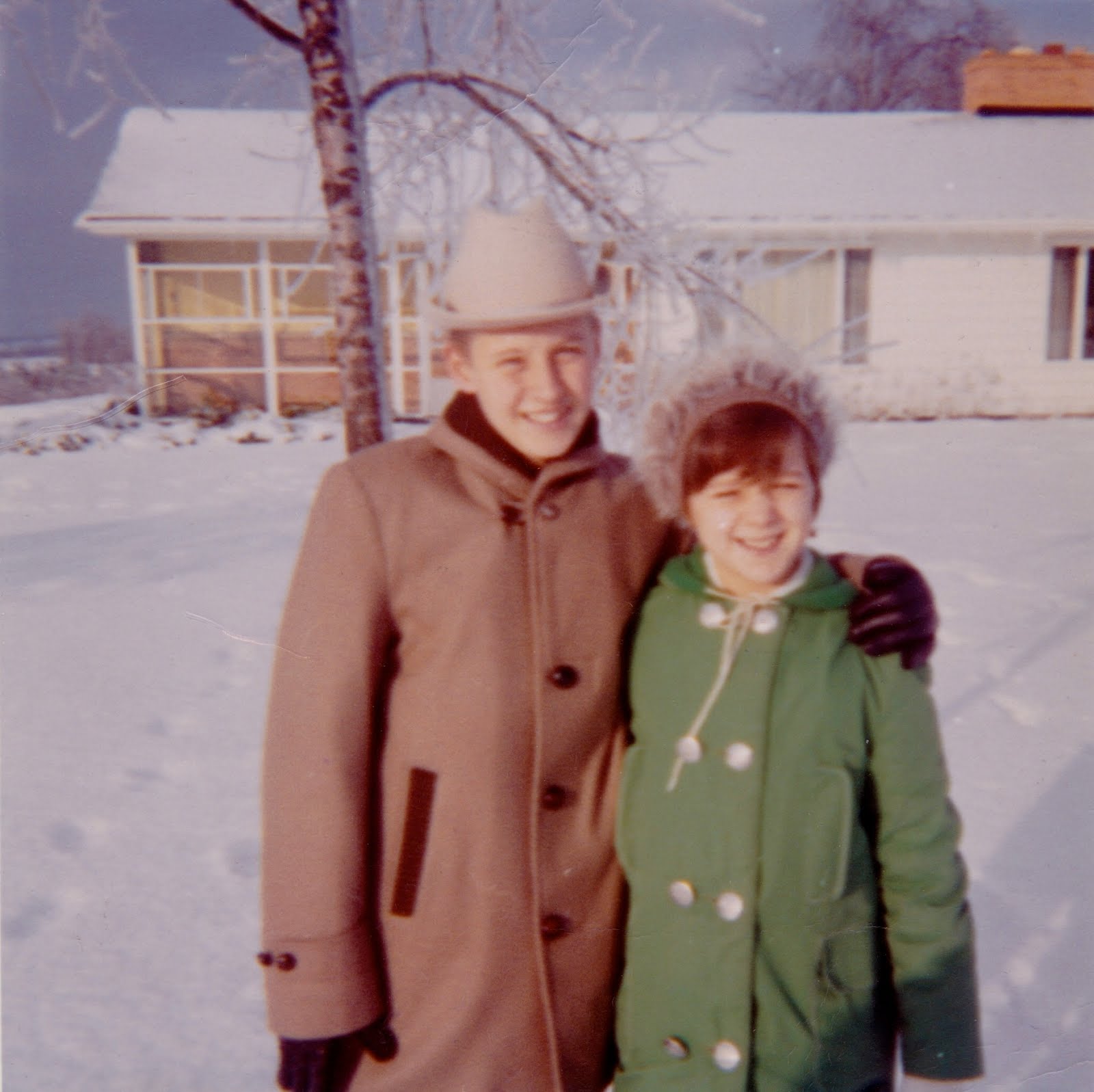
Wintertime is on us in Marilla, probably in 1961.  Through the kitchen window we see snow on the roof of the front porch, with bare branches of the big old cherry tree etching through the grey sky.

Indoors all is cozy, especially for whoever just made himself the whiskey sour sitting on that tray there on the cupboard. The Maraschino cherry is already in it.  Behind the tray we see the little jar of those revolting Maraschino cherries, as well as a big glass jar of something white:  powdered sugar for whiskey sours? Vitamins?  Either way, the signs point to Dad, our EJZ, as photographer.

Alors, au téléphone c'est moi, JZ, looking maybe 7 years old, which is how I date this photo.  The white blobs on my headband are ballerinas in tutus.  No doubt I am talking with cousins Deb and Sharon. 

But the important thing is the radio.


That Zenith radio was big and solid and green. It had vaccuum tubes. It was sturdy and long-lived, even though not particularly fancy, i.e. in having no short-wave band reception.  Marty and Julie worshipped this radio, as it told us when snow days were declared and we did not have to go to school. The light-colored things on either side are holy pictures, which I do not recall specifically. Still, we kids could have stuck them on there to pray for snow days!  Who knows? We were real bon vivants that way.

Below is a picture from the interwebs of a radio of the same make and model. In Marilla that dial, that big metal ring with frequency numbers, was always shiny bright.  In the photo above, I am fiddling with the handle, which is the only use the handle ever got. That radio never went anywhere.


A mere couple of years after this, men made transistor radios. Uncle Tom, our Tom Kontak, had a beautiful small red one, early on; I remember him showing it to us and we being very impressed with the coolness. Tom's was a bit like the one below, except that the dial was black and there were parallel lines of red plastic, instead of that array of holes in the plastic.  Right, Tom? Amazing, the useless things I remember.


In closing, I can only say Hello to you from 1962! You should be so cool!

Saturday, February 4, 2012

"News from Poland," Radio News at thenews.pl

Annie Zdrojewski wrote a while back with a news flash about Bogdan Zdrojewski.  What, you don't remember Bogdan?  Well, Bogdan Zdrojewski is the Polish Minister of Culture, that's what.  His office last July released a publicity item in which he praised the chosen design for the new Polish History Museum to be built in Warsaw.

"Culture Minister hails Polish History Museum design"

This site has some fun stuff, as I found by looking around a bit.  There's an announcement of casting efforts for a bilingual production of Romeo and Juliet, to be produced in London. The idea is to demonstrate the opposition of the House of Montague with the House of Capulet by having Romeo's family speak Polish and Juliet's speak English!  What a great way to dramatize communications problems - although probably in the original tale the two houses understood each other perfectly well and hated each other for other reasons - but that is no matter.

Very striking, to me, is hearing the radio announcer speak.  I nearly fell out my chair.  His first language is obviously Polish, and his second is BBC-style British English with all those "plummy vowels."  It's not what one heard on the East Side of Buffalo back in the day!  So I recommend heartily the link below;  one then clicks the little black-and-white audio icon just under the main title of the news item.

"Polish Romeo and English Juliet"


Julie