Santa Catalina Island had been developed as a resort by Joseph Wrigley in the 1920s, but then:
"During World War II, the island was closed to tourists and used for military training facilities. Catalina's steamships were expropriated for use as troop transports and a number of military camps were established. The U.S. Maritime Service set up a training facility in Avalon, the Coast Guard had training at Two Harbors, the Army Signal Corp maintained a radar station in the interior, the Office of Strategic Services did training at Toyon Bay, and the Navy did underwater demolition training at Emerald Bay."
Toyon Bay was:
". . . in the early 1900s, . . . the site of a boys' boarding school. During World War II, the boys were evacuated and the facility was turned into an Office of Strategic Services training camp. Chinese and American men were trained in guerrilla warfare for use behind Japanese lines in China."
 |
Toyon Bay and some of the buildings, during the war.
From the Catalina Island museum. |
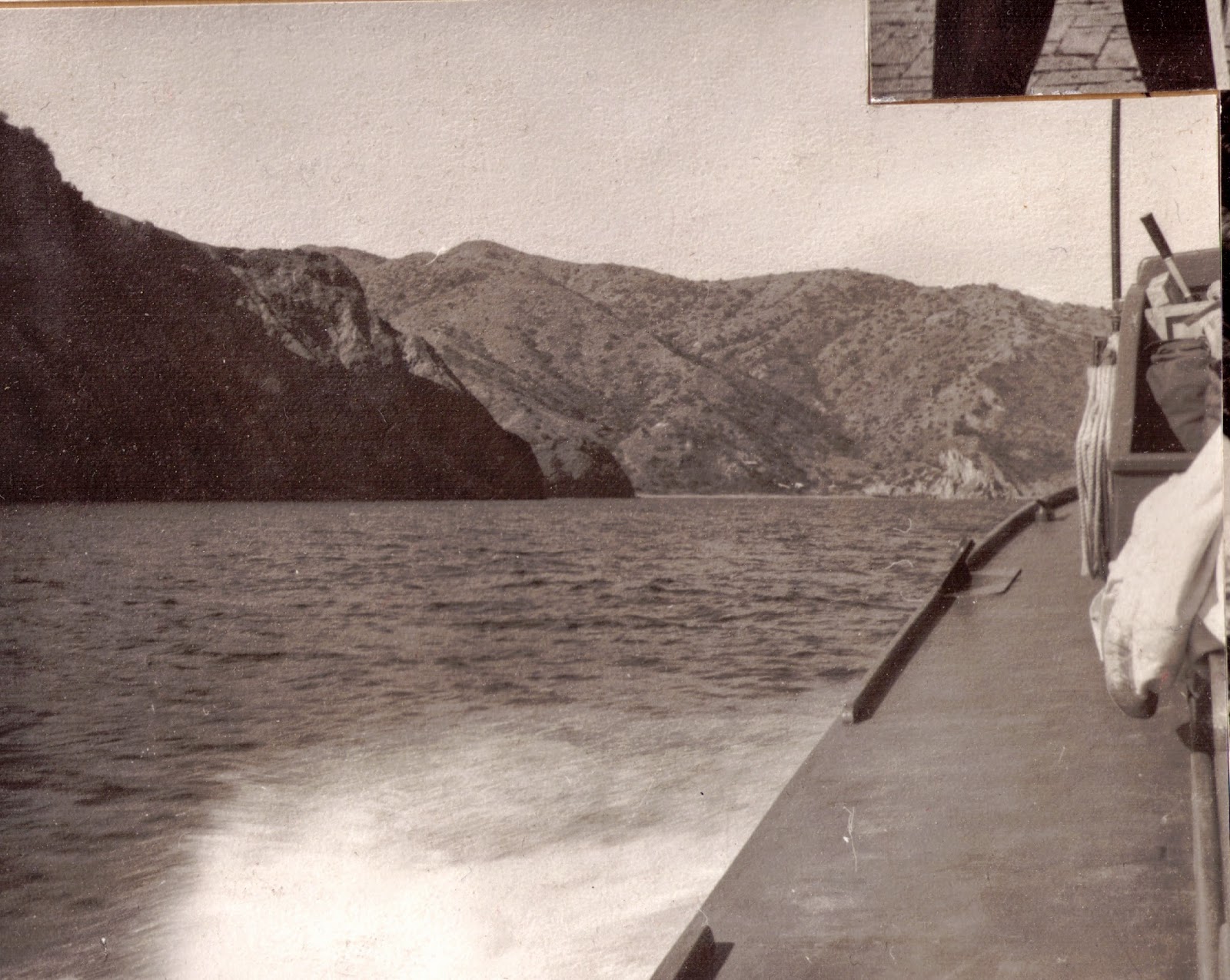
Mount Orizaba, at 2,097 feet, is the highest point on the island. Here is a view from the summit:
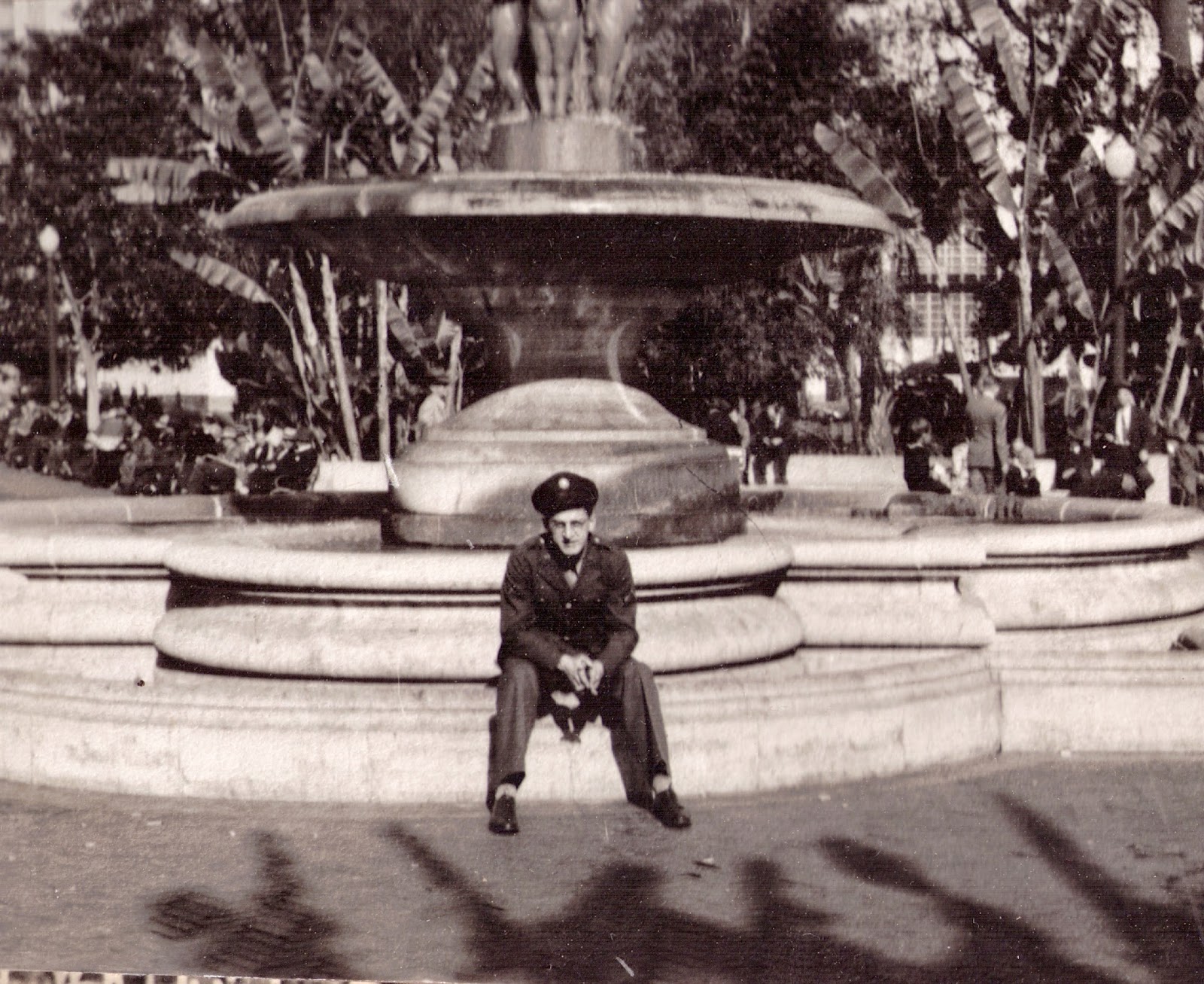
An image search on "OSS Toyon Bay" yielded this photo, below, of otherwise unknown provenance, of a soldier or sailor in training.
Toyon Bay, two and a half miles northwest of Avalon, and a smaller cove nearby known as Gallagher’s Beach, were selected for the use of the OSS for several reasons.
The beaches at Toyon and Gallagher’s are hemmed in by steep mountains, and no road had yet been built into the area.
The isolation was ideal for the kind of training that would go on there. In addition, there were already several buildings in place at the bottom of Swain’s Canyon, inland from Toyon’s beach. The facilities had been used by the Catalina Island School for Boys before its closure in December of 1941.
Along with the military branches, the OSS geared up during 1942. The site at Toyon Bay was leased in December of 1943, and the training center began operations in June of 1944. The base was top secret. Most Merchant Marine, Coast Guard and Army personnel stationed at other Catalina locations knew nothing of its existence.
Men who trained at Toyon Bay became experts with many weapons including carbines, M-1 rifles, 45 caliber pistols, the Fairbairn-Skyes dagger and explosives.
They also trained in martial arts and methods of “silent killing”. Much of the training was applicable to jungle combat. The tough physical conditioning regimen included calisthenics on the beach and long runs up the mountains and along the ridges of Catalina Island.
Toyon Bay served as a super secret training area for American spies and guerrilla warfare specialists from 1943-1945. While on the Island the men learned survival, hand-to-hand combat with knives and other silent weapons, unarmed combat, demolitions, map reading, cryptography, and clandestine radio operations.
Each training class conducted mock raids on the US Coast Guard base at Two Harbors and other “enemy” targets all around the Island. Agents were landed by submarine and rubber boats at other “enemy-held” strongholds.
From Toyon Bay the trainees went to Burma and China where they did behind-the-lines intelligence work for British and Indian armies fighting to recapture Burma.
They recruited, trained and led a guerrilla force of native Kachin fighters whose exploits have never been equaled in the history of guerrilla warfare, and who were largely responsible for the opening of the Burma road to China, and retaking of Northern Burma.
The Catalina Island Museum had a 2013 exhibition entitled "First Line of Defense: Catalina Island and World War II." Local television picked up on the story and reprinted some of the images here, including this one:
From the section of Nathan Masters's essay dealing with OSS on Catalina:
"Formed by President Roosevelt to conduct missions behind enemy lines, the top-secret OSS found in Catalina an ideal training facility. While still located close to Los Angeles, the island was secluded, separated a twenty-mile-wide channel off-limits to most vessels. Its temperate waters provided a place to practice amphibious assaults, and the rugged interior tested recruits' physical stamina and simulated the terrain OSS operatives would encounter in East Asia.
At three locations on Catalina -- Toyon Bay, Howland's Landing, and Fourth of July Cove -- OSS recruits practiced their unique, muscular style of spycraft.
Commandos from the OSS's Special Operations branch, nicknamed the "Bang Bang Boys," endured a five-day survival exercise on the island's rough geography. Using only a knife and fishing wire as tools, the men were expected to survive on the island's feral goats, wild boars, and marine life. They could never be spotted by any military personnel.
Another exercise sent recruits in the OSS's Maritime Unit on raids into mock-hostile territory. Entering Avalon underwater with a SCUBA-like breathing apparatus, the commandos were ordered to capture the town's post office or bank by scrawling an X on the building. The soldiers guarding the harbor were not forewarned, and if detected the OSS recruits risked being shot on sight.
Knowledge of the OSS's activities and even its presence on Catalina Island was a closely guarded secret until the federal government recently declassified documents related to its predecessor agency. "
Those documents were declassified in 2008, the year Dad died. He had been instructed at the time of his discharge not to talk details - so he did not talk details. And he jammed his papers way under the eaves of the attic and did not tell us kids about them. Further, he did not live long enough to enter the time when he could have pulled them out and shown them to us with no reservation. Oh, Dad. You had to go it alone all your life with respect to this huge chunk of important historical knowledge and serious memory.
But he did tell us little kids about eating ants.
"They blindfolded us and put bits of food in front of us and had us try it. 'How do you like this? What did that taste like?'"
"'Well', I said . . . 'it tasted like pineapple.'"
"Blindfold off - They were ants!"
Once I asked him what he did in China, fighting the Japanese. He said he taught the Chinese how to fight. He said he taught the Chinese how to use explosives. He said he put on black clothes and black cap, rubbed burnt cork on his face and hands, swam to the base of a railroad bridge, and attached explosives to the bridge so that it could be blown up when the train came over. He was quite diffident about it and just answered the question simply, without offering further conversation.
There is a third memory, but it might be true memory, or it might be manufactured. It bubbled to the surface when I read this essay by a Dr. John Whiteclay Chambers II initially for the National Park Service, explaining to them why their parks were taken over by the military during the war. This passage rang bells:
"Advanced SO men were sent on survival problems, dispatched into desolate
areas with only a minimum of
food, forced to live on fish they
could catch or game they could
shoot. Subsequently they were
tested on preparing effective
plans to sabotage military facilities in San Pedro harbor and
the Orange County coast. Lt.
Hugh Tovar, SI, a Harvard
ROTC graduate, was one of
those OSS trainees in the interior of rugged, windswept Santa
Catalina Island in 1945. “They
gave me a carbine with one bullet and told me to survive on
my own out there for several
days,” he recalled. He did and
went on afterward to China and
Indochina."
- Studies in Intelligence Vol. 54, No. 2 (June 2010)
Dad may have - very probably may have - mentioned having to go off for 3 or maybe 5 days with a knife, a fishline, and a buddy, and their having to feed themselves and stay hidden.
Several National Parks in Virginia were commandeered for use by OSS. (One later became Camp David.)
"The Catoctin ("Area B", in Maryland) superintendent complained to
the camp commander when
trainee/hunters killed a rabbit;
he lodged a formal protest when
a dozen large trees were cut
down; and he expressed dissatisfaction when trainees shot
several wild turkeys."
The British Special Operations Executive was established prior to OSS, but very soon the Americans went their own way:
Although SOE had considerable influence in the beginning,
not only through Camp-X, but
by temporarily lending instructors and providing copies of its
manuals, lectures, and training
materials, as well as the latest
explosives and Allied and Axis
weapons, OSS eventually went
its own way. It never adopted
the British model of two
entirely separate government
agencies for secret intelligence and special operations (SIS and
SOE). It rejected the class formality between officers and
enlisted men and the rigid military discipline of SOE training
camps. By mid-1943 only one
British instructor remained
with the Americans."
"Because of the OSS emphasis
on prowess, self-confidence, and
self-reliance on hazardous missions, instruction in close-combat techniques, armed and
unarmed, was a major component of the training. Its chief
instructor was a William (“Dangerous Dan”) Fairbairn, legendary former head of the British
Shanghai riot squad. . ."
"The new basic unified course,
still called the E Course, was
taught beginning in July 1944
at Area A, and subsequently at
RTU-11, Area F, and the new
West Coast training facility on
Santa Catalina Island off Los
Angeles. The aim of this introductory course was to provide a
quick but intensive survey to
all operational recruits of the
various kinds of work done by
OSS. Having been created by
SI, it was heavier on the intelligence than paramilitary side. Subjects such as agent undercover techniques, intelligence
objectives and reporting, sabotage, small arms, demolitions,
unarmed defense, as well as the
basic elements of counterespionage and black propaganda
were crammed into only two or,
at most, three weeks. At the
same time, the basic SO paramilitary course (the A-4 Course)
was also taught at various
times not only in Area A but at
Areas B, D, F, and on Catalina
Island."
So, that goes on the job list: find out whether Eugene J. Zdrojewski, 42021053, took the E course or the A-4 course.
Dobranoc
Julia