Showing posts with label Marilla house. Show all posts

Sunday, October 14, 2018

A Familiar Face

Dave Brubeck's music has given me great enjoyment - so much so that quite a while ago I pulled his photo out of his CD album and put it up on the refrigerator.


It seemed like such a natural thing to do. The thought of taking down that smiling face is disturbing. That's not an option!


Marian McPartland interviewed many jazz pianists for her radio show. Her Piano Jazz episode with Dave Brubeck is a favorite. They talk about and play music; he discusses how his classical piano training made his jazz possible and meaningful; he recalled his trip to Kraków, to the Jagiellonian University museum, where he "saw Chopin's piano."  A fan of Chopin!  No wonder I'm a fan of Brubeck!

Well, well, the joke is on me.  The other day, while sifting through the Photo Trove, I found this print in my hands.


It's the early 1960s, and a cool day with green leaves on the big cherry tree in the front yard at the Marilla house.  Perhaps the occasion is one of Mom and Dad's Memorial Day picnics. Any road, the party seems to be going well.


Memory is a funny thing; apparently so are preferences and inclinations. Brubeck's face looked really lovable to me.  I did not consciously think of Dad when admiring it. But subconsciously - that's another story, wouldn't you say?

Well now I am spooked. It is time to pull out one of those bubble beer mugs of Marilla origin and pour some beer into it as in days of yore. It is time to "restore the tissues," as Bertie Wooster says, and consider memories, and memory.

Blue Rondo alla Turca is among the favorites.


Lubię piwo.  Na zdrowie!


Sunday, September 30, 2018

Snopki

This time of year Dad would glean a few armsful of dry cornstalks that had missed the chopper at corn harvest  in the neighboring fields. He would bind them together in sheaves and prop them up at doorposts with bright pumpkins and gourds arrayed around them. Indian corn, in purples, reds, yellows, whites, and blacks, he would hang near them.

So for our snopki we had stalks of American cow-corn grown by American farmers - owner-operators of their farms, and of the farm machinery that lightens the work and vastly increases productivity.

In centuries past, across Europe, the snopki were of wheat or barley straw. At harvest, the peasants walked along in a line, each with a scythe, cutting the wheat or barley. Others would follow behind, binding the stalks into sheaves and standing three or four sheaves upright against each other so that if rain fell it would mostly drain off.

Still, the sheaves had to be dry when brought into the barn. So on a bright, sunny day following a few good drying days, there would take place "bringing in the sheaves."


This is "Chłopiec niosący snop" - "Boy Carrying a Sheaf." 

Snop is a sheaf; snopy, sheaves.

Snopek is a little sheaf; snopki, little sheaves.

 Aleksander Gierymski painted this in 1893 in a Polish village called Bronowic. Looks like a good dry day, doesn't it? By the shadow I would say it is late morning, which it would have to be for the dew to have burned off. The field is otherwise empty as much as we can see, so maybe they have been doing this for a few days, planning their harvest festival all the while.

Leszek Lubicki maintains a fascinating blog, Obrazowo rzecz ujmując, ("Figuratively Speaking") for his discussions of Polish paintings of late C19 and early C20.  Lubicki includes in what I call his Snopek post, his essay on this one painting of Gierymski, a photo of the painting as displayed at the National Museum in Wrocław.


Notice the bronze of the man with a scythe.


Friday, March 24, 2017

Richard Mazurowski


Richard Mazurowski (1925-2017) was son of Pearl Haremska Mazurowska, nephew of Clara Haremska Matynka, brother of Genevieve Mazurowska Stroinska, cousin of Clara Matynka Zdrojewska. He was Dad to Debbie, and he was Uncle Dick to Sharon and to Marty and me.

Below, we see him acting as groomsman in a wedding party sometime in the late 1940s or early 1950s. Richard (Ryszard) is third from the right. Sorry, I have no idea who the couple are. But first from the left is Clara Adamina Matynka, aka Mom.  Clara and Richard and Genevieve are first cousins; their mothers were sisters.


We can zoom in a little here, to the curly locks, 3-piece morning dress, and proper cravat.


Below we see another wedding party. The print is on deckle-edge paper. I like the ordinary houses with the Italian Renaissance-style campanile in the background. It houses the belfry of the parish church.


Genevieve and Edward Stroinski are the couple this time. Richard appears as Best Man. Isn't that Florence with him? I think it is. Please correct me if I am wrong.


Cabinetry and the making of fine furniture was Uncle Dick's profession. Below is a bookcase he designed, built, and installed for Gene and Clara. This is in the G&C house in Bowmansville, the year being between 1950 and 1956. Here in the Trove are at least three prints just of this bookcase. They were happy to have it; mayhap it was their Christmas gift to themselves.  See the bits of Christmas tree at the right of the photo?


1957 was the year of G&C moving into the Marilla house. Below is a scene at one of the early parties there. Proper parties always included 40 people or thereabouts, and went on in several rooms, including the finished part of the basement. Below we see, left to right, Casimir Zdrojewski, Adam Matynka, and Richard. The item of furniture in the background is a cobbler's bench done up by him.


The house on Poplar Street was similarly a noted party venue. Below we have New Year celebrations featuring dancing, lots of dancing, here with Florence and Richard.


Fourth of July featured culinary special ops, such as BBQ at the tent site in Marilla. Dick and Gene do not mess around.  I'm guessing 1960s here.


Below we see a very patient, as well as very stylish, Uncle Dick, in the dining room at another Marilla party, c1969.


(No snake is climbing up that wall. That is the stem of a split-leaved Philodendron, the leaves of which had, um, split the scene, for some reason.)


Left to right, below,  we have Clara Matynka, Uncle Dick, some idiot blowing out candles and looking like Oscar Wilde, Aunt Florence aka Auntie 'Lossie, Clara Zdrojewska aka Mom, and Uncle Eddie Stroinski. We also appear to have a fruit-Jello mold. 

But look at the wall behind Mom and Uncle Eddie. See those red-and-black encyclopedias? They are the same Compton's Encyclopedia, shelved on the same Uncle Dick bookcase, as in the Bowmansville photo above. When G&C worked on the design of the Marilla house, they stipulated a recessed niche in that wall, to accomodate that bookcase.


Below are Mom and Uncle Dick at a family event in 1971.


Uncle Dick set up his own furniture refinishing business, using his business name of Richard Mast, and went in with Uncle Eddie Jr. and Uncle Eddie Sr. Below we see him showing the latest progress on the revitalizing of the Zdrojewski grandfather clock, in the 1980s.


Uncle Dick was always at the wheel of  the station wagon when it was loaded up with "The Poplar Street Gang" and driven to Marilla for partying. He also had a motorboat for some time. I remember seeing it in the garage. If you send me any boating photos, or any photos at all of Dick and Florence, I will be delighted to put them up. 


Saturday, May 21, 2016

Uncle Dick Refinishes the Clock


John Zdrojewski, our JPZ, built this grandfather clock in his family home, completing some detail work on the kitchen table on the day his son Eugene was born.  From 1923 to 1982 it looked like this, with the dark stain and shiny varnish:


More photos and details of this clock have been posted as "Grandfather Clock, Then and Now," as well as at "Gene and the Grandfather Clock," "Wartime," and "More on Wartime."  Now some photos have turned up from its time in the professional workshop of Richard Mazurowski.

Uncle Dick took the case apart, sandblasted the wood, and refinished it without dark stain, so that the grain of the wood stands out in all its glory.  He did this work in winter and spring of 1982.


Great work, Uncle Dick.


When the clock came home, Annie Zdrojewski, granddaughter of the maker, kindly posed with the revitalized grandfather clock.


And just as a couple of asides here, note on the right edge of the photo part of the Blue Boy copy, above the piano.  Then way on the left edge, hanging on the divider wall, that Chinese sword.

Chinese sword?


Thursday, May 19, 2016

Green Radio, Marilla Kitchen, c1961

I had decided not to post this picture of myself, out of recoil from vanity or embarrassment; take your pick. But then some intriguing results from G&C Readership Research prompted a change of policy in this instance. Thank you for your responses, Readership Critique Team.

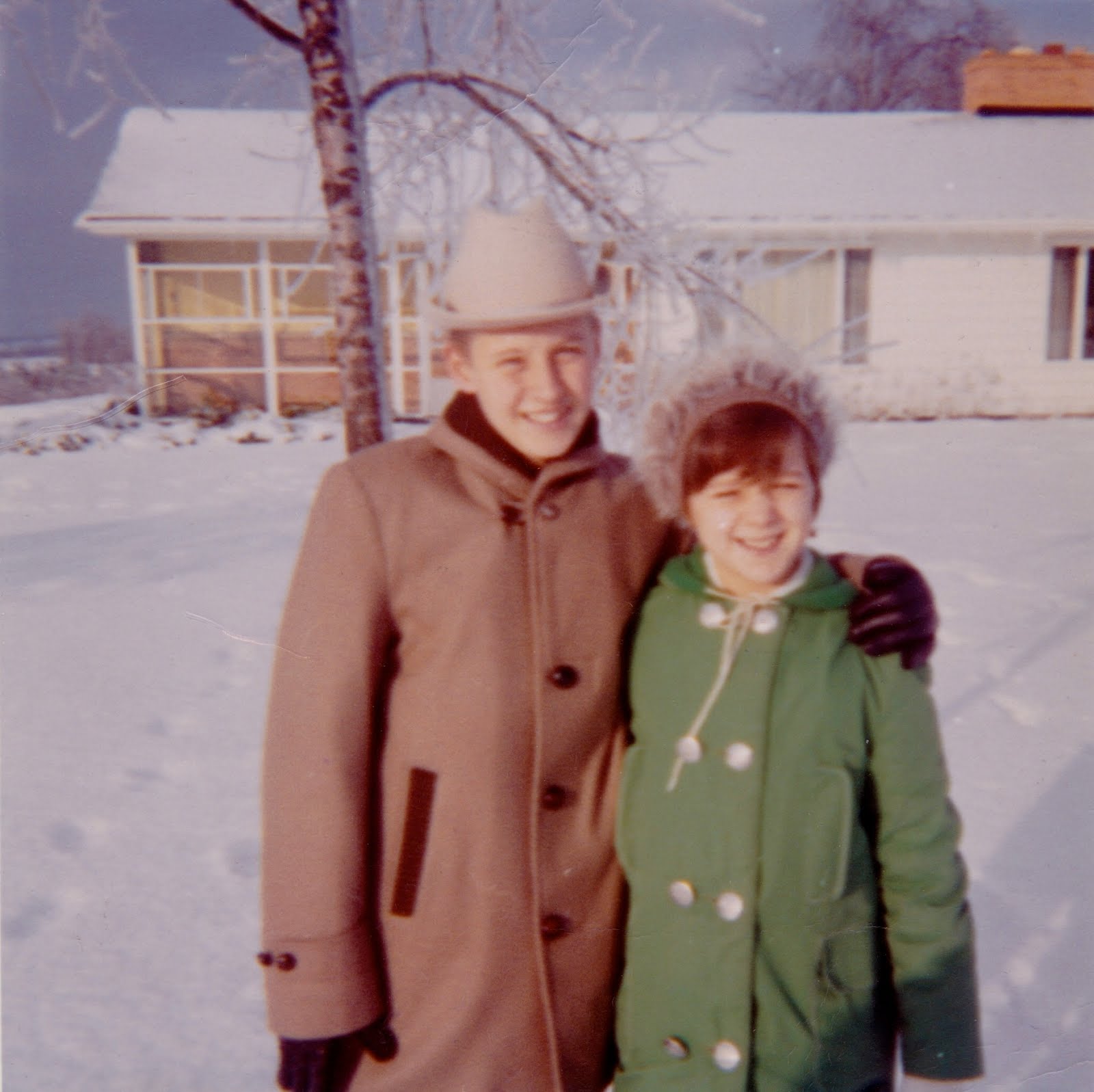
Wintertime is on us in Marilla, probably in 1961.  Through the kitchen window we see snow on the roof of the front porch, with bare branches of the big old cherry tree etching through the grey sky.

Indoors all is cozy, especially for whoever just made himself the whiskey sour sitting on that tray there on the cupboard. The Maraschino cherry is already in it.  Behind the tray we see the little jar of those revolting Maraschino cherries, as well as a big glass jar of something white:  powdered sugar for whiskey sours? Vitamins?  Either way, the signs point to Dad, our EJZ, as photographer.

Alors, au téléphone c'est moi, JZ, looking maybe 7 years old, which is how I date this photo.  The white blobs on my headband are ballerinas in tutus.  No doubt I am talking with cousins Deb and Sharon. 

But the important thing is the radio.


That Zenith radio was big and solid and green. It had vaccuum tubes. It was sturdy and long-lived, even though not particularly fancy, i.e. in having no short-wave band reception.  Marty and Julie worshipped this radio, as it told us when snow days were declared and we did not have to go to school. The light-colored things on either side are holy pictures, which I do not recall specifically. Still, we kids could have stuck them on there to pray for snow days!  Who knows? We were real bon vivants that way.

Below is a picture from the interwebs of a radio of the same make and model. In Marilla that dial, that big metal ring with frequency numbers, was always shiny bright.  In the photo above, I am fiddling with the handle, which is the only use the handle ever got. That radio never went anywhere.


A mere couple of years after this, men made transistor radios. Uncle Tom, our Tom Kontak, had a beautiful small red one, early on; I remember him showing it to us and we being very impressed with the coolness. Tom's was a bit like the one below, except that the dial was black and there were parallel lines of red plastic, instead of that array of holes in the plastic.  Right, Tom? Amazing, the useless things I remember.


In closing, I can only say Hello to you from 1962! You should be so cool!

Monday, May 16, 2016

The Stroinski "Ringo"

The Coot Hill Family Historical Preservation Society offices house several paintings by Buffalo artist and favorite relation Edward Stroinski. We have featured one from our North Gallery and a second from our Administrative Office early in this blog. The Militello horse that made a photographic apearance last post has inspired the Curatress to show off this example of Stroinski equine portraiture.


Ringo was my Quarter Horse gelding, a gift from Mom and Dad.  He was Palomino-and-white, with white mane and tail, and he was mellow.  Physical exertion did not interest him overmuch; speed he did not wish to attain, but he was biddable enough to wander the countryside with me for hours.  At all seasons we would take off and disappear for a while, exploring. What a friend.


I remember Uncle Eddie at a family gathering one time, walking up to Ringo's fencerail and snapping some pictures.  Later he asked my Dad to rustle up some weathered barn boards so he could fashion the frame.  Then they gave me the portrait, just like that.  Whose idea was it? Uncle Eddie's?  Or Mom and Dad's?

Look how tall Dad's pine trees had grown, from 1957 to 1967.


See the shading on the ventral aspect of Ringo's neck, and the shadow of his head and halter on the fencerail.  I stared at these things often instead of studying.


Sunday, May 15, 2016

Picnic Supper in Marilla, 1970s

JPZ, Dad, Dziadzi.

It's the back yard picnic venue in Marilla.  Some shirt-and-tie event has taken place earlier.  Now at suppertime, even though the shadows are long, it must be kinda warm, for he has undone his tie.

Marty, did you take these pictures?


John has taken his tie clean off!  And Dad has changed into a sport shirt, since he's home and can do so. This is the first appearance of the EJZ mustache on this blog. Dad is in his Lech Wałęsa lookalike phase - although Solidarity is a decade in the future at this point. 


Sideburns!  How could you menfolk stand them?


A Militello must have come over on a Militello horse.  That's not Queenie; she had light beige mane and forelock.  Marty, do you remember this horse's name?


Dad hung onions out to dry on the front porch.

So does anyone recall what occasion this was?  Please comment on the site if you can supply any details.


Marilla Kitchen, c1957


What a nice surprise to pull this out of a box!  We look back at the scene of so much family life over the years since Gene and Clara built their home in 1957.

The brick is the back of the fireplace; no brass or iron hooks have yet been drilled into it for hanging things up.  The stove has two ovens;  I'm still envious.  She has a glass milk bottle in her right hand; what is she up to?  We see the back hall leading to the back door.

Great nightgown and bobby socks, Mom.  Dad's evidently been home a few minutes: long enough to take off "collar and hames," the shirt and tie.  The table is set for supper for two, not four; a serving bowl is being kept warm in that round glass chafing dish with a candle inside it; the little sliver of kitchen window we see is dark.  So are the kids in bed already?  Did Dad get home extra late from the office this Monday or Friday night?

To the right of the refrigerator are the binoculars that have been to China and back. He uses them now to watch birds.

Along to the right are the chafing dish and a bunch of stuff that must include that big green radio.

The kitchen table still has the glass top under that tablecloth; it will be years before I sit on it and break the glass.  It's my desk now, and those chairs are my office chairs.

Mom would wear actual clothes were there visitors.  So Dad must have set up a tripod and timer.  They stand at their kitchen hearth and look forward with confidence to their future life here.

Saturday, October 18, 2014

Grandfather Clock, Then and Now

John Peter Zdrojewski, our JPZ, came to America on the boat in 1903 with his parents, Ludwig and Victoria Zdrojewski.  As a young man in Buffalo, he worked for a time in a carpentry shop.  We have a photo of the crew in the shop.  JPZ is second from right, identified for us by his son John, our JFZ.


John Peter built a grandfather clock, a "case clock," at home.  Family legend has him just finishing it up on the kitchen table when his firstborn, Eugene, our EJZ, was born in the next room.  That was October 7, 1923.

So it was always in the house, on St. Louis Street and then on May Street, in Buffalo.  Below we see Eugene home from Orchard Lake - high school? or college? - at Christmastime.  The grandfather clock is in the background, obscured by that lamp.


In 1940, JPZ's younger brother Casimir Zdrojewski and his wife Cecelia brought their firstborn, Paul, to visit.  Here is the photo of the young family seated by the grandfather clock.


During World War II, while Eugene was away 1943-1945, JPZ made a photo series about being a parent on the home front.  We have seen the photo below, here and also here.  This is the best photo we have found so far of that clock.


The grandfather clock moved to the Marilla house some time after its completion in 1957.  We have yet to find a photo of that clock in its place in the Marilla house!  That is a shock.  With luck we will find some.  It was important; it was a fixture; so where are the pictures?

In the 1980s Gene and Clara took the clock to somebody for refinishing.  We have a couple of Polaroids from their visit to the clock while it was in rehab.  Tye found them inside the case.


When the Marilla house was closed in 2008, the clock went to its new home with Tye and Kim Zdrojewski.  Thanks, Tye, for the photos.

The old, dark varnish had historic-sentimental value, but the new finish shows off the wood so much better.  Looks like curly maple, doesn't it?  

A treasure beyond price.