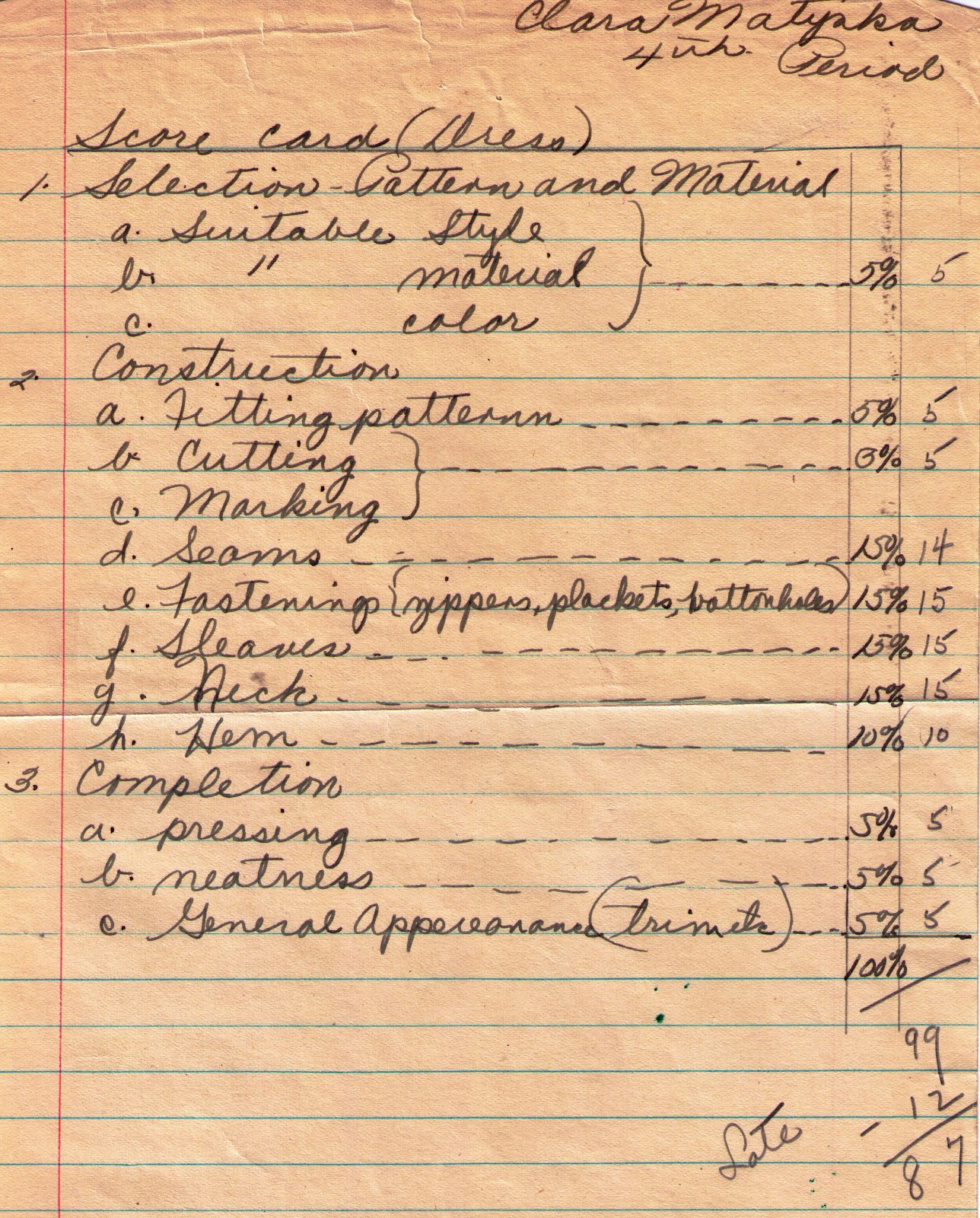
The transition from sewing mechanics to costume design began with discussion of six characteristics of a well-designed costume: harmony of color; balance; emphasis; proportion; rhythm; harmony of line and decoration.
 |
| Balance can be "formal," (with mirror symmetry); or "informal"; or sadly lacking with laughable result. |

 |
| One part is to be emphasized - have more interest - than the rest, yet be related to the entire garment. |
 |
| Is the ribbony bit centered or scattered? I worry. |
 |
| Click to enlarge. "Good proportion is the pleasing relationship of parts." "The flowing Grecian costume was simply girdled at the waistline thus breaking up the long dress into two parts . . . Thus in order to have a pleasing effect the division must fall somewhere between one-half and two-thirds of an area." |
 |
| "Fig. 1 is pleasing because (the) mind is able to recognize approximitly (sic) the relation of the parts to each other and to the large oblong. But because the mind does not decete (sic) the exact proportion at once the attention is stimulated and held and interest is the result." |
Flash to c1970: Four senior girls are standing on the front steps of Iroquois Central High School, Elma, New York, waiting in the chilly air for their parents to pick them up at 9am. They have been sent home to change their clothes! Why, were they immodest? Noooo. Were they sporting gang uniforms? Noooo. Were they strutting around in historical-criminal regalia? Noooo. They were wearing Empire-style long gowns - you know, like Jane Austen characters wore, except with higher necklines and homier homespun fabric. They had made their "granny dresses" themselves, and looked like Colonial-era American lasses.
So what was their offense? Silly question: it was being out of conformity. It made a big impression on me. Great teaching job, Iroquois!
So anyway, too bad they could not quote classical Greek principles of proportion, like the one above, to the Principal.
 |
| "Fig.5. an illustration of the Greek Law of Proportion. The Greek Law of Proportion is: Two lines or areas are comparable, interesting and desirable (sic) when one is between half and 2/3 the length or area of the other." (1970 example: "granny dress," with or without "granny glasses.") |
 |
| "The human figure is an example of fine proportion and the costumes which have been considered beautiful through all ages regardless of fashion are those which have been formed to the natural divisions of the body." |
 |
| "Rhythm is present in a design when the eye is led easily from one part of it to another. Rhythm is an easy connected path along which the eye may travel in any arrangement of lines, colors, objects or light and dark effects. In a perfectly plain space there is no movement but the moment a pattern is placed upon the plain space rhythm is created. This movement may be organized and easy and thus rhythmic or it may be restless and distracting and lacking in rhythm." Web designers, are you paying attention? |
 |
| Repetition, at left; Gradation, at right. |
 |
| Opposition, at left; Radiation, at center; Transition, at right. |
 |
| "Harmony is an agreeable combination of parts making a connected whole . . A well designed dress needs little decoration but whatever decoration it has should appear to be a needed part of the dress not something added to it after it was finished." |
 |
| Fig. 1. Vertical lines and divisions make a space appear taller and narrower. Fig. 2. Horizontal lines make a space appear shorter and wider. Fig. 3. A narrow panel makes a space appear taller and narrower. Fig. 4. A wide panel makes a space appear wider. Fig. 5. Vertical inward sloping lines decrease width. Fig. 6. Vertical outward sloping lines increase width. Fig. 7. Horizontal sloping lines add width." |
Wear what you like.
Just be ready to defend your choice on the basis of timeless aesthetic principles.
Mum