Showing posts with label 1940s. Show all posts

Friday, March 24, 2017

Richard Mazurowski


Richard Mazurowski (1925-2017) was son of Pearl Haremska Mazurowska, nephew of Clara Haremska Matynka, brother of Genevieve Mazurowska Stroinska, cousin of Clara Matynka Zdrojewska. He was Dad to Debbie, and he was Uncle Dick to Sharon and to Marty and me.

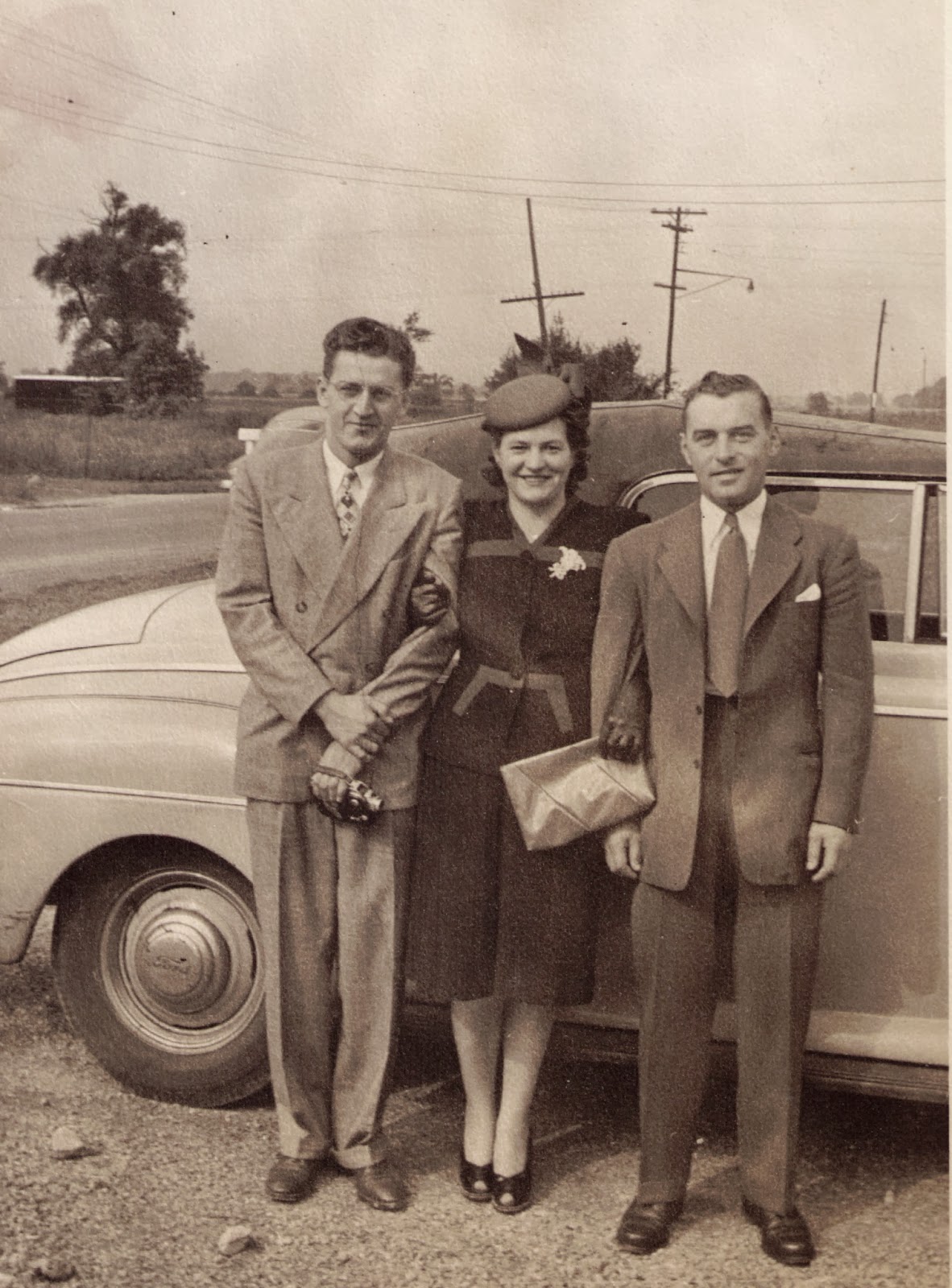
Below, we see him acting as groomsman in a wedding party sometime in the late 1940s or early 1950s. Richard (Ryszard) is third from the right. Sorry, I have no idea who the couple are. But first from the left is Clara Adamina Matynka, aka Mom.  Clara and Richard and Genevieve are first cousins; their mothers were sisters.


We can zoom in a little here, to the curly locks, 3-piece morning dress, and proper cravat.


Below we see another wedding party. The print is on deckle-edge paper. I like the ordinary houses with the Italian Renaissance-style campanile in the background. It houses the belfry of the parish church.


Genevieve and Edward Stroinski are the couple this time. Richard appears as Best Man. Isn't that Florence with him? I think it is. Please correct me if I am wrong.


Cabinetry and the making of fine furniture was Uncle Dick's profession. Below is a bookcase he designed, built, and installed for Gene and Clara. This is in the G&C house in Bowmansville, the year being between 1950 and 1956. Here in the Trove are at least three prints just of this bookcase. They were happy to have it; mayhap it was their Christmas gift to themselves.  See the bits of Christmas tree at the right of the photo?


1957 was the year of G&C moving into the Marilla house. Below is a scene at one of the early parties there. Proper parties always included 40 people or thereabouts, and went on in several rooms, including the finished part of the basement. Below we see, left to right, Casimir Zdrojewski, Adam Matynka, and Richard. The item of furniture in the background is a cobbler's bench done up by him.


The house on Poplar Street was similarly a noted party venue. Below we have New Year celebrations featuring dancing, lots of dancing, here with Florence and Richard.


Fourth of July featured culinary special ops, such as BBQ at the tent site in Marilla. Dick and Gene do not mess around.  I'm guessing 1960s here.


Below we see a very patient, as well as very stylish, Uncle Dick, in the dining room at another Marilla party, c1969.


(No snake is climbing up that wall. That is the stem of a split-leaved Philodendron, the leaves of which had, um, split the scene, for some reason.)


Left to right, below,  we have Clara Matynka, Uncle Dick, some idiot blowing out candles and looking like Oscar Wilde, Aunt Florence aka Auntie 'Lossie, Clara Zdrojewska aka Mom, and Uncle Eddie Stroinski. We also appear to have a fruit-Jello mold. 

But look at the wall behind Mom and Uncle Eddie. See those red-and-black encyclopedias? They are the same Compton's Encyclopedia, shelved on the same Uncle Dick bookcase, as in the Bowmansville photo above. When G&C worked on the design of the Marilla house, they stipulated a recessed niche in that wall, to accomodate that bookcase.


Below are Mom and Uncle Dick at a family event in 1971.


Uncle Dick set up his own furniture refinishing business, using his business name of Richard Mast, and went in with Uncle Eddie Jr. and Uncle Eddie Sr. Below we see him showing the latest progress on the revitalizing of the Zdrojewski grandfather clock, in the 1980s.


Uncle Dick was always at the wheel of  the station wagon when it was loaded up with "The Poplar Street Gang" and driven to Marilla for partying. He also had a motorboat for some time. I remember seeing it in the garage. If you send me any boating photos, or any photos at all of Dick and Florence, I will be delighted to put them up. 


Thursday, March 6, 2014

Good-bye, Old Paint

We learned about the c1941Ford coupe convertible in a Casimir at Kanty post, and, in relation to a similar vehicle, in the 1946 picnic post.  To me it's intriguing, as Marty and I never heard anything about this "old Ford," so it's almost like finding a long-lost relative.  

Emotions rise logarithmically when I recall my own first car, a 1968 Mustang, which I sure wish I had now!  I sold it because as a poor college student I could not afford to replace the "throwout bearing," whatever that is.  It might as well have been the canooter valve, for all I could then afford to replace it.  Painful recollection.


From the New Trove:


From the last PYC Monthly in our collection:


The final paragraph of the "Just Between Us" feature refers to a certain car:

          "We shall all rise now, in a minute of silent prayer, and mourn the departure of a faithful friend.  It was indeed a friend in great need and a veteran of many engagements, struggling through thick and "tin" (that's what it was made of).  So long, old Ford."


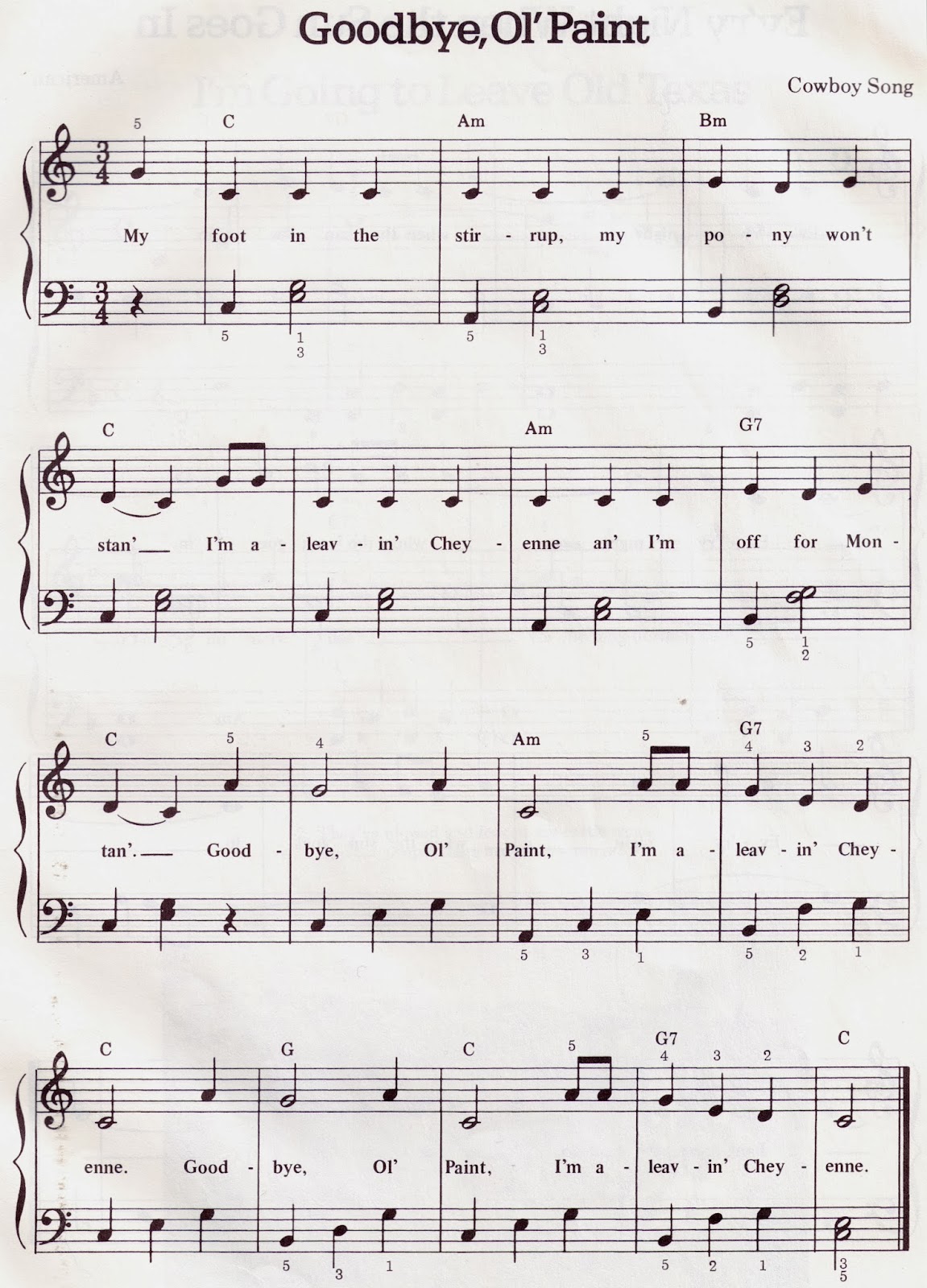
I'm a-leavin' Cheyenne, I'm off to Montan'.
Goodbye, old Paint, I'm a-leavin' Cheyenne.

          Goodbye, old Paint, I'm a leavin' Cheyenne.
          Goodbye, old Paint, I'm a leavin' Cheyenne.

Old Paint's a good pony, he'll pace when he can,

Goodbye, old Paint, I'm a-leavin' Cheyenne;

And seat yourself by me as long as you may.
Go hitch up your hosses and give them some hay

My hosses ain't hungry, they won't eat your hay
My wagon is loaded and rolling away.

My foot's in the stirrup, the reins in my hand,
Good mornin', young lady, my hosses won't stand.


Monday, March 3, 2014

PYC Monthly, April 6, 1947 - Lots Going On

This beautifully preserved eight-page glossy Parish Youth Council Monthly is the last of the collection of St. Luke's youth publications saved by Clara Zdrojewski and now in the Argyle Family Historical Society Collections.  A couple more posts, and it will go into a carton to be called "full" and also "dealth with."

Then you are going to have to come visit me if you want it opened up again.

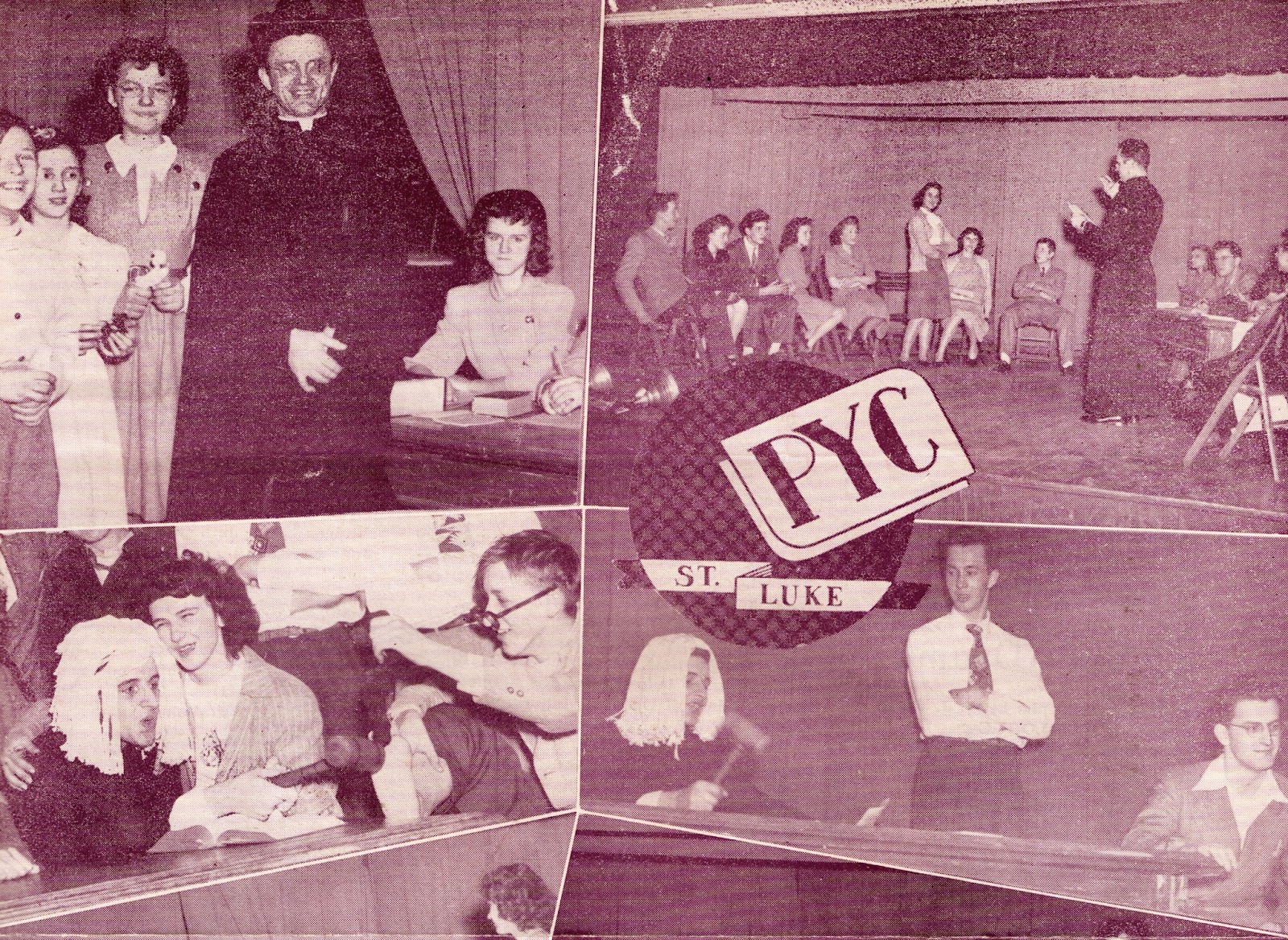
This style of photomontage
was evidently quite popular.
Pages are 9" x 12".

Isn't that a Monsignor-hat that Father Tomiak is wearing?
He is acting as quiz-show interlocutor at top.
Moot court appears in session below; Gene's in the dock.


Click to enlarge.
Several in-jokes here surely originating in
Norman and  Zdrojewski.


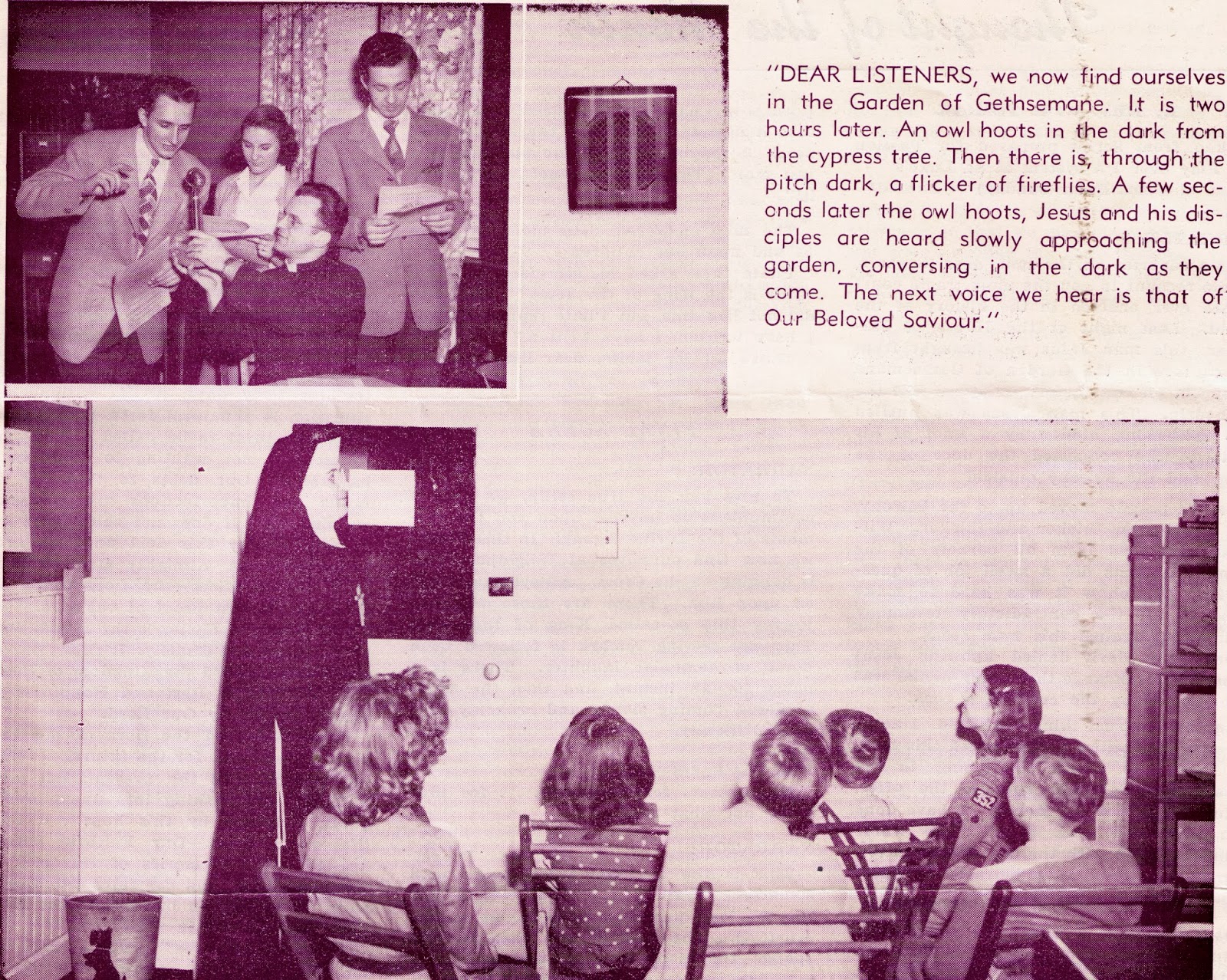
Here we go again with combination electronics
in cabinetry - this time for a raffle.

Gene Norman, at top left, speaks into the microphone.
They're doing a dramatization of the Garden of Gethsemane scene.
Passion Play, upgraded from medieval town square or hillside
to a Sunday-School public-address system!
See the speaker set into the classroom wall?


Bottom Center:
Appreciation:  Many thanks to Father Tomiak for showing
the pictures of scouting, camping, St. Anne de Beaupre
and other scenes.  Also appreciation to Mr. Eugene
Zdrojewski for allowing the children to see the pictures
taken in India and China.  Naturally, we extend same to
Sister Tarsilia for running the films for us.

 These "pictures taken in India and China" may refer, in part,to the 16mm color film that Gene brought back, and certainly refer to the scrapbook full of prints:


U Chicago, OSS training school.

Into southwest China.

The pages measure 10" x 14".  I can without damaging the book undo the binding, take the pages out, scan top and bottom halves in my own scanner, and rebind the book. Such scanned images would be a little larger than the photos.  Then I would put up those scanned images plus the whole page photos, like the two above.

Now tell me, is that going to be good enough?

Or do I take the book to Ithaca sometime and use a University scanner with a bigger flatbed?  That would take longer. There are about 40 pages.

Julie


Saturday, March 1, 2014

Posting Updated

There's an update on the previous post, incorporating Kotwas family data John sent.  To see the corrected version, Wedding and Graduation Season, 1946? - Updated and Corrected with Kotwas Family Members, is up on Gene and Clara's.

Dziękuję, Janek

Julianna

Friday, February 28, 2014

Wedding and Graduation Season, 1946? - Updated and Corrected with Kotwas Family Members

The previous posting featured Casimir Zdrojewski in his high school dorm at St. John Kanty preparatory school in Erie, Pennsylvania.  Here is Casimir all robed up for graduation therefrom.  It looks like the basement at Kanty; maybe it rained that day.

Grandma Victoria Zdrojewska, her daughter-in-law Eleanor Kotwas Zdrojewska, and to her left (in white dress and black hat) Eleanor's mother, Ludwicka ("Louise") Chmielewska Kotwas.

John, our JFZ, writes of his maternal grandmother Louise, our LCK, as "the kindest person I have ever met."

Also, "And, interestingly, Louise' parents came to America in the late 1870s and were among the first parishioners of St. Stanislaus Church in Buffalo."

Continuing around the table, we have 3 mystery people, JPZ nattily dressed, and to the JPZ's own left is, as John writes, "Eleanor's father, who came from the Russian partition of Poland in 1902."

Then we have the man of the hour, Casimir with boutonnier and mortarboard.  Oh, and diploma!

Does someone have more photos of this event, or the diploma to scan?  If so, please send them; I would love to put them up!


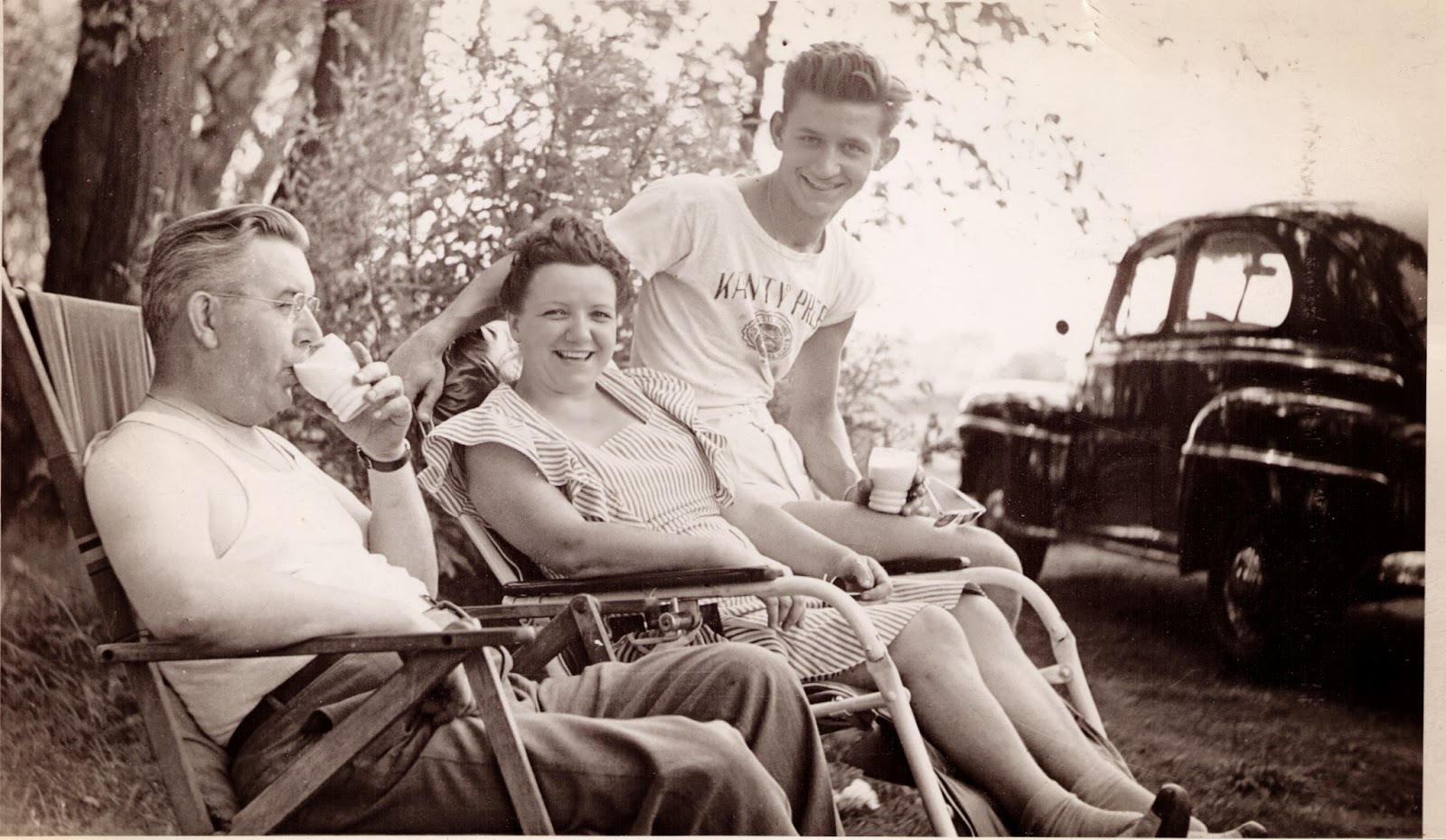
And here below, a terrific find from the New Trove - thanks, Marty!  Casey and Gene and a very cool car, all right at the front doors of Kanty Prep.

Andrew, you are the Spirit and Image of your grandfather at that age.  Come walk around Krakow with me so I can have fun watching you run into a doppelganger around every corner. 


A Google Image search on "Ford coupe converible 1941" returns many pretty pictures of cars like Gene's, including these two:


Must be Eugene took the photo below, probably in 1946.  JPZ and Eleanor were married in August of that year.  Casey is grinning wickedly in his James Dean hairdo still.  And a similar Ford is prominently included in the shot.  Paint job? New car? JPZmobile?


Le pique-nique with Grandma Kotwas, Eugene, JPZ,
the picnic basket and percolator, Casimir, and Eleanor.

Below, we see Eleanor, at right, and Clara, at left by Eugene, gamely smiling as they realize the antics their new family gets into at the drop of a hat, or some napery, or a potted plant.

Paul Zadner's lovely Mamma is unfazed. Paul has no idea that there is Chow Mein in his future. We saw this photo near the beginning of this blog, in - let's see - "Wedding Photo on the Wall".


Thursday, February 27, 2014

Gene and Casey and John Cantius

The photo, below, of Gene and Casey before-the-war, or before their war, featured, naturally, in the Japanese Christmas card post.  Dr. John, our JFZ, has since confirmed that the location is the back yard of May St.  Thanks, John! 

Incidentally, that means that JPZ's garden was in a strip along that fence behind the lads. I remember strawberry plants and tomato plants thriving in that little patch in the middle of Buffalo.


Late 1942 or 1943: Gene is drafted into the Army;
1943: Gene does Basic Training at Fort Benning, Georgia;
1943: Julia Mostkowska Zdrojewska dies of cardiac arrest while Gene is doing Basic and Casey is in late grammar school or early high school;
1944: Gene is at University of Chicago studying the Japanese language;
1944-45: Gene is in China; returns via Suez to Scotland, then home.

1946, August: JPZ and Eleanor Kotwas marry;
1947: Gene is President of St. Luke's Youth Council.

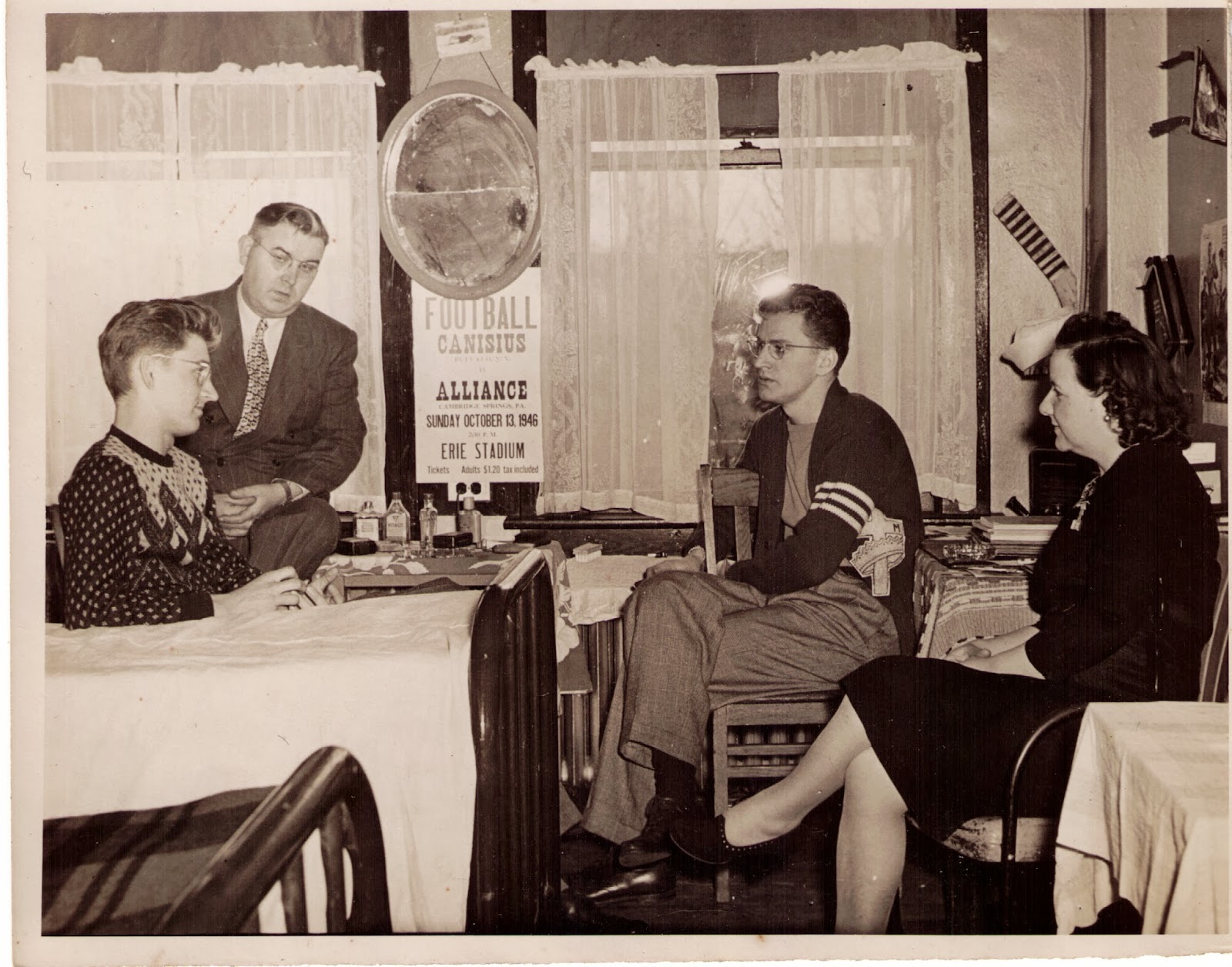
Given all that, what can we construe from the photo below?

Eleanor is there - Busia to me and to all the children of Gene and of Casey - and I really want to know if she is wearing silk or nylon stockings.  Controlling our curiosity on this sartorial point, we see that Gene is wearing the famous blue sweater with the three white stripes, so he must be current CYC Prez.  The setting is a dorm room.  So this is some time during academic year '46-'47 or '47-'48.

Click to enlarge and then take a squint at the poster announcing the football game.  It's coming up - Canisius versus Alliance - on August 13, 1946.  Or it took place then, and the poster is a memento.


John recalls that Casey attended St. John Kanty Preparatory School in Erie, Pennsylvania.  

What year did he graduate?

I love Casey's sweater, and his proto-James-Dean hairstyle.


John comments:

I'm convinced it"s Kanty. Note the flyer about the Canisius-Alliance football game at Erie Stadium. The no longer operating Alliance College in Erie was founded by the Polish National Alliance. My mother's brother, William Kotwas, DDS, of Auburn was a member of the Board of Trustees there for a time and we went to one of its graduations during that period.

. . . I believe one of the Zdro videos shows him in the graduation processional.

And interestingly do you see how the photographer, JPZ, set the photo up using the football game flyer to tell us the time and location? A sense of history!
John


The school operated from 1919-1980, when for some reason, and despite high enrollment, it was abandoned, the property sold and the building demolished.

St. John Kanty Prep, exterior of the building featured
in the JPZ dorm-room shot.

The school's statue of St. John Kanty,
which was at the main entrance.

John Cantius, Joannis Cantii, Jan Kanty,  1390-1473, was a Scholastic philosopher and academician in Krakow, at what would become Jagiellonian University.

Scholasticism is described on Wikipedia in this wise:  "Not so much a philosophy or a theology as a method of learning, scholasticism places a strong emphasis on dialectical reasoning to extend knowledge by inference, and to resolve contradictions. Scholastic thought is also known for rigorous conceptual analysis and the careful drawing of distinctions. In the classroom and in writing, it often takes the form of explicit disputation: a topic drawn from the tradition is broached in the form of a question, opponents' responses are given, a counterproposal is argued and opponent's arguments rebutted. Because of its emphasis on rigorous dialectical method, scholasticism was eventually applied to many other fields of study."

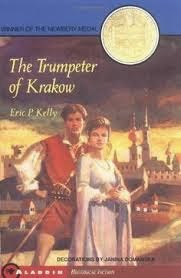
One admirer of Jan Kanty was Eric P. Kelly, "an American journalist, academic and author of children's books. He was a professor of English at Dartmouth College and briefly a lecturer at the Jagiellonian University in Krakow. He won the 1929 Newbery Medal recognizing his first published book, The Trumpeter of Krakow, as the preceding year's most distinguished contribution to American children's literature."

Kelly's much-loved children's book is The Trumpeter of Krakow.


Kelly loved Krakow, and wrote his 1929 juvenile novel about the trumpeters of the Hejnal at St. Mary's, their traditions, struggles, and heroics. He set it in 1461 and brought in Jan Kanty as one of the heroes of the tale.  Here is an excerpt from Chapter IV, "The Good Jan Kanty."

     "Among the most remarkable personages of Krakow's age of glory in the fifteenth century  was a certain scholar-priest by the name of Jan Kanty.  He had been educated at the University of Krakow in the period of late Scholasticism when the chief teachings were still mere expositions of the seven arts, of which grammar was the king.  However, a full life and much contact with men had made Jan Kanty a well-rounded man.  He loved learning for its own sake, but he honored most of all its precepts and its application to life, and he gave himself over in his cell-like quarters on the lower floor of the old university building (now long since destroyed by fire), to the creation of new points of view on old subjects, to comments on the conduct and opinions of the masters and doctors  of the university at the great church councils of Europe, and to an intellectual chronicle of his age."

     "His life was saintly and his cell was as much visited, perhaps, as is his shrine in the magnificent old university library today.  The peasants loved him especially, and this was rather curious since the men from the farms rarely sought the advice of the men of the university; they were, in fact somewhat shy of the dispensers of higher learning.  They were not shy of Jan Kanty, however.  They came to Krakow to ask his opinion on the weather in the seasons of grains and vegetables, they called upon him for decisions in disputes between landowners, they consulted him concerning the proper kind of food for their livestock, they questioned him on all problems having to do with morals or religion, and they accepted his rulings with as much finality and satisfaction as if they had been the rulings of Heaven."

     "Therefore his name was one to be reckoned with everywhere, inside the city and out.  He hated above all things cruelty of man against man, or of man against something helpless, a horse, or a dog, or a child.  And when he saw one man and a woman and a boy of honest features and good appearance harassed by some hundred men, he did not hesitate but rushed into the midst of the flying stones without regard to his own safety or comfort."

So when you read the The Trumpeter of Krakow you will find out what happens with the boy and the jewel thieves and the mad alchemist and all.


Your Dr. Who