Showing posts with label Krakow. Show all posts

Sunday, March 2, 2014

Conturbare Cave

"Conturbare cave,
Non est placare suave.

Diffamare cave,
nam revocare grave."


This was the personal motto of John Cantius; he wrote it on the wall of his cell, and tried to govern himself by it.  Let's  see:

"Of aggressive contention* beware,
It is not sweetly pleasing."

        (*wrangling; obnoxious, quarrelsome arguing; the tiresome go-round)

"Of defamation beware"   (Hence "Avoid defamatory remarks.")
since revoking them is gravely difficult."


Apparently, he contributed to the eventual development of Newtonian mechanics in physics, by studying and teaching the "Theory of Impetus" of Jean Buridan, making the road smooth for Copernicus a little later.

This is in addition to his religious study, pastoral work, unofficial Justice of the Peace for the peasants round about, and advisor on agricultural matters.

In this painting, for which I can find no provenance, he is shown in Krakow, with St. Mary's in the background, consoling a lass with a broken water vessel.  Is that a basket of laundry in the background? Is this really about washday, or all a metaphor for sin, contrition, and redemption?


We'll never know.  But I do know that compared to this paragon, I have been wasting my time.

Julie

Thursday, February 27, 2014

Gene and Casey and John Cantius

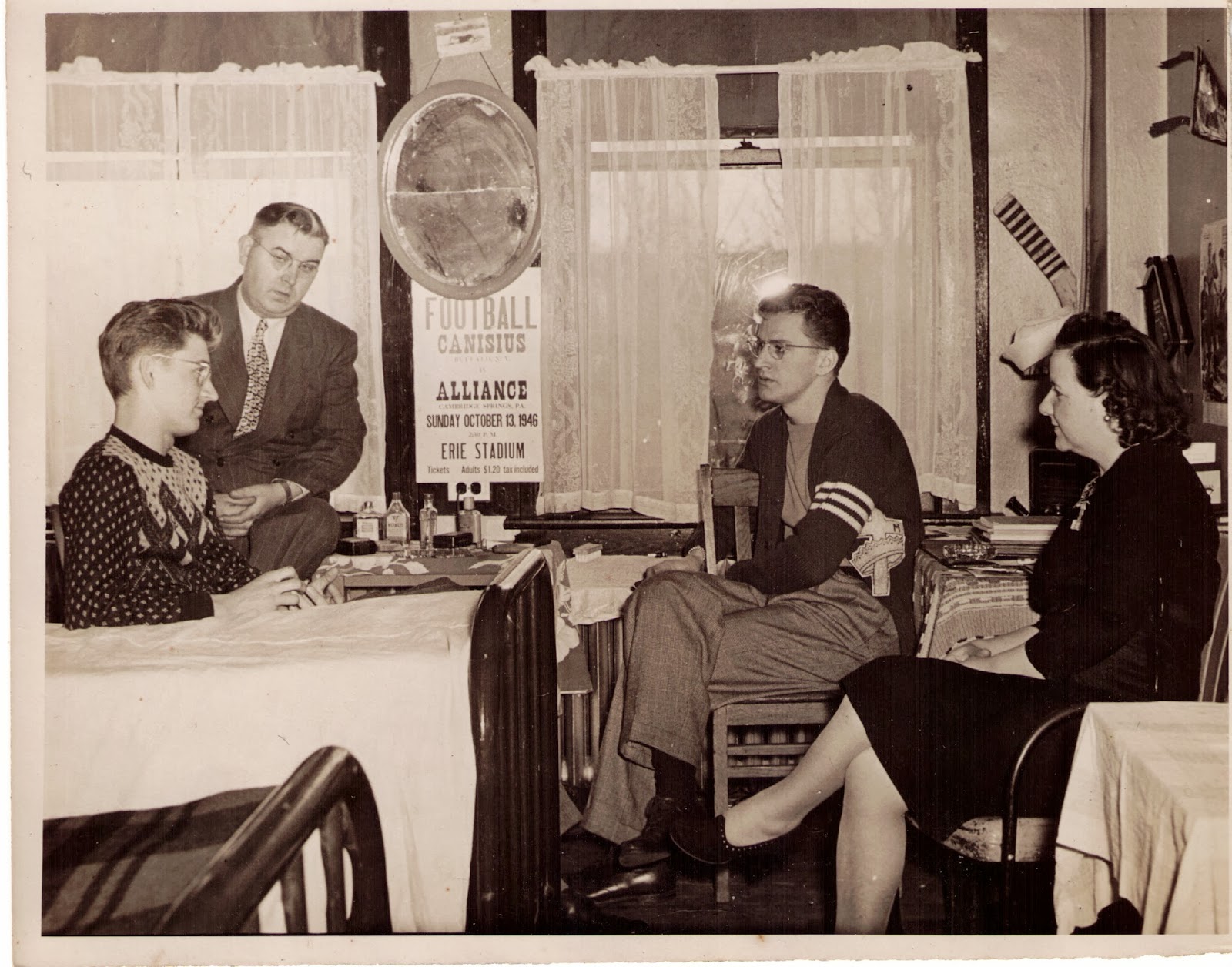
The photo, below, of Gene and Casey before-the-war, or before their war, featured, naturally, in the Japanese Christmas card post.  Dr. John, our JFZ, has since confirmed that the location is the back yard of May St.  Thanks, John! 

Incidentally, that means that JPZ's garden was in a strip along that fence behind the lads. I remember strawberry plants and tomato plants thriving in that little patch in the middle of Buffalo.


Late 1942 or 1943: Gene is drafted into the Army;
1943: Gene does Basic Training at Fort Benning, Georgia;
1943: Julia Mostkowska Zdrojewska dies of cardiac arrest while Gene is doing Basic and Casey is in late grammar school or early high school;
1944: Gene is at University of Chicago studying the Japanese language;
1944-45: Gene is in China; returns via Suez to Scotland, then home.

1946, August: JPZ and Eleanor Kotwas marry;
1947: Gene is President of St. Luke's Youth Council.

Given all that, what can we construe from the photo below?

Eleanor is there - Busia to me and to all the children of Gene and of Casey - and I really want to know if she is wearing silk or nylon stockings.  Controlling our curiosity on this sartorial point, we see that Gene is wearing the famous blue sweater with the three white stripes, so he must be current CYC Prez.  The setting is a dorm room.  So this is some time during academic year '46-'47 or '47-'48.

Click to enlarge and then take a squint at the poster announcing the football game.  It's coming up - Canisius versus Alliance - on August 13, 1946.  Or it took place then, and the poster is a memento.


John recalls that Casey attended St. John Kanty Preparatory School in Erie, Pennsylvania.  

What year did he graduate?

I love Casey's sweater, and his proto-James-Dean hairstyle.


John comments:

I'm convinced it"s Kanty. Note the flyer about the Canisius-Alliance football game at Erie Stadium. The no longer operating Alliance College in Erie was founded by the Polish National Alliance. My mother's brother, William Kotwas, DDS, of Auburn was a member of the Board of Trustees there for a time and we went to one of its graduations during that period.

. . . I believe one of the Zdro videos shows him in the graduation processional.

And interestingly do you see how the photographer, JPZ, set the photo up using the football game flyer to tell us the time and location? A sense of history!
John


The school operated from 1919-1980, when for some reason, and despite high enrollment, it was abandoned, the property sold and the building demolished.

St. John Kanty Prep, exterior of the building featured
in the JPZ dorm-room shot.

The school's statue of St. John Kanty,
which was at the main entrance.

John Cantius, Joannis Cantii, Jan Kanty,  1390-1473, was a Scholastic philosopher and academician in Krakow, at what would become Jagiellonian University.

Scholasticism is described on Wikipedia in this wise:  "Not so much a philosophy or a theology as a method of learning, scholasticism places a strong emphasis on dialectical reasoning to extend knowledge by inference, and to resolve contradictions. Scholastic thought is also known for rigorous conceptual analysis and the careful drawing of distinctions. In the classroom and in writing, it often takes the form of explicit disputation: a topic drawn from the tradition is broached in the form of a question, opponents' responses are given, a counterproposal is argued and opponent's arguments rebutted. Because of its emphasis on rigorous dialectical method, scholasticism was eventually applied to many other fields of study."

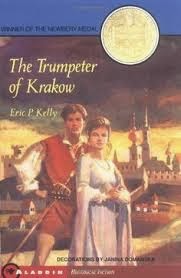
One admirer of Jan Kanty was Eric P. Kelly, "an American journalist, academic and author of children's books. He was a professor of English at Dartmouth College and briefly a lecturer at the Jagiellonian University in Krakow. He won the 1929 Newbery Medal recognizing his first published book, The Trumpeter of Krakow, as the preceding year's most distinguished contribution to American children's literature."

Kelly's much-loved children's book is The Trumpeter of Krakow.


Kelly loved Krakow, and wrote his 1929 juvenile novel about the trumpeters of the Hejnal at St. Mary's, their traditions, struggles, and heroics. He set it in 1461 and brought in Jan Kanty as one of the heroes of the tale.  Here is an excerpt from Chapter IV, "The Good Jan Kanty."

     "Among the most remarkable personages of Krakow's age of glory in the fifteenth century  was a certain scholar-priest by the name of Jan Kanty.  He had been educated at the University of Krakow in the period of late Scholasticism when the chief teachings were still mere expositions of the seven arts, of which grammar was the king.  However, a full life and much contact with men had made Jan Kanty a well-rounded man.  He loved learning for its own sake, but he honored most of all its precepts and its application to life, and he gave himself over in his cell-like quarters on the lower floor of the old university building (now long since destroyed by fire), to the creation of new points of view on old subjects, to comments on the conduct and opinions of the masters and doctors  of the university at the great church councils of Europe, and to an intellectual chronicle of his age."

     "His life was saintly and his cell was as much visited, perhaps, as is his shrine in the magnificent old university library today.  The peasants loved him especially, and this was rather curious since the men from the farms rarely sought the advice of the men of the university; they were, in fact somewhat shy of the dispensers of higher learning.  They were not shy of Jan Kanty, however.  They came to Krakow to ask his opinion on the weather in the seasons of grains and vegetables, they called upon him for decisions in disputes between landowners, they consulted him concerning the proper kind of food for their livestock, they questioned him on all problems having to do with morals or religion, and they accepted his rulings with as much finality and satisfaction as if they had been the rulings of Heaven."

     "Therefore his name was one to be reckoned with everywhere, inside the city and out.  He hated above all things cruelty of man against man, or of man against something helpless, a horse, or a dog, or a child.  And when he saw one man and a woman and a boy of honest features and good appearance harassed by some hundred men, he did not hesitate but rushed into the midst of the flying stones without regard to his own safety or comfort."

So when you read the The Trumpeter of Krakow you will find out what happens with the boy and the jewel thieves and the mad alchemist and all.


Your Dr. Who


Friday, November 22, 2013

Clara Matynka High School Art Folio, and Some Other Art News

  
Our CAMZ saved a couple of folios
from her art courses
at Kensington High School
in Buffalo, from which
she was a 1947 graduate.

This one contains a stack two inches high
of 12" x 9" drawings on heavy stock.
We never saw these but  once
during her lifetime;
all her work she kept up in the attic.


Pen-and-ink and watercolor.
Do you have some time?
We are just at the top of the stack.


The Greeks painted their
architectural detail
and the detail on their statuary.
We have to keep reminding ourselves
of that when what we see
is weathered stone scattered about.


Those three golden-brown things
are done in a shiny metallic paint.

Another art unveiling, in a different league, you might say, and on the other side of the planet, was recently in the news.  I put it up for my wallpaper:

Poland's great artist, Jan Matejko, is depicted in a bronze statue
just unveiled recently, as it happens, in the Square of the Old Town
of Krakow.  While photographing this bottle for the sake of the label,
I caught the wallpaper by dumb luck.

There, now you can see the photo properly.
Beard, Barbican, and all, it's from an article in "The News from Poland,"
mentioning the recent unveiling ceremony.


Saturday, December 1, 2012

"Aegis Fortissima Virtus" prosequitur

The Kensington High School Yearbook of 1942 included a page featuring students who sold wartime "savings stamps," by means of which school-age kids could lend money at interest to the US Treasury for the war effort.


 "The entire student body has co-operated in making the campaign a success.  A real incentive in this work was the visit in January of the lovely Hollywood star, Miss Dorothy Lamour, who inspired the students to buy still more bonds and stamps.  Said Miss Lamour: 'If other schools respond with the same fine spirit of patriotism, I know that our boys are going to have all the material they need to win this war.'  Purchases rose rapidly as a result of the star's visit."


Dorothy Lamour was one of a number of Hollywood stars who supported the war effort in this way.  She also starred in the "Road" movies with Bob Hope and Bing Crosby.


A teacher was called up from Reserves to Actives; students donated to the Red Cross; "seventy-five Seniors willingly gave their services during the days of sugar rationing"; students volunteered to work on farms in the summer; students collected books to send to USO libraries.  Click to enlarge into Preview.  Check out the totals for stamp sales: $8,550; war bonds  $19,575.


The theme of concord among allied nationalities applied pressingly, one can imagine, to the internal management of a Buffalo high school, which had, as a glance at the class list shows, lots of ethnic German students and lots ethnic Polish students. National survival was going to require youth dropping the domestic rivalries of past years.


"Your teachers . . . have spent four years with you in an effort to strengthen your character and to prepare you, as strong Americans, to meet the totalitarian challenge to democracy."


As an elementary school student in the 1960s, I, too, heard about values from my teachers.  One stood in front of the class and finished off a conversation by saying loud and clear, "I wouldn't want to make a value judgment."

What an idiot.  It is impossible not to make a value judgment, as long as one is alive.


"Amid incessant and fiery debates, the members of the International Relations Club periodically endeavored to create a concordant ending of world combats.  Labor-Capital disputes; England's admirable conduct during air raids; American-Chinese policies; and Russian benevolence to the Allies were merely a few of the fascinating discussions which made this club singular."


Check out some demented faculty member's conception of "Cooperation."


Fortunately, this guy skipped Assembly that day, dressed and combed his hair the way he wanted, and produced art from his own particular head - art of the style used, in cooperation with other individuals, in the cooperative war effort.


"If you delight in solving brain-tickling mathematical problems or in measuring landmarks, the stars, moon, and other planets, we sincerely urge you to join the Slide Rule Club . . .

"At first, the members used improvised slide rules made from lined paper and later bought more accurate implements for themselves.  In due course, the problems increased in difficulty, but were met with proportionate ease as the training progressed . . . 

"Next the boys and girls were familiarized with the sextant, a remarkable instrument used in determining angles and ascertaining heights and distances.  Each member had the opportunity of measuring our renowned school chimney and other prominent landmarks in the distance . . .

"Many students have the false impression that this interesting organization is reserved exclusively for that small body of mathematical wizards which attends the school, but it is open to any student who is inclined to use mathematics either for enjoyment or as an occupation.'


John Napier, 8th Laird of Merchistoun (1550-1617) kept his shoulder off the wheel - thank God - and instead followed his own path to discover logarithms and invent the proto-slide rule. 

Trinity College, Cambridge, possesses a surviving set of "Napier's Bones."


This is the "geometry room" in the basement of Collegium Maius of Jagellonian University, in Kraków.

The Museum of Collegium Maius possesses a set "of Napier's bones" (London, late seventeenth century) a calculating instrument publicized in 1617 by Lord John Napier, the author of algorithms.  It was used until the late eighteenth century, and at the Cracow Academy it was exercised by Professor Jan Brozek."
(Podlecki and Waltos, Collegium Maius, p.46)


This and all the other treasures of Jagellonian University were in the hands of the Nazis in 1942.  The faculty had been summoned to the campus by the Gestapo, arrested, and murdered.

American kids were learning to understand slide rules by making their own with lined paper, so that they could progress to real, manufactured ones.

". . . for whatsoever from one place do fall . . . is with the tide unto an other brought . . ."


Julie

Friday, February 24, 2012

Poznan Zdrojewskis: From the Old Country, Part 6


Here is our couple in 1973.  What is that place name?  Sieraliov?  Sievaliov?  


These three photos of this wooden church are not labeled, but the prints are  the same size and style as the photos of the couple.  That makes me wonder if this church is also in or near "Sieralov."

A Wikipedia search for wooden churches yields Wooden Churches of Southern Lesser Poland.  There you see a style quite different, with watchtowers often on the front of the building, and the construction typically with horizontal timbers and with shingles.  This one is very simple board-and-batten, with just one little onion-dome on the belfry roof.  It looks new.

Anyone have any idea where this is?  I studied Google Images of wooden churches of Poland until my eyes crossed, but found nothing exactly like it.


The Slav is at home in the forest!


The Slav is at home in the forest!  In Krakow, the statue of Mickiewicz has at the base four additional figures, representing four elements of the basis of Polish culture. There is the farmer, in his field teaching his son; there is the Jewish mother teaching her child the Psalms of David; there are the Romans with their law; and there is the ancient Slav.


With just his furs, his sandals, sword, shield, and winged helmet, he rules the forest.


  In good times.