


While the first drop of the advance team of JACKAL was happening, Captain Zarembo was sent to Kunming for supplies for the team. From the Team Log started by Zarembo, quoted on MMB 55:
" . . . One week later I returned, much worse for wear and tear but with the supplies firmly clutched to my military bosom - two C-47s loaded with containers, all packed and ready for JACKAL's second drop of men and supplies . . . "
The C-47 Skytrain was modified from the civilian Douglas DC-3 for military use "being fitted with a cargo door, hoist
attachment and strengthened floor - along with a shortened tail cone for
glider-towing shackles, and an astrodome in the cabin roof." The C-53 came along a bit later; it was bigger, with greater capacity. But the C-47 had a couple of advantages: it could do with a shorter runway, and American industry produced a lot of them:
"More than 10,000 aircraft were produced in Long Beach and Santa Monica, California, and Oklahoma City, Oklahoma. Between March 1943 and August 1945, the Oklahoma City plant produced 5,354 C-47s."
These were the planes of the Flying Tigers, of flying The Hump, and of the Berlin Airlift.
From the American Airpower Museum:


So Cyr, Chu, Friele, Robichaud, and Welo on landing dealt with smashed rifles, smashed cameras, Welo's smashed-up leg, and reports of multitudes of Japanese search parties detailed to look for them, so that "out of twenty consecutive days" they must make "fourteen daily moves." All around were Japanese troops, Chinese troops, Chinese Puppets-of-the-Japanese troops, and Chinese troops who don Puppet uniforms to go mingle with the CPoJ troops, in emulation of their commander Sun Ping-Ying, publicly a Puppet, but secretly not, sort of like the Scarlet Pimpernel but with a different style of poetry.
Cyr traveled by means of a closed-in, horse-drawn cart to meet with Sun Ping-Ying in Hsinhsiang/Xinxiang. We have seen a cart like that in a photo on Photobook Page 17:

The SCR-694 radio mentioned on MMB 65 as being repaired by Welo and Friele is a kind we have seen before.

Want one? They are available.

This advance team came to an understanding with Sun Ping-Ying about chain of command with the First War Area and the Americans; they agreed that all would wait and strike together according to an agreed-upon plan; they reconnoitered some potential targets in the city.
Finally, they began to understand and get used to the psychological situation. In Europe as Jedburghs they had fought alongside "resistance groups that had feelings of patriotism in fighting for their countries against the Germans. Chinese resistance was motivated by individual hatred toward the Japanese invaders for their barbaric and savage treatment of the populace, and not for . . . their country, China, which wasn't really an effective country organization or entity at all because of the Civil War in progress." (MMB 66) That reads to me as a requirement for them to go without hearing the signals of national patriotism to which they were accustomed, and learn to concentrate on an array of different-sounding signals, to make possible after all their mutual goal.
Will the signal-to-noise ratio be constant, or even knowable?
Here is a links roundup for review of the background relevant to this book:


G&C Maps Page has been spiffed up with new additions.
One comes from the very good overview article Second Sino-Japanese War, which provides discussion, illustration, maps, links to video, and references.
"Japanese Empire's Territorial Expansion" clearly shows the location and year of each move, beginning with the 1874 taking of the Ryukyu Islands, which include Okinawa, and moving on and up through the 1931 invasion of Manchuria and 1939 of Haiman. This illustrates the historical setting of what the US and Allies considered the China Theater of the Pacific War of WWII.

What a relief it was to find a couple of good, readable river maps. This map of the Yellow River (Huang He) shows very clearly the course of the river, its tributaries and basin, basic regional topography, important cities, and surrounding regions. Hsian/Xian, at the junction of the Wei and Jing tributaries, was the OSS center of forward operations in the history we are considering.
One city, part of our story, that is not on this map is Kaifeng. That would be the mysterious Kaifeng-on-the-Dollar-Bill, of which we may or may not ever figure out the meaning.
Kaifeng is located east of Zhengzhou, right at the place where the Yellow River bends to the northeast.
The source of this map is an essay that goes into a lot of detail, on historical courses of the river, for example, or the deliberate 1938 KMT flooding of the Yellow River valley to deter Japanese troops.

A map of the Yangtze has similar advantages in clarity, showing just enough detail of the course, drainage basin, geographical relation to the Yellow and the Pearl Rivers, geographical relation to Tibet, India, Burma, and the coast. It shows us Kunming and Hsian/Xian, clearly and on the same map.

Last but not least, a 1959 set of topographical maps of eastern and southern China is available for download from the University of Texas Libraries. The master map looks like this:

From the landing page, I clicked on Hsian from the list of major place-names, zoomed in a bit, and took a screenshot of the ancient city and the rivers nearby:

This kind of reading and map study is useful in reminding us of the who-what-when-where of the broader stage and action in which fits our JACKAL story, to which we return.
. . . There is so much that must remain unsaid and such a vast and complex field to cover-and I am so ignorant-that I hardly dare pretend to have anything to say about the China of today. But of one thing I am sure- it is completely and radically different from the Pekin you knew and the life that was lead [sic] there when you were a young man. . .
I don't know how to start or to end in describing the scene. Indeed I'm not sure in can be described- that is, it is not consistent; . . . things are so fluid that they don't permit of conclusions as to pattern. . . In the first place the Chinese don't hate the Japanese and never have- they merely hope in some vague way , that the Japs will go away. . . Second, the Chinese have little, if any conception of nationhood. And the Party [the unidentified writer here refers to the Koumintang Party] has not appealed to the love of China, but rather insisted on devotion and loyalty to the Party and its leader- a narrow and limited appeal in any event and particularly sterile in recent years because of the "reactionary", or better, moribund leadership from the Gissimo down. . . Third, the soldier and the army are still the lowest in the social and intellectual scale. there is no conscription; not one of the members of the government has suffered any personal loss of sons or brothers.
On the contrary, all have profited hugely and are prosperous beyond their wildest dreams so that the great majority of government people, plus the traders, merchant and business man, doesn't [all caps, X'd over!] want the war to end.
The young Chinese doesn't enlist; he pursues his studies. Only coolies and forced conscripts join the army- they don't join- they are dragged off to a miserable life without enough food or clothing and with miserable quarters, etc.[So imagine these specifically-trained Americans, come to defeat the Imperialist Japanese who had attacked their own country and also invaded, rampaging and doing murder, this ally China. Some of these Americans descended from the Mayflower colonists, others from refugees crossing the Atlantic in steerage holds only forty years before, others, Nisei, sons of ethnic Japanese-American parents who loved their adopted country even as it did not yet love them back. They rode, on ponies and trucks, or flew in, to find a thrall-and-warlord based feudal society enmeshed in complicated, opaque, and deadly strategic traps. Their mission was to help these guys fight the Japanese. Okay, but. . . Just imagine it.]
Another point. I said that the Chinese don't hate the Japanese- indeed they don't hate anybody. Someone said here recently that there hasn't been a shot fired in anger by the Chinese since Dec. 8, 1941. He meant merely, the Chinese decided then and there, it was our war and they would let us carry the ball.[Those are two distinctly different points. Some hate the murderous invader, of course: just remember Nanking. But can they shoot back, or are they disarmed, starving, and powerless? The Chinese who "decided" to "let us carry the ball" are not the ones fighting, they are the ones not fighting, but protecting their localized power and commercial interests.]
- quotations from a letter in the R. Harris Smith papers, Box 2, Folder 1, Hoover Institution Archives.
OSS intelligence files at Chungking (conscientiously maintained by a jolly amateur chef named Julia McWilliams Child) bulged with reports about the incompetence of the Chinese military command. In November 1944, when Japanese troops began an offensive that threatened Chennault's air bases, groups of OSS demolition teams were sent to destroy equipment that might be captured by the enemy. A fifteen-man team commanded by a 25-year-old veteran of Detachment 101 discovered three huge ammunition dumps that held tons of arms and supplies. They were told the equipment had been collected and hoarded for years against a crisis in east China. With the Japanese only twenty miles away, the bungling Chinese Army commanders were still zealously hoarding the materiel. The Americans were forced to destroy the entire stores only hours before the Japanese entered the town.Since this entire blog is Amateur Hour, I'll give my take on this. Bungling is a misdiagnosis. Those commanders were not bungling, they were sticking with the program instilled in them by their entire warlord-owned culture: obey, be quiet, do not stand out; your warlord awaits his opportunity. Within that context, they performed their parts competently, according to their cultural algorithm.

Other OSS officers were sickened by the treatment the Chinese government afforded its own troops. An OSS doctor who helped select Chinese soldiers for guerilla training described the conditions in their army as a 'crime against humanity.'Where could Smith have found that quotation? Well! We now possess scans of Smith's notes for this chapter, thanks to the work and help of the Hoover Institution Archives. Thank you, Hoover pros! Smith is quoting Stuart and Levy, from their 1965 Kind-Hearted Tiger:
R.H. Smith typescript described as "Stuart and Levy, 1965, p.347":
When OSS began to recruit Chinese soldiers for a second Commando group early in 1945, [Note that our EJZ arrived in Kunming in early 1945, to train Chinese commandos.] the surgeon general for the Chinese OGs (John Hamlin) found the Chinese troops from whom he was to select - "Their bodies were covered with standard thin cotton khaki trousers and tunics. Some still had straw sandals. Most were without footgear. All were weak from marching and malnutrition. Many also had dysentery.
Said Hamlin, "We can't accept any of these men. They're dying on their feet. Even in trucks, I doubt if they'll last to Kunming. This is a crime against humanity.
In effect, selecting any of them for OSS training was saving their lives for it would mean shelter and decent food for the commandos who were to be trained. When they reached Kunming, they were marched to their first real meal in months. Some of them had never eaten meat before.
- R. Harris Smith papers, Box 2, Folder 1, Hoover Institution Archives.

 |
| Skillful cover art depicts the Windy City. |
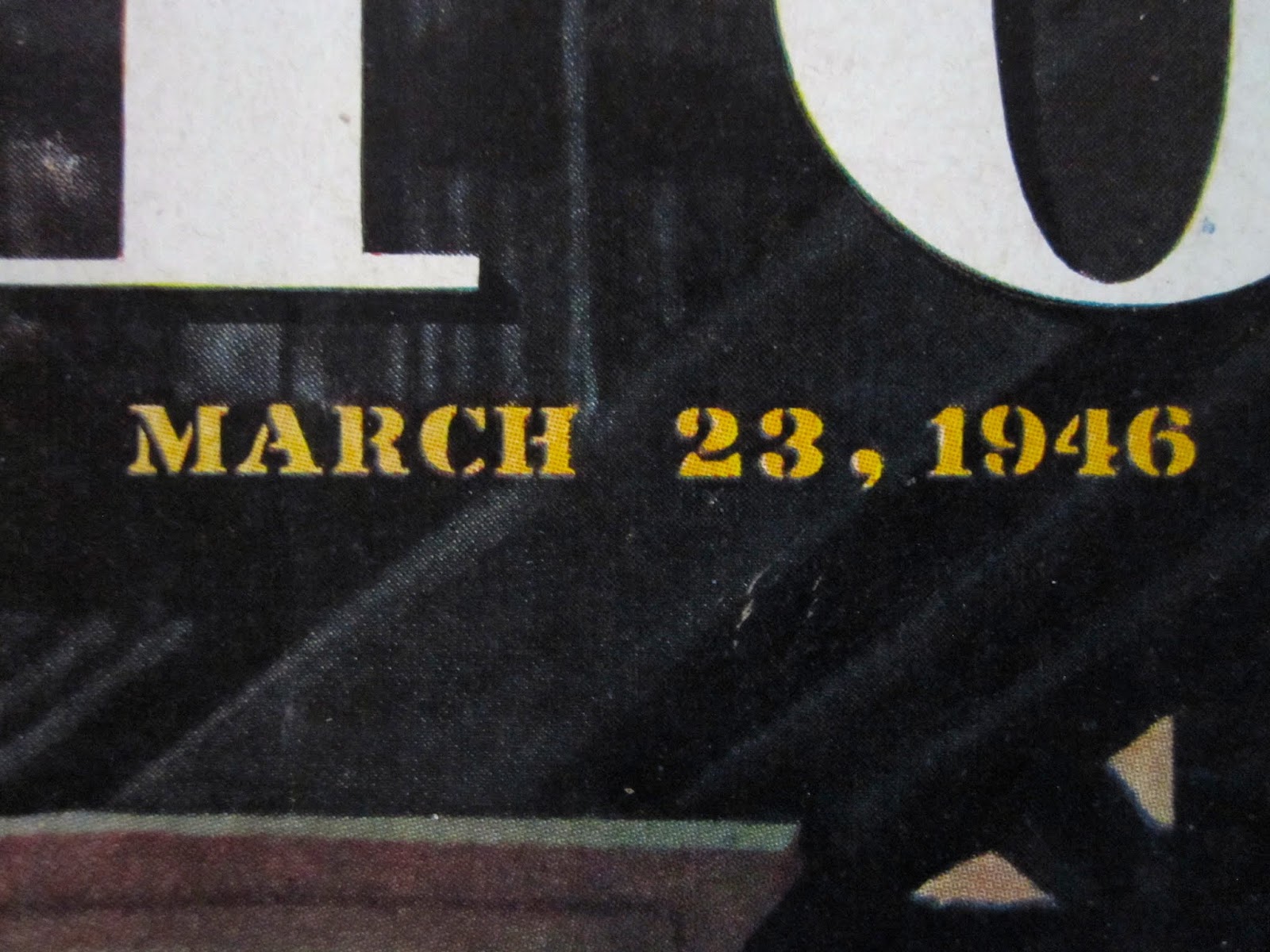 |
| Notice the font used for the issue date: military-stamp style. At this point not all our soldiers were home yet. The whole country, not just the US Armed Forces, was going through a lengthy demobilization. |


. . . research material for the book by R. H. Smith, entitled OSS : The Secret History of America's First Central Intelligence Agency (Berkeley, 1972).If you search the collection for "China" it turns up one hit: "Box 2: China." Could that box have, after all, anything of interest to us in pursuit of Team Jackal data? I took a look the old-fashioned way, by consulting the Index in EJZ's old copy of the book. Anybody else recall seeing this book lying around? I often saw him sitting on the sofa, reading it intently, but he said nothing directly about it.

The American position in this dispute was a model of ambiguity. Wedemeyer ordered American forces to aid the central government armies in the reoccupation of enemy areas. They were to provide transport to Chiang's troops and were authorized to accept Japanese surrenders on behalf of the Chiang government. But, added Wedemeyer, none of these actions should violate the basic principle that American forces were not to be used to aid the Chinese government in a civil war with the Communists!
OSS officers were the first to see the absurdity of this dream of "neutrality." In April 1945, forty-six OSS men set up headquarters at an old Seventh Day Adventist mission at Sian in north China, some 150 miles south of Yenan.. . .

In early August, the German-American colonel [that must be Kraus] who commanded the group (he was selected for the post because the local Chinese warlord had been educated in Berlin) began dispatching his OSS teams into the field. These units encountered difficulties with Japanese and Chinese troops of all descriptions. There was a thin line, for example, between Kuomintang loyalists and Chinese puppet soldiers who had fought for the Japanese. [!] One team commanded by a 24-year-old Jedburgh
[the team is JACKAL; the commander is Paul Cyr; the source is the Saturday Evening Post article we have here in the Trove]
parachuted to their "drop zone" to find their "reception committee" composed of a "group of Chinese who were paid by the Japs - got their arms from the Japs and might easily be loyal to them." The local warlord "had commanded a division for the Chinese Nationalist government; when he was captured by the Japs, he commanded a division for them with the same aplomb and good nature. It was our information that he was still in correspondence with Chiang Kai-shek, and would help if he didn't risk his own neck." These puppet troops were only a temporary problem. When the war ended, the warlord generals who had been traitors to their country abruptly realigned themselves with the Chiang government. The Chungking regime accepted their support as allies against the Communists with open arms.
OSS had also become inadvertently concerned about growing Communist strength. In the last month of the war, two OSS teams dispatched from Sian to the guerilla zones were arrested by Communist troops, In both cases, the Dixie Mission at Yenan secured their release. It appeared that local Communist zealots had acted without approval of Communist headquarters. Then in August dozens of OSS intelligence officers were sent into the northern hinterland from Sian to report on the local military conditions. Communist troops, who saw these teams as tools for the Kuomintang, deliberately harassed the Americans. In mid-August, the OSS commander at Sian [again, that would be Colonel Kraus] anxiously wired Kunming: "Now appears all field teams face conflict with Communists in trying to carry out orders to occupy cities on Jap surrender and seize records. . . Request instructions on what action teams should take. Suggest that if teams must fight Reds to carry out orders they be withdrawn to Sian. Sincerely feel teams should not risk their lives in conflict with Reds. Feeling in North China is civil war will start immediately after Jap capitulation."Dad said that he and his buddies met up with Russians. Stalin's army and NKVD were advising and training the Red Chinese. Dad told me that during one of these wary, slow-motion encounters, one of the Russians took him to one side to beg him, plead with him:


