Showing posts with label Frenchie. Show all posts

Wednesday, March 27, 2024

OSS CBI Photobook 17

 
  Page 17 is the first of several showing us off-duty moments in the HQ near Kaifeng. They seem to have quite a few such moments, and quite a lot of film.

Above: scan of top half of page 17.


 Above: scan of bottom half of page 17.
 
This mode of transport will be featured in stories coming up.

Robichaud, aka Frenchie

This kind of scene became a classic in after years, right?
Looks like blackjack.


Mills, Mills, and Brunner has lists of team members beginning on page 503. Note in the image above that the team name changed over time. 
 
As of May 22, 1945, the eight-member team is set up under Paul Cyr.

Zdrojewski is the only member of the small group that trained together on Catalina who has ended up in JACKAL.

For Friele, at least, we now have a hint. Andrew photoshopped the dollar bill pasted into the Page 16 photomontage:


There's a name we know! Sgt. B. E. Friele. 
 

This photo has the following caption in the "Communications Branch" section
 
"1SG Berent Friele sending a message at SO Team JACKAL, China, 1945. Friele had previously been the radio operator of Jedburgh Team GERALD in France 1944."

Thursday, May 26, 2016

Gene's M-1. The Power and the Transmission of Memory.


Some things were seen; many were not seen. Some few things were known; many more were not known. In the end, one day, my brother shone a light in the darkness.


A certain leather strap was always in the same spot at one end of Dad’s closet. To the right of his shirts, hard by his tie rack, directly above the shoeshine kit, it hung on a spindly wire hanger.  Worn, oddly folded, and bearing odd buckles, it was part of our childhood landscape but we did not mess with it.  We also did not ask about it; somehow we knew it were better not to probe.


A clunky scrapbook, with forty-odd pages of photographic prints pasted in in the crazy-quilt style fashionable in the 1940s, was also part of our home. We looked, and we inquired, but the answers, though kind, were brief. Yes, I was in China. We rode ponies into China and when mine went lame I found saddle sores; there was nothing I could do for my pony.
We taught the Chinese to blow up bridges. We blacked our faces, swam out at night, and attached the explosives. When a train came over carrying Japanese soldiers, we blew up the bridge.
A few bits of backstory came to our ears indirectly. From an uncle: There was hand-to-hand. From our mother: He told them he knew English, Polish, Latin, and French, so they taught him Japanese, and then they sent him to China! At the dinner table, talking with my future father-in-law: Ha! Yes, we were flown back over the Hump in late ’45 and the Japanese were still shooting up at us. From the eulogy delivered by the uncle: He jumped out of that plane snapping pictures on the way down, so the planners would have an idea of the terrain for the land invasion they had to prepare.
And we knew from our mother that in his nightmares he would cry out, Hey, Frenchie, look out! Look out, Frenchie!

Yet when we grew up and asked for details, he would just smile and say, There was a lot of running.
Dad died with his boots on, as he had frequently proclaimed he would. Mom kept his bathrobe on her pillow for a few months, then followed him. My brother and I emptied our childhood home; on clearing their closets I took up that strap as though on autopilot, silently packing it for the trip to my office where a collection of Dad-related items began to grow.
On the last day, alone in the house by the woods, alone in the empty house, my brother felt that his job was not done. Not everything was safe. Question marks still hovered in the air. Something made him climb yet again into the big, low attic, turn on the flashlight, and slowly crawl all around looking for answers.
There, jammed way under the eaves, silent and generally invisible, were two grey packages. He took them out from their waiting place. From one he drew photo logs, hand-drawn maps, and a Bronze Star citation related to OSS Detachment 202 Team JACKAL. Out of the other came an Army money belt, from which tumbled medals, ribbons, a field compass, and Chinese coins.
The entire trove is here with me now; I am partway through a proper study and have made some progress. Scanned photos reveal a lot. I figured out who Frenchie was, for which my relatives will forever be grateful. Still, the papers from under the eaves refer to events prior to and after the big mission, in the same way that the scrapbook contains no photos of the big mission, and little information beyond what is offered in the Saturday Evening Post article of March 23,1946, which is pasted right in there. He took home what they let him take home, just as he spoke only of what they let him speak. His handwritten mission journal is in Box 862 of something called “OSS Personnel Files – RG 226 Entry 224” in an OSS/CIA stronghold – maybe the Hoover. Some day I would like to hold that journal in my hands.
The strap is the sling from his M1. The earliest photo of his rifle is from A.S.T.P. training at the University of Chicago.

By the time he shipped out, he had been training with this rifle for a year and a half. As far as I can tell, the rifle is a version of a .30 Caliber M1 carbine.
Its next photographic appearance is somewhere near Kunming, where his buddy snapped a shot of Gene demonstrating how the OSS looks for bad guys in caves.

And there we see the leather carbine sling. We see the pistol in the holster, either a US M3 fighting knife or US M4 bayonet with hilt visible behind the holster, and a magazine pouch mounted on the stock. A 15-round magazine is visible just below the sight.
A true gent named David Fletcher at Iton’s Cave explained to me that “the vertical thing in the carbine stock is a strap well.” Further, “. . .the string arrangement under the pistol holster is a leg tie string, which was often braided if the holster was not secured to the leg at the bottom. . . There was a special method for braiding them, at least in the USA.” Thank you, David Fletcher.
The photo below of a US Army paratrooper’s kit is from the 1938 edition of Philip B. Sharp’s The Rifle in America. The paratrooper’s M1 is a little shorter than the standard rifle that ground troops would carry, according to the text. It does not look exactly the same: the strap well on the stock looks different. It is an “M11903A1.” But look, you can see very well how the strap attaches to the rifle.

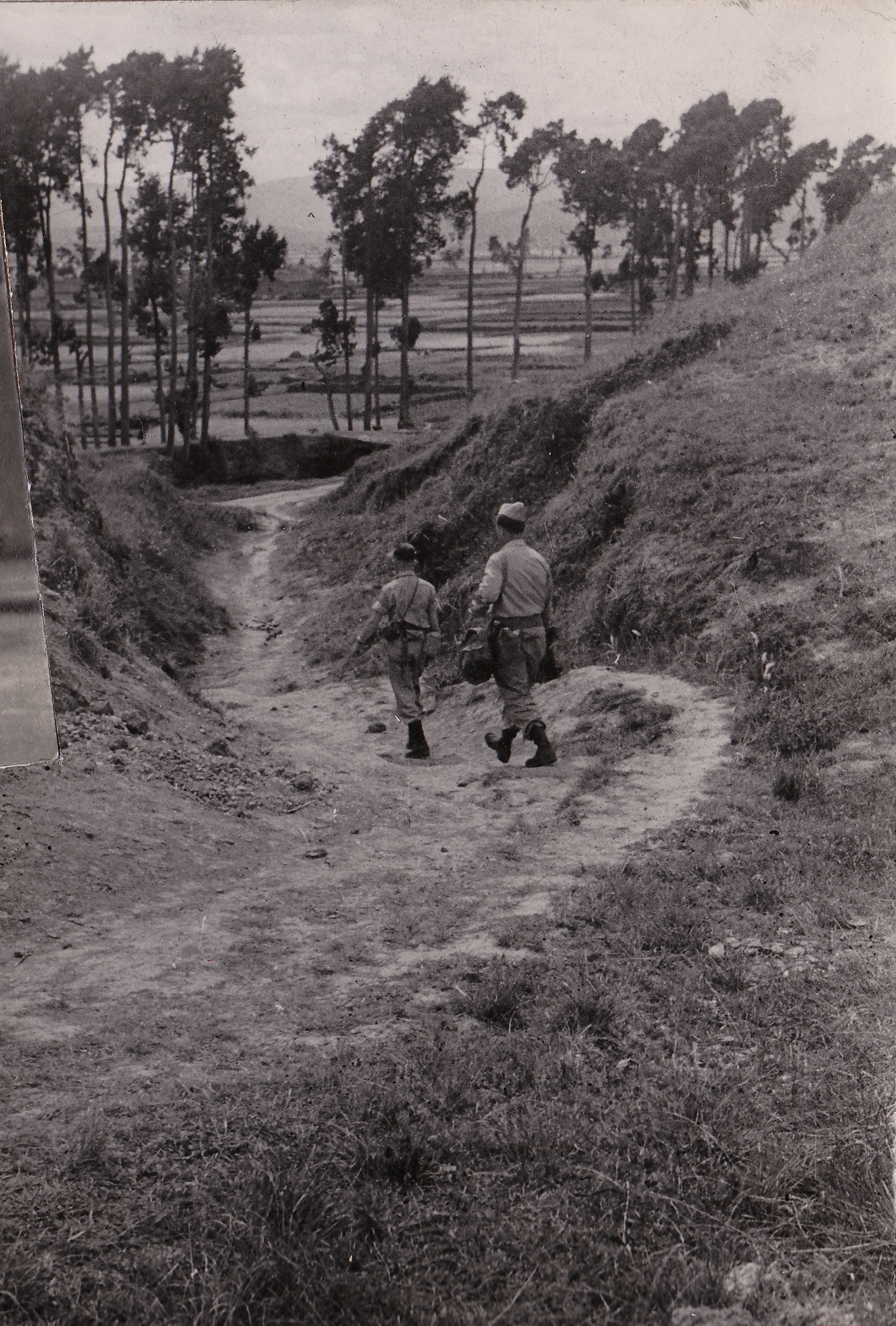
A person looking through the China section of the scrapbook thus far, with almost touristic scenes of the rural area near Kunming, would conclude they were just fooling around, wasting film. Actually, they were working. From end-May through early August, 1945, they made multiple sorties north to sabotage things critical to Japanese transport, while preparing for their big mission. 
George C. Chalou edited the 1992 National Archives and Records Administration’s book The Secrets War: The Office of Strategic Services in World War II.From page 95:
          "Vital to Japan’s control of the Chinese interior was the mile-long bridge that crossed the Hwang-Ho (Yellow) River near Kaifeng. This double-track bridge was the thread that joined the Japanese armies of north and south China. Against all odds, Jed veterans and a brave band of Chinese guerillas under the command of Col. Frank Mills and Maj. Paul Cyr mined the great Hwang-Ho bridge. On August 9, 1945, the day Nagasaki was bombed, [in fact over the night of 8-9 August] SO Mission Jackal blew away two large spans in the bridge just as a Japanese troop train was passing over. The entire train, carrying some 2,000 Japanese soldiers, was dragged to the bottom of the Hwang-Ho."
Frank Mills, et. al., published in 2002 OSS Special Operations in China. Chapter 3 discusses the Hwang-Ho Bridges mission, relying on the mission journal. From pages 84-85, Gene:
          . . . was Field Photo trained and . . . [kept] the day-by-day Team Log all the time JACKAL was in the field. Zdrojewski was young, about twenty I guess, [he was 22] but he had been parachute-trained in Kunming and I believe this was his first combat assignment. He was impressionable and his language in the Team Log reveals thoughts that most of us had but never expressed . . . The Team Log was always guarded and placed in a separate container with incendiary grenades that could be ignited immediately if capture was imminent . . .I don’t know of any other operational teams in China that kept a log with this detail. The standard issue blue-lined paper from letter-size writing pads is now getting yellow and ragged with age, but Zdrojewski’s handwritten entries in pencil script are clear.I can picture him, sitting in one of the mud huts or in the rooms they had later in the walled compounds, writing down the day’s events as they unfolded during the months to follow, probably just before climbing into his sleeping bag to grab a little sleep with his.45 pistol and grenades by his side and a lantern or candle or an Army issue flashlight lighting up the scene."
The trove waits for me to resume study, as it had to be set aside for a while. But now I can start again. And I have been keeping that strap oiled.
To the right of his shirts, hard by his tie rack, directly above the shoeshine kit, Gene’s rifle strap was never farther than 12 feet from his hand, every night since he came home in 1946.


(An earlier version of this photoessay appeared on the Member Feed at Ricochet.com)


Wednesday, April 15, 2015

OSS CBI Photobook 16 - Team JACKAL, Black Ducks, Transition to Kaifeng, Part 2, The Dollar

In Part 1, we began the study of Page 16, and noted the transition from the first base camp, somewhere near Kunming, the terminus of the Burma Road, south of the Yangtze.  The majority of the photos on the page are from that location.  

Team JACKAL has moved about a thousand miles to the northeast, to Kaifeng of many canals, on the Yellow River, east of the target destination, Hsien.

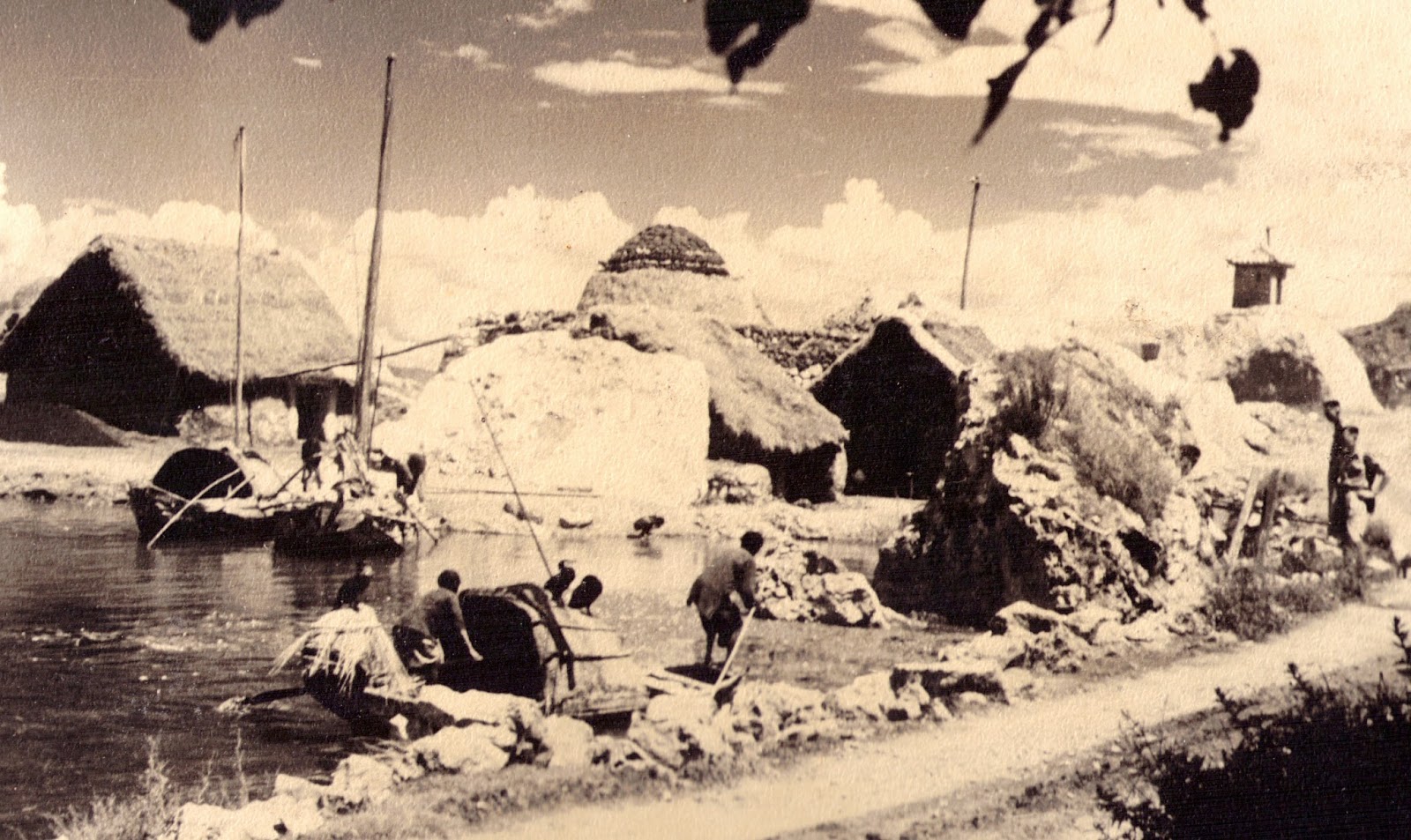
The photo top right is the first to show a canal; the photo bottom center shows a houseboat on a canal or a lake.  See how they and the dollar bill slant off - to the northeast, as it were.


Page 16, scan of bottom half.

Eugene Zdrojewski and Albert Robichaud.


Why save this dollar?  Let us take a close look.


C.H. Phelps,
F. A. BucKANAN,
G.A. Cook,
J. KEllEY

S.W. Hart
S.P. LIU

James D. Kelley rotated the bill
and wrote his address:  Pritchard, West Virginia.

Roy Perkins, Jr.

GABRIEL MASH
B'KLYN, N.Y.

The dollar bill is glued to the page with the purple letters backwards.  When we flip the image of the scan, we see this, below.  Can you read the top line?  If so, please let me know.

"KAIFENG, CHINA" is Dad's writing; I can tell you that.


Captain Edward B. Zarembo

Kaifeng


Chinese commando patch.
From the OSS site.


Tuesday, April 14, 2015

OSS Jump Instructors Near Kunming, in David W. Hogan, Jr.'s Special Ops Book; Albert Wedemeyer

U.S. Army Special Operations in World War II is an online book, in which Chapter 5 deals with Special Operations in CBI Theater.


Below is an excerpt from pages 124-126, in Chapter 5 (emphasis mine):

 "The establishment of an independent OSS branch in China and the end of the war in Europe in early 1945 greatly facilitated the expansion of OSS operations. After assuming command of the new China Theater in October 1944, Maj. Gen. Albert C. Wedemeyer pushed hard for control over all U.S. clandestine operations in China. His arguments before the Joint Chiefs of Staff and Donovan's constant complaints to President Roosevelt of Chinese obstructionism finally resulted in the creation of an OSS agency independent of the Sino-American Cooperative Organization and under Wedemeyer's control. Meanwhile, the end of the war in Europe enabled the OSS to shift materiel, supplies, and personnel, including trained operational groups, to the Far East. By the summer of 1945 four-man OSS teams were training and leading large groups of Chinese partisans in operations against Japanese communications in southern China.39

Even before the end of the war in Europe, OSS personnel had been attempting to organize Chinese commando forces for operations behind enemy lines. The idea apparently drew its inspiration from Wedemeyer, who, as a staff officer, had been involved in the formation of Darby's Rangers. Given the generally deplorable performance of Chiang's regular army in the field, the American theater commander hoped that smaller Chinese units, with intensive American training and guidance, might fight more effectively than the standard Chinese divisions. After some opposition, Chiang's government grudgingly agreed in February 1945 to provide about 4,000 troops, food, clothing, and equipment for a force of twenty commando units. Almost immediately, the project encountered problems. The Chinese soldiers failed to arrive at the training area in Kunming until mid-April, and the quality of those who finally came varied greatly. Not surprisingly, Chiang's generals gave little support to the effort. Nevertheless, with the Office of Strategic Services in China providing most of the supplies and equipment, the OSS instructors began a hurried eight-week course in weapons training, guerrilla tactics, and parachuting. By July three commando units, each containing about 150 Chinese and 20 American advisers, were ready for the field.40

On balance, the program was a success but came too late in the war to have much of an impact. Under the operational control of the Chinese military command, the commandos were to attack communications, to capture significant operational objectives, to gather intelligence, and to protect key facilities from destruction by retreating Japanese forces. Although the commandos later suffered severe losses in the field, they exhibited a fighting spirit rare in the other Nationalist combat units, but lack of coordination and their subsequent misuse as line infantry were major problems. For example, during an assault by three commando units and the Chinese 265th Regiment on Tanchuk airfield, the OSS-trained forces seized high ground overlooking the airfield but took heavy casualties and were forced to withdraw when the 265th failed to arrive in time to support them. An attack on Taiyuanshih by another commando unit and local guerrillas also failed for similar reasons. Nevertheless, by the time the Japanese finally surrendered in August 1945, the commandos appeared to have become an effective fighting force. The Chinese Nationalist high command, however, continued to mistrust these American-inspired units and showed little grasp of their proper employment.41"

Citations:

"39. Roosevelt, War Report of the OSS, 2: 364, 417-18, 440-47; Miles, A Different Kind of War, pp. 433-41, 455, 476; Smith, OSS, p. 266; Albert C. Wedemeyer, Wedemeyer Reports! (New York: Holt, 1958), pp. 252-53, 271. 

40. Roosevelt, War Report of the OSS, 2: 417, 443, 454-55; see OSS/China monthly reports in OSS, History Office Files, Entry 99, Boxes 65-66, RG 226, NARA; Memorandum of Information to the JCS, 10 Aug 45, OSS, History Office Files, Entry 99, Box 68, Folder 218, RG 226, NARA.

41. Operational group monthly reports and the Nanking Mission in Folders 207 and 208, OSS Activities China, 11 Jun 45, and Memorandum of Information for the JCS, 30 Aug 45, Sub: OSS Special Operations in China, Folder 211, all in OSS, History Office Files, Entry 99, Boxes 65-66, RG 226, NARA."


The photo below is linked within page 125, Chapter 5:

Officers and men of the OSS who instructed Chinese commandos in parachute jumping and commando tactics at the commando training camp in Kunming, China (U.S. Army photograph)


Fourth row, standing, second from the right:  Eugene Zdrojewski.
(My identification.)

Second row, seated, second from left:  Is this Frenchie?
Edit: Yes.

Third row, standing, fourth from left.

First row, seated, third from left.
This looks like Ralph Sebastian
from A.S.T.P. Chicago days.

General Albert Coady Wedemeyer pushed the Joint Chiefs
to get OSS in CBI out of the SACO.
(Widipedia photo.)


Wedemeyer on the Ledo Road.
(Source: LedoRoad site.)

Nebraska boy in China.
(Source: Romanus & Sunderland.)


Sunday, April 12, 2015

OSS CBI Photobook 16 - Team JACKAL, Black Ducks, Transition to Kaifeng, Part 1


Scan of top half of Page 16

Still on guard for bad guys in that cave!  What's that patch on Dad's left shoulder?


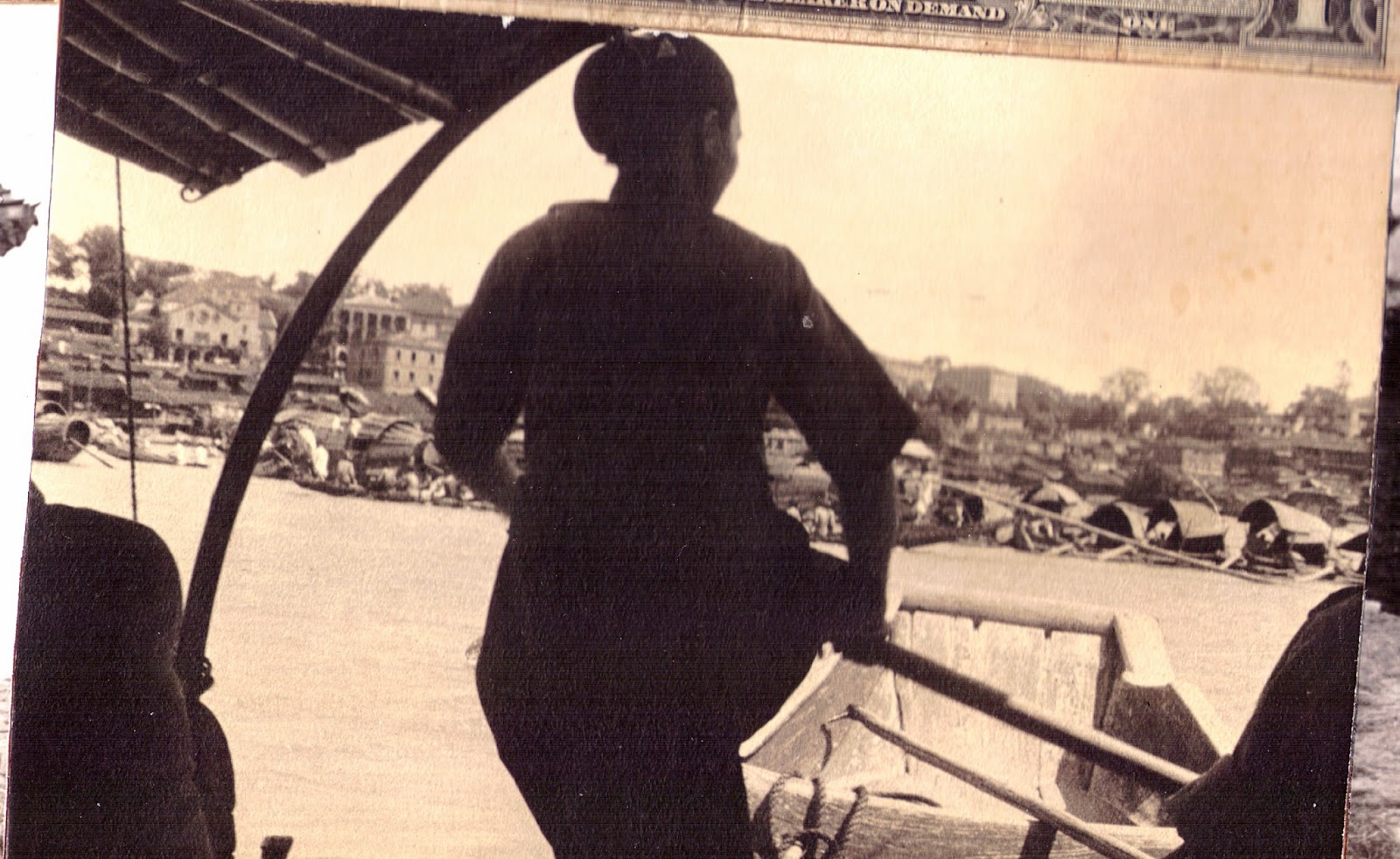
I wonder if this page shows us a transition from the first HQ, from earlier pages, to Kaifeng.  See the masts of the houseboats - and that dome; what is it? - and those black blobs on the nearest houseboat.


This is as close-in as I can scan it.  Things also become more clear just from straightening the picture.  See the ripples on the water surface?  Those blobs are ducks, black ducks: two on the house roof and one at the stern.  You can see the blade of the oar that the woman is rowing, and the pole being worked by the man in the bow.

Two more houseboats are in the background.  What is the dark blob seemingly attached to the rightmost houseboat?  Maybe it is a gadget; maybe a person is holding a jar.


Some damage shows up in the enlargement, below.


Zdrojewski and Robichaud together.  Frenchie taught Dad some French; I recall it now, and perhaps it explains why he would not let me spend senior year of high school in France as an exchange student.


Details of equipment show up, below, including dog tags, shoulder patch, wristwatch (which we still have), camera, something in his shirt pocket.


Here pops up on enlargement another fine view of the carbine an strap, watch, camera, bracelet.  We have the strap and the jump bracelet.  Now, who is the proud young man bottom right?


Who is he? How come he has no insignia?  The pouch on his belt is stamped "U.S."

Notice what is behind him: a soldier in all the kit (Is it Dad?) on a Kansas mule or Chinese pony. Where are they and what is happening?


UPDATE 2023:
This is Major Wu Ping Lin.
He was on the JACKAL team for the bridges demolition.
His daughter and friends have contacted me;
I have their kind permission to post his memoir.