Showing posts with label Kensington. Show all posts

Sunday, December 8, 2013

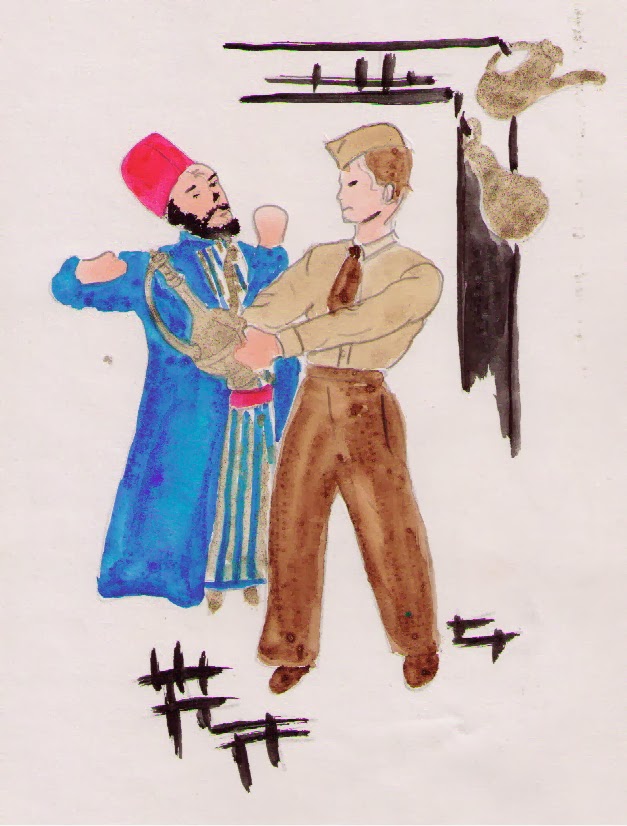
Clara Matynka High School Art Folio, continued: Postwar Bazaar and Postwar Italy, 1 of 2

Watercolor and pencil.

Colored paper - all of it - in a dozen colors.

The rest of these are pages from a contemporary photojournal,
 Life Magazine. The caption reads: "Italian workmen under direction
 of AMG dig for valuable fragments of sculpture, fresco, architectural
ornament  in bombed Capua Cathedral."
Capua is inland a bit from the Allied landing beaches.


Same image, but the bottom half.  I don't have a giant scanner
so you are going to get these cropped or in halves.
"Allies try to save great relics."
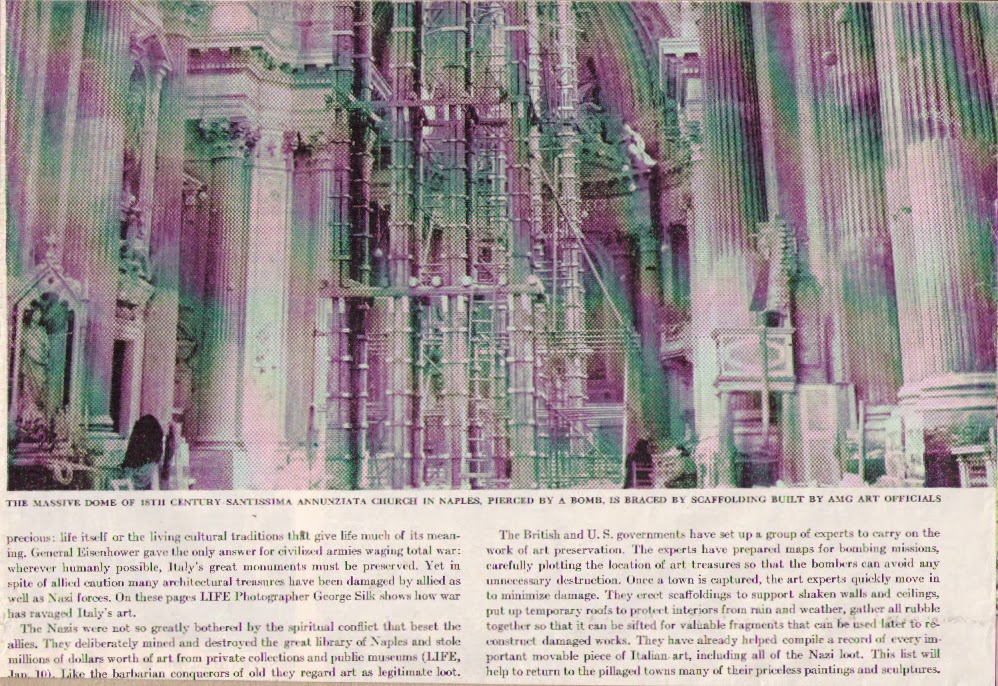
Interesting how those bands of color appeared in iPhoto.
Do they have to do with the color printing process
used at the time?


"In the Palace of Caserta a British corporal takes a cat nap beneath a
16th Century statue of the Duke of Parma, who is being crowned by Victory.
Built in 1752 for Charles III, the palace was recently turned into a public museum.
Germans once used palace as official headquarters.
When Nazis were routed, allied officials made it their headquarters."


"The massive dome of 18th century Santissima Annunziata Church
in Naples, pierced by a bomb, is braced by scaffolding
built by AMG art officials."


From the text of the article:

   "Yet in spite of allied caution many architectural treasures have been damaged by allied as well as Nazi forces. On these pages LIFE Photographer George Silk shows how war has ravaged Italy's art."

   "The Nazis were not so greatly bothered by the spiritual conflict that beset the allies. They deliberately mined and destroyed the great library of Naples and stole millions of dollars worth of art from private collections and public museums. . . The British and U.S. governments have set up a group of experts to carry on the work of art preservation.  The experts have prepared maps for bombing missions, carefully plotting the location of art treasures so that the bombers can avoid any unnecessary damage. They erect scaffoldings  to support shaken walls and ceilings, put up temporary roofs to protect interiors from rain and weather, gather all rubble together so that it can be sifted for valuable fragments that can be used later to reconstruct damaged works. They have already helped compile a record of every important movable piece of Italian art, including all of the Nazi loot. This list will help to return to the pillaged towns many of their priceless paintings and sculptures."

So we can date this issue of LIFE Magazine to late 1943.


Santissima Annunziata Maggiore, the nave today

Robert M. Edsel has written two books about this, one being Monuments Men.  So I'm thinking "AMG" refers to an "Allied Monuments Group."  Previous to that he published Rescuing da Vinci.

Sunday, February 17, 2013

Public Health Study, circa 1944

As a high-school freshman in Buffalo, Clara Matynka studied science; we have seen some of her notes here and also here.  The infectious disease portion of her class notes includes mention of viruses and viral disease.

Click to enlarge.  "Causes of Disease"
and "Prevention and Control of Epidemics"


"Viruses; germs too small to be filtered or seen thru a microscope."
"1. Smallpox (contact)
2. Infantile paralysis."

Smallpox disease was yet extant in the US in the 1940s, even though vaccination with vaccinia virus vaccine had been available since the mid-19th century.

It was not until the early 1970s that routine vaccination of schoolchildren was discontinued, when the rate of natural disease had, through vaccination over time, been driven lower than the rate of serious side effects to vaccinia virus vaccine.

It was not until 1979 that smallpox virus was eradicated from nature.

I was in third grade, about 9 years old, when I was vaccinated.  Don't know about Mom. At any rate, her class notes include the Health Department flyer describing aftercare following vaccination.


Clean, dry, exposed to air, not scratched.
Supposedly it takes 2 or 3 weeks to progress
through the stages of red spot, blister, drainage, and scab.
I remember none of that from my own vaccination;
perhaps the vaccine was more attenuated by the 1960s.


I wonder if in school they read the Kipling story, The Tomb of his Ancestors, in which the British officer in India is sent to the far-off wildest tribe to enforce the vaccination program.  He succeeds by means of diplomacy, sales pitch, and by - well, no, I won't spoil the surprise.

"Catch that girl and bring her to me. . . She will not come? Then she shall be shamed by her little brother, a fat boy, a bold boy.  He puts out his arm like a soldier.  Look!  He does not flinch at the blood.  Some day he shall be in my regiment.  And now, mother of many, we will lightly touch thee, for Smallpox has been before us here.  It is a true thing, indeed, that this charm breaks the power of Mata.  There will be no more pitted faces among the Satpuras, and so ye can ask many cows for each maid to be wed."


The notes include as well this flyer, concerning prevention of the spread of communicable diseases generally.  The danger was more than of colds or influenza.  There was no polio vaccine, or diphtheria vaccine, until the 1950s.

Notice how this alert, to be taken home to students' families,
consisted of words and sentences,
which had to be read, and since they were well-written,
could be understood.
Nobody had to stare at ugly cartoons
and try to guess what they meant.

Sorry to have interrupted blogging recently.  I have a new computer now.

Julie

Sunday, January 27, 2013

Physical Science Studies, circa 1944

If someone challenged you to come up with a demonstration of the 20-odd per cent proportion of oxygen in Earth air, could you do it?  

I'd fail.  Fortunately a little refresher course has shown up in the CAMZ class notes from Kensington High freshman science class.

"Some iron filings  were placed in a test tube
which was inverted in a dish of water.
The original level of the water was noted.
The apparatus stood for several days.."


Hold it right there.  See the illustration, below?  How are the iron filings being made to stick to the inside bottom of the test tube?  Spit?


Okay, I can't do a demo; how about understanding some practical application, such as a household hot-water system from that era?


At left, the lovely coil (great shading!)
is being heated via piped natural gas, yes?

The tank on the right has convection currents going.


So far, so good.  But what's this "coil in range," at the far right?  The kitchen stove was used as a parallel heat source. Therefore that tall convection tank had to be sitting in the kitchen.  I've never seen any setup of that kind.  Can someone send in a photo of such a system in place?

And what kinds of stoves burning what sorts of fuel were used in these systems: wood, coal, natural gas, electricity?

When did modern hot-water heaters, gas or electric, become available and replace these systems?


I'm going read up on demos by hunting up my copy of Michael Faraday's Royal Institution Christmas Lectures from a hundred years previous to this.  Or did I give that wonderful volume away to some offspring?  


Michael Faraday set the standard for scientific demonstration.