Showing posts with label Kachin. Show all posts

Saturday, October 4, 2014

OSS CBI Photobook 12, Part 2 - Koumintang 1945, continued


Kachin? Jingpo? Singpho?

I found this photo of Singpho ladies in full regalia,
having a side view of their hats,
of which we will see more as we go along.
They are not the same as the hat in the photo
above this one, which has particular features
in the back.  So the identity of these people
in the Photobook remains a puzzle:
somebody help me out here!


Wednesday, September 24, 2014

Links Roundup: Calcutta to Ledo; Naga and Burma Tribes

One soldier whose story is up on China - Burma - India is Jack Thomas, who was in the 191st Signal Repair Company, stationed in Ledo in 1945.  One set of photos features Ledo and scenes of convoy from Calcutta to Dibrougarh to Ledo.  Here are a few:

Jack Thomas's photo of Dibrougarh in 1945.

Jack Thomas gave this the caption:
"Typical Naga tribesmen."

Jack Thomas's photo of Burmese girl
in Ledo, 1945.

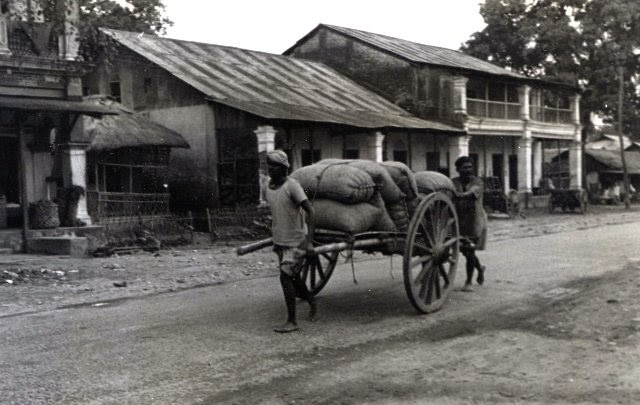
Jack Thomas's photo: Ledo, 1945.


Walter Orey, an aviation engineer, built airstrips in Burma just a few months before Gene's group arrived.  We've referenced his memoir in an earlier post.  This section of his memoir describes the Kachin and the Shan:

"No country of its size had a greater variety of tribal and racial groups than Burma. More than a hundred languages and dialects were spoken in Burma. The two tribal groups that we became most familiar with were the Kachins and the Shans. The Kachins lived in the higher elevations of northern Burma. They lived by cultivating rice and they traded with the Shans. The Shans lived in settlements along river valleys in northern Burma. The Kachins were smiling hill people who were very friendly to the Americans. They helped the Americans because they expected that once the Japanese had been cleared out they would be able to live their lives as before. Some Kachins irregulars had assisted with the capture of Myitkyina and Kachin guerrilla forces worked with the Office of Strategic Services (OSS) behind the Japanese lines. Hundreds of redbrick pagodas and shrines, were scattered on the low lands along the Irrawaddy River. They always seemed more fascinating from a distance then when they were seen close-up. We were told that Buddhists had constructed the temples and shrines many centuries ago. An unusual sight for us was watching the Burmese women puffing on huge cigars, made of tobacco leaves and stems, and rolled in the cornhusks and tied with thread. They called these oversized cigars "cheroots." Most of the civilian homes and buildings in Myitkyina were destroyed in the battle to capture the town. Replacing them was a problem easily solved. Most homes were made of woven bamboo. It was not difficult to harvest an inexhaustible supply of bamboo from the jungle. The 1891st Engineer Aviation Battalion had constructed two airfields in northern Burma from October 1944 to March 1945."


He drove in the first convoy, 1,000 miles from Bhamo, Burma, to Kunming, seeing on the way returning Chinese who had been trained - presumeably to fight and to conduct sabotage operations agains Japanese supply and communications lines - in Assam:

 "The steepness of the grades and the thousands of hairpin curves were the causes of the convoy moving so slowly. We averaged less than 90 miles a day. Now and then we would see Chinese soldiers who had been trained in India, fought in Burma, and were now returning to China on foot."


LIFE Magazine published on the first convoy on the Ledo Road, with photos by Jack Wilkes.

The map below is one of several excellent maps in a highly-recommended overview essay on Warren Weidenburger's CBI site:


The pictures coming up next in the Zdrojewski collection look like China, but include people of various hill tribes.  Perhaps they had a camp inside China but near the Burma border, well to the west of Kunming, which was and is a big city.

We know how Dad traveled back over the hump at the end of the war: we have the color film footage from the transport plane, and we have a story about how the Japanese kept shooting at them.

How did he travel east over the hump into China?  Wouldn't his group have taken a truck convoy or a transport plane?  There are no photos in the collection to give us a clue.  But we do have two stories, heard in childhood.

One was about "riding a Chinese pony through Burma."  It started stumbling and generally acting distressed.  Gene dismounted and removed the saddle and blanket, to reveal a great big fresh saddle sore.  There was not a great deal he could do right away to help the animal, and his own distress at that was evident right there in the Marilla kitchen in the 1960s.

Another story was about "a Chinese pony stepped on my foot, and that is why the nail looks wrong and always will."

He never mentioned mules or horses; it was always "a Chinese pony."


Z

Sunday, June 1, 2014

Catalina Alumnus Tadash Nagaki

We have figured out in earlier posts here, here, here, and here, that our EJZ was in training on Catalina Island from mid-December 1944 to mid-January 1945.

One of his predecessors in OSS training at Toyon Bay was Nebraska farm boy Tadash Nagaki.  He was joining the 442nd Infantry Combat Regiment - "Go for Broke" - in July1943 when OSS put out a call for Nisei to volunteer for dangerous missions.  Tad was Nisei; he wanted a combat unit; soon enough he was at Toyon Bay.

Tad Nagaki was part of OSS Detachment 101, charged with clearing the Japanese from the jungles of Burma and rescuing downed Allied airmen, so that the Burma Road could be re-opened and the Ledo Road built.

Tad Nagaki's big brass:  Merrill and Stillwell

This is from Mary Previte's excellent essay.

Ex-CBI Roundup was a newsletter for veterans of China-Burma-India theater, from all branches, published 1946 through 2009.  Clark King and Gary Goldblatt are scanning the 600 issues and putting them up here, as well as assembling a great deal of background information on CBI here.  Thank you, Gentlemen!

Previte's essay is from the June 2002 issue.  It's riveting, all the way through; here are a couple of quotes to tempt you:

". . . Just before the war started, a tiny handful of Army Intelligence specialists were alerting superiors of the importance of training Japanese language interpreters to master the incredibly complex Japanese language.  But, could youth of an alien race - only one generation removed from the land of their ancestors - be trusted in battle or in top secret intelligence work?  While one hand of the Army was removing Japanese-Americans from the West Coast, another was searching for qualified Nisei for its language and intelligence effort.  In San Francisco, the Army opened a small-scale language school in a converted hangar at Crissy Field, The Presidio.  It hand-picked 58 Nisei for its first class - sitting on apple boxes and orange crates.  When the top brass saw its value, the school was transferred to Camp Savage, Minnesota, where it was reorganized as the Military Intelligence Service Language School. . ."
Remember Camp Savage, Minnesota?  Our EJZ got a letter from there while in Chicago conjugating Japanese verbs, if that's what you do.
". . . The OSS trained the Nisei team first in radio school in Naperville, Illinois, then the Military Intelligence Service Language School in Fort Savage, Minnesota, then six weeks of survival and demolition at Toyon Bay on Catalina Island.  They toughened up with fitness training in the mountains, exercised with water drills from LST boats.  They could survive by fishing or shooting mountain goats.  Catalina Island was ideal for coastal surveillance and commando training.  It was 1944, after begging for action since 1942, the Nisei were about to get their chance. . ."
". . . Late in 1944, Tad Nagaki arrived in Myitkyina (pronounced mich-chi-naw).  Burma, at a bend in the Irrawaddy River. Myitkyina was the strategic key to the entire plan in the north.  It had the only hard-surface, all-weather airstrip in Burma, north of Mandalay.  This was the airfield the legendary Merrill's Marauders had seized. . ."
Tadash Nagaki had to earn the trust of - as in, not get killed by - the Kachin mountain people, who understandably hated Imperial Japanese soldiers, whom he resembled phenotypically.  Take a good look at this old photo of Kachin in World War II, with their characteristic hats and stoles.  I do believe we shall see more of these people in future pages of the Zdrojewski CBI Photobook.

Just google "Kachin World War 2"


Julie