In Part 1, we began the study of Page 16, and noted the transition from the first base camp, somewhere near Kunming, the terminus of the Burma Road, south of the Yangtze. The majority of the photos on the page are from that location.
Team JACKAL has moved about a thousand miles to the northeast, to Kaifeng of many canals, on the Yellow River, east of the target destination, Hsien.
The photo top right is the first to show a canal; the photo bottom center shows a houseboat on a canal or a lake. See how they and the dollar bill slant off - to the northeast, as it were.
Page 16, scan of bottom half.
Eugene Zdrojewski and Albert Robichaud.
Why save this dollar? Let us take a close look.
C.H. Phelps,
F. A. BucKANAN,
G.A. Cook,
J. KEllEY
S.W. Hart
S.P. LIU
James D. Kelley rotated the bill and wrote his address: Pritchard, West Virginia.
Roy Perkins, Jr.
GABRIEL MASH B'KLYN, N.Y.
The dollar bill is glued to the page with the purple letters backwards. When we flip the image of the scan, we see this, below. Can you read the top line? If so, please let me know.
"KAIFENG, CHINA" is Dad's writing; I can tell you that.
G&C Maps Page has been spiffed up with new additions.
One comes from the very good overview article Second Sino-Japanese War, which provides discussion, illustration, maps, links to video, and references.
"Japanese Empire's Territorial Expansion" clearly shows the location and year of each move, beginning with the 1874 taking of the Ryukyu Islands, which include Okinawa, and moving on and up through the 1931 invasion of Manchuria and 1939 of Haiman. This illustrates the historical setting of what the US and Allies considered the China Theater of the Pacific War of WWII.
What a relief it was to find a couple of good, readable river maps. This map of the Yellow River (Huang He) shows very clearly the course of the river, its tributaries and basin, basic regional topography, important cities, and surrounding regions. Hsian/Xian, at the junction of the Wei and Jing tributaries, was the OSS center of forward operations in the history we are considering.
One city, part of our story, that is not on this map is Kaifeng. That would be the mysterious Kaifeng-on-the-Dollar-Bill, of which we may or may not ever figure out the meaning.
Kaifeng is located east of Zhengzhou, right at the place where the Yellow River bends to the northeast.
The source of this map is an essay that goes into a lot of detail, on historical courses of the river, for example, or the deliberate 1938 KMT flooding of the Yellow River valley to deter Japanese troops.
A map of the Yangtze has similar advantages in clarity, showing just enough detail of the course, drainage basin, geographical relation to the Yellow and the Pearl Rivers, geographical relation to Tibet, India, Burma, and the coast. It shows us Kunming and Hsian/Xian, clearly and on the same map.
From the landing page, I clicked on Hsian from the list of major place-names, zoomed in a bit, and took a screenshot of the ancient city and the rivers nearby:
This kind of reading and map study is useful in reminding us of the who-what-when-where of the broader stage and action in which fits our JACKAL story, to which we return.
MMB Chapter 2 concerns the Ping-Han Railway, a north-south line held by the Japanese Army and essential to their troop transport and logistics.
But first comes the story of the 1,000 mile trip with Task Force TAPIR in a big motorized convoy, with the objective of destroying an airbase up north in Laoheku, so as to deny it to the Japanese. The Japanese take the base before TAPIR gets there, but never mind that. They get to go fishing with grenades. And we are introduced to Major Leonard Clark of OSS SI, whose exploits Mills summarizes on p. 19. Look out; here is Len Clark:
With regret I must report failure in finding you an image of Victor Yakovleff, of SI, interpreter and "bodyguard and personal gunman for Leonard Clark."
Those two guys are, to my mind, extreme examples of the kind of self-directing fighting man for which the US Armed Forces have always been famous. I think it was Stephen Ambrose who described the US Army squad or platoon and its largely autonomous mode of operation as essential to victory in Europe. The brass knew to what level to direct them; the knew to give them a goal and let them go to it.
Americans have organized and directed our own defense, far from the seat of authority, since 1607. Here is George Henry Boughton's 1867 painting Pilgrims Going to Church.
So as Mills describes on his p. 30, "Each OSS commander or team leader was given a mission and left to do his job the way he chose to do it, with few restrictions on how he managed, so long as the objective assigned to him was achieved." The setup sounds like our Wild West, for example, except that Tai Li and his organization sound a great deal more institutionalized and better equipped than Geronimo or Vittorio.
Hsian, aka Sian/Xsian, Mills describes as "surrounded by a massive stone bastion . . . [that] formed a rectangle two miles wide and three miles long around the city, with a deep moat dug recently just outside the wall in case the invading Japanese Army should advance that far to the west." (MMB 31-32.)
The Photobook has several pages of what is starting to look a lot like Hsian city and the OSS encampment outside the city. Looking ahead, I spy a photo of the tower that looks just like that on the "main street of Hsian" on MMB 35, and is likely the "Drum Tower." I also spy a photo of statuary sitting out in a cultivated field, such as on MMB 43 and 44. That statuary, all lined up in rows, flanked and guarded the entrance road to that ancient royal palace, which was at that time completely buried. After the war the place was excavated, and those famous buried ranks of terra-cotta soldiers found.
Sorry folks, I do not see in the upcoming Photobook pages any images of Dad yukking it up with General Donovan or General Hu, Commander of the KMT First War Area. There are, however, some very nice water buffalo to come. Stay tuned.
Hu was charged with defense of Hsian not only from Imperial Japanese, but also the Chinese Communists, headquartered "at Yenan, about 300 miles north." (MMB 37) When checking this out on Google Maps, note that the way the English spelling works now: "Yenan" is to the northeast, while "Yan'An," Mao's wartime capital, is directly north of Hsian.
The base compound Mills describes as "about a hundred yards square, enclosed by a stone and clay wall eight feet high." "The Special Operations 'Office' was a dirt-floor, one-room building." "The teams lived in large Army squad tents, one tent per team, and the men slept in their sleeping bags on canvas field cots." The Photobook has images of these things in the upcoming pages, so we will be having a close look.
There are about a hundred men at this base compound outside Hsian. Colonel Mills and his officers disperse them in teams of 9 or so to various areas of operation, some of which are outlined on the map on MMB 546. After squinting at this map a lot, and comparing it with others, I can say with confidence that the thick black line is the Yellow River, flowing south, taking that big bend just northeast of Hsian, and flowing east to the Yellow Sea.
The Ping-Han Railway, single-track according to the map legend, ran north-south from Beijing (Peiping) to Hanzhou:
The virtual loupe lets us enlarge the area of interest, in this case the area to which Team JACKAL was assigned. We see the Ping-Han crossing the Yellow River, between the LION and JACKAL zones. We see the Huang-Ho River, tributary of the Yellow. We see Kaifeng on the south bank of the Yellow. Not shown is Hsinshiang/Xinxiang, but I would place it on the Ping-Han where that black line from Kaifeng joins it. As we will see later, that is the "Hsinshiang-Kaifeng Railway." On May 22, 1945, half of Team JACKAL was flown over Hsinshiang/Xinxiang, at night, on the way to their drop zone. Flown "at 300 feet!" But there was no flack from that dark city.
The mission was to quit playing whack-a-mole with railway sabotage, and instead wreck all the rail bridges in that area at the same time. This May 22 insertion was the first of OSS team members to Chinese reception committee on the ground. Who made that first jump ?
Below is a photo from MMB52, scanned and tweaked. I kind of have my doubts about the caption. I am thinking "Major Cyr; Boris Chu, Interpreter; B. E. Friele, Radio; Jerry Welo, Photographer." It would be nice to find another photo somewhere of Jerry Welo, for further confirmation of these IDs. If you find one, let me know, all right?
What happened after they hit the ground? When did the rest of the team arrive? Did anybody write anything down? Until next time - keep reading!
I. Brain assembles scattered facts and forms pattern; clarity ensues.
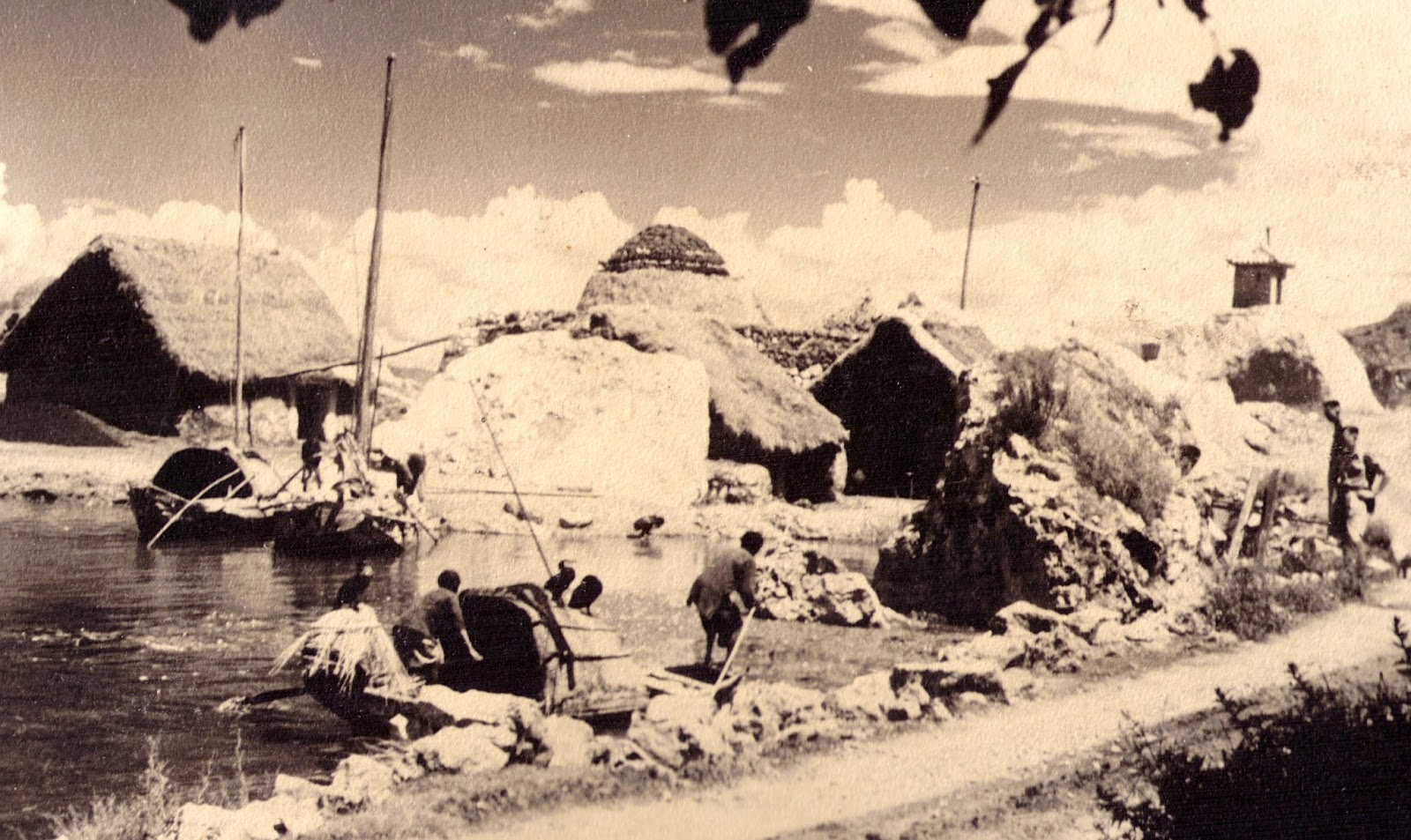
Here is a swimming hole in a southwest Chinese village in the summer of 1945. I am not 100% sure of all that the villagers did with this water, but they must have done some things of significance or Dad would not have snapped the photo.
This village was a recruiting station for KMT soldiers attached to US OSS for jump, combat, and demolition training for purposes of harassing Tojo’s occupying forces. They learned quickly. These volunteers made excellent soldiers who fought eagerly for their country. In two months they and their mentors conducted multiple missions and did their job.
Later in the summer the team was flown to Kaifeng, from whence they jumped to Hsien for the Hwang-Ho Bridges mission. Here is a scene in Kaifeng, city of canals.
A shadow of a certain kind passed over Dad’s face as he told 12-year-old me, once, I had amoebic dysentery. It was very painful and it took a long time to go away. It was a shadow of remembered pain. He had been lucky: he survived, had never been captured, was not maimed, and his illness did go away. So the illness must have been impressively painful to have caused such a recollection decades on.
Dysentery comes from the Greek for bad gut, bowels gone wrong. Medically, it indicates pain and blood. All diarrhea involves loss of body salts and water. Dysentery severe and prolonged additionally can result in blood-loss anemia. Amoebic dysentery, prolonged and undertreated, can result in liver infection and abscess formation with the protozoan, with consequent liver impairment and jaundice. The creatures can settle in the brain, too; after all, once they get into the bloodstream they have to fetch up somewhere.
Our pathogen, Entamoeba histolytica, has anabsurdly complex life cycle. In brief, victim-host ingests an encysted form. Organisms excyst in the intestinal lumen, develop into theirtrophozoite form, and either are excreted or invade the tissue lining the intestine.
Here is normal intestinal lining:
The section has been stained with H&E, hematoxalin (blue, for nuclear material) and eosin (pink, for cytoplasm.) This is from a histopathology text (Figure 24.3) but anyone who has ever nurtured and grown any plant or animal can see that the structures are healthy. Those villi are long and elegant. The cells lining each villus are plump and entire. They can do their work of absorbing sugars, salts, amino acids, water, and so on, and of keeping out toxins and pathogens.
But if the toxins or pathogens are too strong, or the host is weakened, they can damage these defensive structures and effect a breach. Then the germ can go systemic. Here is a CDC photomicrograph of a typical flask-shaped ulcer of intestinal amebiasis. Yep, it is an ulcer all right – a hole in the lining – and the bad guys have poured in. But also note the remaining villi. They are blunted and thickened. Most of their own lining cells are shriveling up or exploding, and so not working well at all. The victim-host cannot absorb much water, nutrients, or medicines. After consuming his store of body fat, he starts to break down his muscle tissue for protein and energy. He becomes weak and cachexic. Yet he continues to fight.
What treatment can be offered a person with amoebic dysentery?
Stop the ingestion of new cysts. Clean up the drinking water, improve general sanitation and kitchen hygiene, and get the human carriers out of the kitchen. Such things were pretty well impossible in rural China in 1945. Oral electrolyte solutions were not generally available at that time, either. Intravenous electrolyte replenishment and intravenous alimentation were only fantasies, on remote battlegrounds.
As far as I can learn, the only antimicrobials available at that time were the sulfa drugs and, more rarely, penicillin. Sulfa would only work if the diagnosis were wrong and the soldier in fact had a bacterial disease. (It presents its own problems as well: it must be mixed with plenty of water to avoid damaging the soldier’s kidneys. And what’s in that water? Something sulfa does not kill?) Penicillin has no effect on enteric protozoans.
We are fortunate now to have metronidazole (Flagyl) which trashes the DNA of microbial cells while doing no harm to host cells. The MDs have that now among their options for killing amoebae that have invaded human tissues. We also have the aminoglycoside drug paromomycin, which gums up the works of microbial ribosomes; the MDs have that among their options for killing amoebae still in the gut lumen. But those were not available commercially until 1960. I can find no evidence that anything like either of them was available, even experimentally, during World War II.
So, a stricken man could only eat and drink the cleanest stuff he could find, and the easiest to absorb, including salt. It was a race to rebuild the intestinal lining, using materials gleaned largely from elsewhere in the body, before those ran out or new waves of the pathogen attacked.
During the war years there were thousands of men in this fix, in all theaters and climates, with the highest rates being in CBI, the China-Burma-India theater. The Army epidemiologists kept records:
In late 1942 and in 1943, increasing numbers of troops entered North Africa and the Mediterranean, the Middle East, and the China-Burma-India theaters, all north of the Equator. Rates for the total Army rose to 25 per 1,000 and for troops overseas to 66 per 1,000, the 1943 annual rate for all overseas troops being the highest of the war. June 1943 marked the high point in monthly rates for troops overseas, the figure being 164 (chart 28). Large numbers of unseasoned young men made a first entry into poorly sanitated areas of highly endemic diarrheal disease. Conditions were different in subsequent years for smaller numbers of men were rotated into already established bases where preventive medicine practices were established and the bulk of troops had become accustomed to conditions. For overseas troops in 1943, 7.4 percent of all disease and 3.5 percent of all noneffectiveness was due to the diarrheas and dysenteries (table 67). Rates for the total Army were better in 1944 and 1945, 22 and 22, respectively. Rates overseas fell from 66 in 1943, to 38 in 1944, and to 33 in 1945 (table 54).
Highest rates were encountered when United States Army troops intermingled in densely populated areas with Eastern peoples, as in China-Burma India, the Middle East, North Africa, and the Philippines. It was at these points of contact with Eastern civilizations that highest rates of diarrheal disease occurred. Diarrheal disease was hyperendemic in these locations into which United States troops were introduced. The criticism was often made that United States troops, accustomed to the advanced sanitary practices of Western civilization, were not sufficiently briefed regarding precautions necessary to prevent personal and mass diarrheal disease in these Eastern locations.
China, Burma, and India are all hyperendemic areas in respect to diarrheal disease. Many sanitary practices of these overcrowded populations, both personal and communal, are tied to habits and customs of generations past. The saving and collection of night soil for agricultural purposes and the promiscuous deposition of filth including feces and garbage favored survival and spread of the infectious agents of intestinal diseases. Food is commonly unprotected from dust, rodents, and flies. Refrigeration is almost universally lacking. Flies are generally abundant. Diarrhea and dysentery, bacillary and protozoal, are constantly present.
These diseases were quickly established among United States troops entering this environment, where standards of sanitation were so different from those at home. Close contact with the native population was often demanded by the military situation. Native help was almost universally employed in foodhandling throughout the theater.
In the China sector, arrangements existed whereby the Chinese Government provided food and lodging for United States Army personnel. A Chinese Government agency, the War Area Service Command, organized and staffed messes and living accommodations at stations and airfields. Air shipments over “the Hump” were limited to essential military materials, and personnel and sanitation materials had low priority. The United States Army in China, in certain respects, was a nonpaying guest, and severe criticism of sanitation was not considered diplomatic. However, inspections were made by medical officers, and mess sergeants were assigned to supervise. Ultimately, new equipment and sanitation supplies were provided, and a gradual improvement in sanitation was achieved. Separate data for the sectors of the theater are available for the period from November 1944 through December 1945. The China rate for diarrheas and dysenteries was 122 cases per 1,000 troops per annum, contrasted with a rate of 86 for the India-Burma sector. The latter sector had the benefit of a belatedly organized preventive medicine program and the opening of area and research laboratories.
Here’s Dad on the troopship home, passing through Suez headed for Strathclyde. Seasickness may be contributing to the drama in this photo.
They let him go home for a month to recuperate, that Christmas, before having him back in D.C. for prolonged debriefing. He still has smudges under his eyes and an anxious expression.
There is a later photo showing him standing on a scale and smiling a big smile that goes around his face three times. He must have reached some goal for weight gain.
II. Higher-ups enter the story; confusion and obfuscation abound.
Primary source item dated August 29, 1945 is a mimeographed recommendation for citation. It mentions the entire Team Jackal and summarizes their various actions.
There was a big encampment at Kunming, and they all had to wait around there for some time, so an OSS named Krause had the duty of writing these up.
Importantly, the final two sentences of this recommendation read (emphasis mine): These men all did extremely fine job despite fact they were continually besieged by attacks of dysentary,[sic] diarrhea and worms. Intelligence submitted was also excellent and helped to pinpoint targets for Air Force.
Now contrast this with primary source item dated 13 September 1945. I don’t know the proper term for this 3-page document of which I have flimsy copy; it is a writeup of the reasons for the citation. (The body of the text, edited down by some 15%, appears with similar wording in the citation proper. The rest of this document is attestation of data points concerning the recipient, in the manner of an affadavit, except that it is unsigned.) Nor can I tell which headquarters is meant: HQ in China? in Assam? in D.C.?
The writer added many details about the various missions, for which I commend and thank him.
But he censored out the germs and worms.
Instead there are slick, nonspecific phrases about untiring energy and devotion to duty.
Why do higher-ups do this? Is it personal, or careerist, in that they want to sound suave themselves, rather than crude? This guy could have transmitted the truth that was given to him, using language less graphic. He did not have to write diarrhea. He could have written . . . chronic debilitation due to health conditions in the area of operation. Phrasing of that sort would preserve and transmit the truth while maintaining a tone of propriety. Our soldiers deserve both truth and propriety. They do not deserve to come home to a lifetime of psychological isolation from badly-informed countrymen.
Or is it policy? If so, is the policy of sanitizing reports and citations for some purpose of domestic morale? Or is it to cover mistakes that led to avoidable casualty? Or is it intended to burnish the public image of one outfit that is competing with all the other outfits for, well, everything – replacements, equipment, fame? Did all branches pretty up their reports this way?
What did our WWII Staff and Cabinet think was going to happen when the citizenry found out various suppressed truths as to front-line hardships, as eventually they did, twenty-five years later on the development of wartime news on evening television? What did they think their situation was going to be when the citizenry no longer felt they could believe anything they said?
Was it part of diplomatic policy, as above: severe criticism of sanitation was not considered diplomatic. Was this instance of potential, implied criticism censored to avoid offending the sensibilities of Chiang Kai-shek? If so, that did not work out too well, did it?
This is a case of elision of unpleasant truth just days from the Japanese surrender and, possibly, before leaving China. One step back from the scene of battle, the truth begins to take hits.
This sanitizing of field reports may well have been done for the best of reasons as understood at the time. If on the other hand any single one of the actors on that stage at that time were indeed of the sort against whom Hotspur made his protest, in his own time, then he deserves that same protest, as well. Here Gielgud delivers it, from Henry IV, Part I, I:3.
Still on guard for bad guys in that cave! What's that patch on Dad's left shoulder?
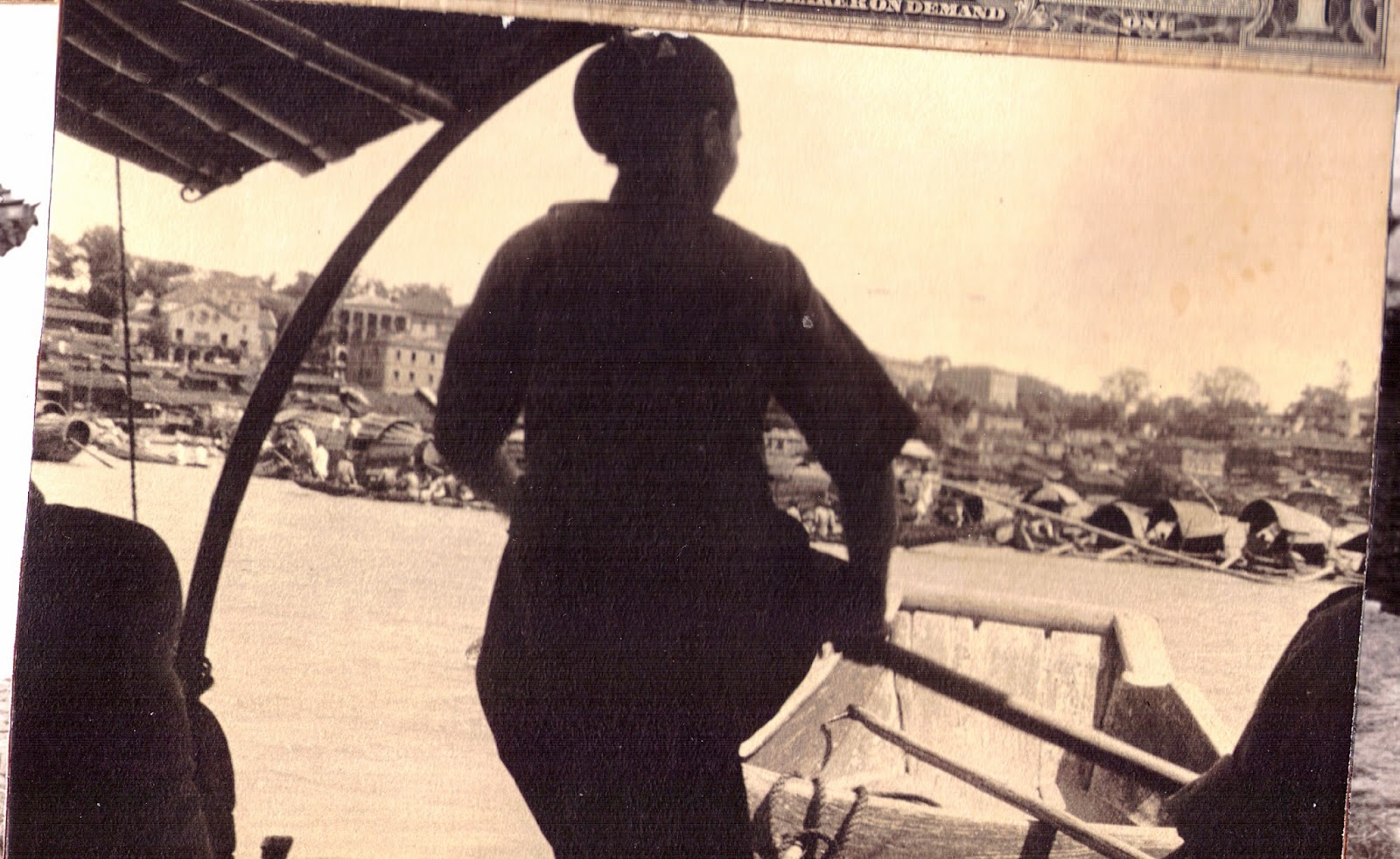
I wonder if this page shows us a transition from the first HQ, from earlier pages, to Kaifeng. See the masts of the houseboats - and that dome; what is it? - and those black blobs on the nearest houseboat.
This is as close-in as I can scan it. Things also become more clear just from straightening the picture. See the ripples on the water surface? Those blobs are ducks, black ducks: two on the house roof and one at the stern. You can see the blade of the oar that the woman is rowing, and the pole being worked by the man in the bow.
Two more houseboats are in the background. What is the dark blob seemingly attached to the rightmost houseboat? Maybe it is a gadget; maybe a person is holding a jar.
Some damage shows up in the enlargement, below.
Zdrojewski and Robichaud together. Frenchie taught Dad some French; I recall it now, and perhaps it explains why he would not let me spend senior year of high school in France as an exchange student.
Details of equipment show up, below, including dog tags, shoulder patch, wristwatch (which we still have), camera, something in his shirt pocket.
Here pops up on enlargement another fine view of the carbine an strap, watch, camera, bracelet. We have the strap and the jump bracelet. Now, who is the proud young man bottom right?
Who is he? How come he has no insignia? The pouch on his belt is stamped "U.S."
Notice what is behind him: a soldier in all the kit (Is it Dad?) on a Kansas mule or Chinese pony. Where are they and what is happening?
UPDATE 2023:
This is Major Wu Ping Lin.
He was on the JACKAL team for the bridges demolition.
I can find no citation for the front jacket image. Was it of the Yellow River Bridges Mission of August 9, 1945? Or was it of another mission, earlier in the summer?
Who took the photo? Pfc. Eugene Zdrojewski, Field Photo? Or Captain Zarembo? Or Frenchie? Or members of another Team?
This scan of the back jacket image shows guys under awnings in a boat. What is the location - perhaps Kaifeng, city of canals?
Francis Mills's Acknowledgements begin with the reason this book was written when it was:
Preparation of this book was started in 1985 when the CIA declassified many of the secret reports prepared by commanders of Special Operations teams of the Office of Strategic Services (OSS), with details about the guerrilla wars they conducted in mainland China against the Japanese Expeditionary Army during 1945 . .
Chinese place-names, common and proper nouns, and other terms that we run across at G&C are spelled in English in different ways, for example Peking/Beijing. John W. Brunner's Preface includes mention of the nineteenth-century Wade-Giles system of Romanized transcription of Mandarin to English:
At the time when the events in this book took place, the most prevalent practice was to use the Wade-Giles system . . . Because the pertinent documents and military maps of the period generally used this system, that is the system that will be used here.
We are doing that here, too, because we are looking at all this primary material. So far, the only place-name for which I routinely give two spellings is Sian/Xian.
The Introduction explains that Francis Mills was
. . . in charge of Special Operations in the large area of China north of the Yangtze River, extending north to . . . Peking. In this story he describes the operations in North China and also tells about the expansion of other guerrilla attacks in the southern half of the country that were so effective against the strong, clever, ruthless and barbaric Japanese Expeditionary Army during the last year of the war . . . the . . . Japanese Army of about one million men that had occupied and controlled the eastern area of China extending about 300 miles inland from the Pacific Ocean.
More detail is found in an online essay about the book; here are the first three paragraphs from that essay's "About the Author" section:
In 1943, as an Army Major in the Field Artillery, Frank Mills volunteered for overseas duty with the Office of Strategic Services (OSS). After training in Special Operations, he was ordered to London to join the combined Special Forces Command of British, French and Americans, to support Resistance efforts in Europe as part of the Allied invasion of France.
With OSS Special Forces Detachment 101, he landed in the D-Day Invasion with advance elements of the First Infantry Division on Omaha Beach. He coordinated French Resistance activities with the military operations of First Army as the Allied invasion forces went ashore and moved through France.
When the German forces had been driven out of France in late 1944, he was named OSS Chief of Special Operations for the Central Field Command in China. In that capacity he was in charge of all OSS guerrilla warfare against the Japanese Expeditionary Army in the area extending about 1,000 miles north from the Yangtze River and along the Yellow River. He remained at that command until September, 1945.
Did Francis Mills meet Albert Robichaud, our "Frenchie," in France? So far I've found no reference to that; we'll keep on the alert for clues. Next up: Chapter 1, The China Situation, Background for War.