Tuesday, April 2, 2013

1945 Kensington High School Yearbook, Part 3 of 3

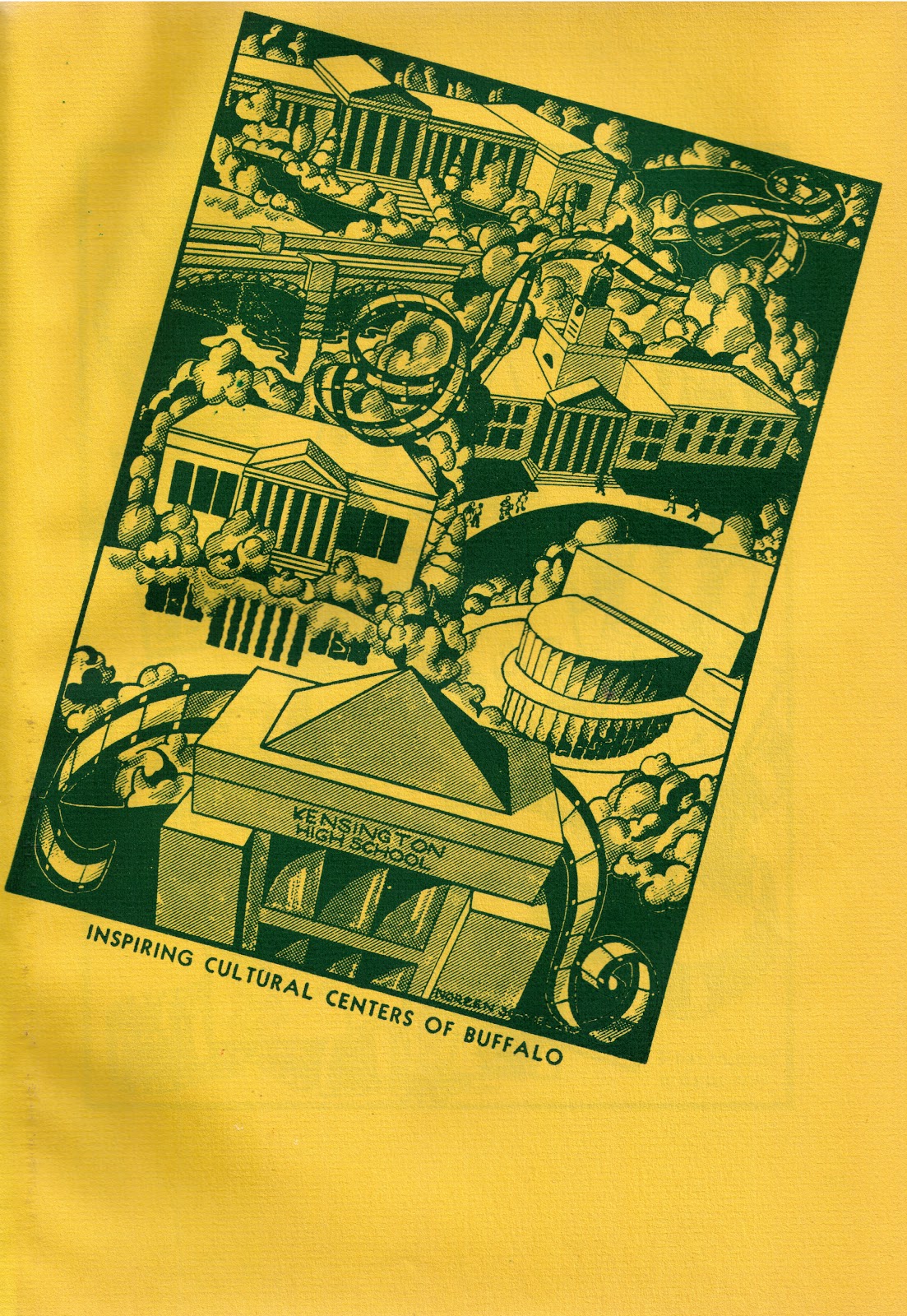
Student art continues the theme with representation of Buffalo cultural centers: Albright-Knox Art Gallery, the Buffalo Museum of Science, the Historical Society Building, and Kleinhans Music Hall.


Sophomore girls include Clara Matynka, back row, fifth from the right.


Click to enlarge.


Homeroom 106 went all-out with their purchased ad.


Monday, April 1, 2013

1945 Kensington High School Yearbook, Part 2 of 3

"As the war moves toward a successful conclusion, the editors of the Compass feel that it is an appropriate time to turn our attention to our own home city, Buffalo;  the city to which many of the Kensington boys now in foreign lands will soon be returning.  Our division pages will tell the story of Buffalo's part in the war and of our own aspirations to help create an even better city when peace has come.  Our artists have depicted the  commerce, industry, cultural and recreational centers, and all the assets that make Buffalo worthy of her title - Queen City of the Lakes."


"Buffalo's industries, pictured on the opposite page, are many and varied.  Some, notably shipping and flour-milling, are outstanding nationally.  Equally important are the small, privately-owned forms making everything from hair pins to nuts and bolts."

"But it is the airplane and steel-manufacturing plants that have played the greatest wartime role.  Kensington boys, who are now serving their country, must feel proud of Buffalo as the great planes from Curtiss and Bell join in the fight for freedom."


The Bell Aircraft Factory was part of Bell Aircraft, founded in 1935 by Lawrence D. Bell.


Glenn Curtiss founded Curtiss Aeroplane and Motor Company.  Here's one of their WWII-era planes, the SB2C Helldiver:


"The knowledge that Japan still resisted dimmed the horns and quieted the clamor of the gay celebrants.  Thousands of American fighting men still fought and died on Okinawa and the other approaches to Tokyo.  For them tthere was no V-Dayy.  There was only fighting and then more fighting."

"But there was hope for a final V-Day - a V-J Day . . ."


Sunday, March 31, 2013

1945 Kensington High School Yearbook, Part 1 of 3

Academic year 1944-45 drew to a close after V-E Day but while the War in the Pacific still raged.

The theme was the City of Buffalo, in which high-school students were graduating while many of the veterans were returning, at least temporarily.  It seemed that a land invasion of Japan would be necessary.


Featured in the City Seal are the Port of Buffalo with lighthouse; a sailing vessel such as transported grain or coal from the Midwest; a canal boat on the Erie Canal.  The Compass version of the Seal showed the mule team towing the canal boat.

Zdrojewski family tradition holds that Ludwig and Victoria landed at Ellis Island, took a train to Albany, then crossed the Empire State from east to west in a boat on the Erie Canal.  The first jobs the menfolk had were as stevedores, unloading the ships at the docks of the Port of Buffalo.


The flyleaf announces the artistic theme of the volume:  "A Film of Buffalo as Seen from the Air."
 

The endpapers illustrate scenes of Buffalo past, present, and presumed future, most from an aerial perspective, and garnished overall with strips of film.


Buck Rogers would have liked the futuristic Buffalo cityscape.


The film projector and the school building are joined artistically on the title page.


 I like this bookplate.  Mom should have inscribed her name there!  It has City Hall and a stack of books, some of which are done up in a bookstrap.


Imagery on the back cover recalls the Seal elements, the compass, the arrow, and military chevrons, all contributing to a civic result.


Tuesday, March 12, 2013

Witaj Królowo Nieba

"Hail, Queen of Heaven" is an old Polish hymn, traditionally sung at the graveside.  The singers ask Mary, Queen of Heaven, to intercede with her Son on behalf of the deceased, to hasten his admission to Heaven.  The simple melody sounds exactly like the voice and the tones of a child, a well-behaved and serious, loving and beloved child, asking his mother for favor and blessing for an important and worthy purpose.  The lyric conveys that request in simple, reverent, serious, yet confident phrases.

John Zdrojewski, our JFZ, gave a moving eulogy at the funeral of his brother Eugene, our EJZ, and one thing he mentioned was "Witaj Królowo Nieba."  This hymn the Zdrojewski sons, each in his turn, sang at funerals when they were altar boys at St. Luke's, wearing their robes, swinging the censer, accompanying the priest, and moving those present to tears.

This is Eugene's Polish hymnal, which is all new to me.  John has one, too, he tells me; everybody at St. Luke's had one.


"śpiewać" is "to sing;"   (similar to "spiel" and calling to mind our phrase "Don't give me that song and dance!")

"śpiewnik" is "songbook;"

"śpiewnik koscielny" is "songbook for church," hence "hymnal;"

"wielbij duszo moja pana śpiewnik koscielny"  can be rendered as a title and subtitle: 

"My Soul Glorifies my Lord - Sacred Songbook."


The volume format seems more intended for an organist than a chorister, and not too many lyrics are given.  So choristers would perhaps use this to learn a hymn for performance from memory.


 "Nihil obstat" proclaims the censor liborum: "Nothing stands in the way."  No doctrinal error stands in the way of use of this work by the faithful.

"Imprimatur," third-person singular present passive subjunctive of imprimo, print.
Hence, "It may be printed."


"Pieśni za Dusze Zmarłych" -  "Songs for the Souls of the Dead."


You see it just gives four bars, for which I do not know the proper names.  But they are an introductory phrase, the melody line with little lyric-phrasing marks, a long "Amen" phrase, and a final chord.


 Click to enlarge.


The Polish-American Liturgical Center at Orchard Lake Seminary (yes, our Orchard Lake) maintains a collection of these hymns.  Here are their lyrics for "Witaj Królowo Nieba."

Witaj Królowo nieba i Matko litości,
Witaj nadziejo nasza, w smutku i żałości!
K'Tobie wygnańcy Ewy wołamy, synowie,
K'Tobie wzdychamy płacząc z padołu, więźniowie.
Orędowniczko nasza, racz swe litościwe,
Oczy spuścić na nasze serca żałośliwe.
I owoc błogosławion żywota Twojego
Racz pokazać po zejściu z świata mizernego.
O łaskawa, pobożna, o święta Maryja,
Niechaj będą zbawieni wszyscy grzesznicy i ja.
O Jezu, niech po śmierci Ciebie oglądamy,
O Maryjo, uproś nam, czego pożądamy.
Uproś nam żywot wieczny, grzechów odpuszczenie,
A przy śmierci skon lekki i duszy zbawienie.
O Jezu, Jezu, Jezu, Jezu mój kochany,
Jezu wielkiej dobroci nigdy nie przebrany.
Źródło: Śpiewnik Stulecia Orchard Lake

This translation is offered here, where you can listen to a priest singing this hymn on an All Soul's Day at St. Casimir's Oratory in Buffalo.

Hail our Queen of Heaven and Mother of Mercy,
Hail our hope in sorrow and all adversity.
We, the banished sons of Eve, are calling out to Thee,
Sighing and weeping in this prison valley.
O our Mediatrix, direct Thy gaze so merciful
Upon our hearts unworthy, ever so pitiful.
Deign to show us Thy womb’s fruit
Glorious and most blessed,
When it’s time we leave this world
Miserable and wretched.
Hail Mary full of grace, piety and devotion
Let all sinners, me amongst them, obtain our salvation.


Julie

Sunday, February 17, 2013

Public Health Study, circa 1944

As a high-school freshman in Buffalo, Clara Matynka studied science; we have seen some of her notes here and also here.  The infectious disease portion of her class notes includes mention of viruses and viral disease.

Click to enlarge.  "Causes of Disease"
and "Prevention and Control of Epidemics"


"Viruses; germs too small to be filtered or seen thru a microscope."
"1. Smallpox (contact)
2. Infantile paralysis."

Smallpox disease was yet extant in the US in the 1940s, even though vaccination with vaccinia virus vaccine had been available since the mid-19th century.

It was not until the early 1970s that routine vaccination of schoolchildren was discontinued, when the rate of natural disease had, through vaccination over time, been driven lower than the rate of serious side effects to vaccinia virus vaccine.

It was not until 1979 that smallpox virus was eradicated from nature.

I was in third grade, about 9 years old, when I was vaccinated.  Don't know about Mom. At any rate, her class notes include the Health Department flyer describing aftercare following vaccination.


Clean, dry, exposed to air, not scratched.
Supposedly it takes 2 or 3 weeks to progress
through the stages of red spot, blister, drainage, and scab.
I remember none of that from my own vaccination;
perhaps the vaccine was more attenuated by the 1960s.


I wonder if in school they read the Kipling story, The Tomb of his Ancestors, in which the British officer in India is sent to the far-off wildest tribe to enforce the vaccination program.  He succeeds by means of diplomacy, sales pitch, and by - well, no, I won't spoil the surprise.

"Catch that girl and bring her to me. . . She will not come? Then she shall be shamed by her little brother, a fat boy, a bold boy.  He puts out his arm like a soldier.  Look!  He does not flinch at the blood.  Some day he shall be in my regiment.  And now, mother of many, we will lightly touch thee, for Smallpox has been before us here.  It is a true thing, indeed, that this charm breaks the power of Mata.  There will be no more pitted faces among the Satpuras, and so ye can ask many cows for each maid to be wed."


The notes include as well this flyer, concerning prevention of the spread of communicable diseases generally.  The danger was more than of colds or influenza.  There was no polio vaccine, or diphtheria vaccine, until the 1950s.

Notice how this alert, to be taken home to students' families,
consisted of words and sentences,
which had to be read, and since they were well-written,
could be understood.
Nobody had to stare at ugly cartoons
and try to guess what they meant.

Sorry to have interrupted blogging recently.  I have a new computer now.

Julie

Tuesday, January 29, 2013

Zdro Films II, Disc 1, Scene 3: Masses and Processions

John F. Zdrojewski made home movies, many of which have come down to us and been transferred to DVD format.  His great-grandson Tye Zdrojewski has put some up on YouTube for us, the first two such being listed on the right sidebar in the "Links" section.

This third segment is all Masses and processions.  I cued my questions originally to the time marker on the DVD; now I'll enter a few additional time markers from the standalone YouTube video.


JFZ's typewritten label on the inside of the film can says this:

"-Documentary-
Eucharistic Congress-War Memorial
Auditorium-Procession of Bishops
Clergy and various church groups and societies.
Jubilee Mass of Rev. F. Wlodarczak."


(27:30) Mass in a stadium in Buffalo:  Why does the celebrant change his vestments, as at YouTube 2:55?  Is Mass concluded and is he putting his outerwear (red) back on?

YouTube 4:09 shows a row of honor guards wearing wonderful hats with white plumes.  They have swords. Who are they?

(Approximately 31:53)  Is that JFZ being an altar boy??   Or do we just have more relatives than I thought we had?

(32:11) Who are those dignitaries in top hats getting off the bus?   Are they Knights of Columbus?

(32:16) The ladies in white, with blue capes:  who are they?  Can anyone read the yellow stop-sign the leader carries?  Mary's blue mantle, I get that.  (At Annunciation Parish in the 1960s, the nuns tried to get the mothers to agree to dress all the girls in my FHC class all alike, and that way.  Guess, just guess, who scotched that plan?)

(33:15) At YouTube 5:34 it looks like a stadium at night with the people holding flashlights.  So - the Congress kept on congressing past nightfall?

So who was Father Wlodarczak, mentioned on the typewritten card at YouTube 5:52?

At YouTube 6:00 you can see the physical setup for Mass, such as was used for about 1,960 years.  The congregation and the priest face the same way, and the focal point is the Tabernacle.  I remember the day in the mid-sixties, while Vatican II was doing its thing, when we walked into church one Sunday morning to find the altar turned around.  The priest was behind the altar, facing the congregation.  So he had his back to the Tabernacle, or maybe the Tabernacle was shoved off to the sidelines.

Pretty soon they were pulling out the kumbaya guitars and the bongo drums, and our beautiful Liturgy was to be heard no more.

All these offenses and absurdities were a powerful accelerant to the emptying out of the churches in that and subsequent decades.

After everything went to hell in the sixties  After "Vatican II,"  my Dad bought a big beautiful Tridentine Missal, such as the priest used to use while celebrating Mass. It was as if Dad had rescued and brought home a beautiful sheep that the shepherds had tossed into a roadside ditch. I have it upstairs.

(35:40)  Okay!  Father Fimowicz gives the sermon!  But which one is he?  My Dad mentioned him all the time; he was his parish priest at St. Luke's when Dad was young.  And he must have been Father Tomiak's superior.  The only story I remember about Father Fimowicz, though, is about him regularly, all winter, taking off his shoes and socks at the Rectory door, and trotting around the block in the snow, lifting up his cassock so that it would not get wet.  He explained to my Dad that this was good for the circulation. 

Who is the smiling happy man doffing his hat to the camera at the door of the rectory?  Wlodarczak? or Fimowicz?

That is too quick of a pan of St. Luke's, at the end there.  Considering how the physical church of his childhood, as well as the Liturgy of his life, were abandoned, can there be any question why my Dad felt such desolate loss in the last decades of his life?


Julie


Sunday, January 27, 2013

Physical Science Studies, circa 1944

If someone challenged you to come up with a demonstration of the 20-odd per cent proportion of oxygen in Earth air, could you do it?  

I'd fail.  Fortunately a little refresher course has shown up in the CAMZ class notes from Kensington High freshman science class.

"Some iron filings  were placed in a test tube
which was inverted in a dish of water.
The original level of the water was noted.
The apparatus stood for several days.."


Hold it right there.  See the illustration, below?  How are the iron filings being made to stick to the inside bottom of the test tube?  Spit?


Okay, I can't do a demo; how about understanding some practical application, such as a household hot-water system from that era?


At left, the lovely coil (great shading!)
is being heated via piped natural gas, yes?

The tank on the right has convection currents going.


So far, so good.  But what's this "coil in range," at the far right?  The kitchen stove was used as a parallel heat source. Therefore that tall convection tank had to be sitting in the kitchen.  I've never seen any setup of that kind.  Can someone send in a photo of such a system in place?

And what kinds of stoves burning what sorts of fuel were used in these systems: wood, coal, natural gas, electricity?

When did modern hot-water heaters, gas or electric, become available and replace these systems?


I'm going read up on demos by hunting up my copy of Michael Faraday's Royal Institution Christmas Lectures from a hundred years previous to this.  Or did I give that wonderful volume away to some offspring?  


Michael Faraday set the standard for scientific demonstration.


Friday, January 25, 2013

Specific Gravity Study, circa 1944

Clara Matynka, our CAMZ, saved her science class notes.
My guess is Kensington High freshman, 1944.


Brass weights are admittedly not as accurate, or as precise,
as modern scales with digital readouts to umpteen decimal places.
They did have the advantage, however,
of requiring physical contact by the student
with physical reality: masses that have, you know, weight.
And the student could see with her own eyes
how the balance worked.
I think this kind of directly-comprehensible
and directly-sensed equipment
should be retained in the mix
in all teaching labs.