Saturday, March 8, 2014

OSS CBI Photobook 2

Page 2
Army Specialized Training Program,
University of Chicago
c1943-44

So last night I remembered Dad telling a story about "being in the Army" and "going for an interview" as part of his attempt to influence what he would do next.  This could have been going into Basic, or coming out of Basic; maybe some papers in the New Trove will pin that down.


Page 2, top half, scan.

Dad said that interviewer asked this and that: High School?  Yes.  College? Two years in a liberal arts program.  Languages?  English, Polish, Latin, French.  Blah, blah; bye-bye.  Then as he was leaving the interview room, he suddenly turned back and said, "Oh, yes! I can take pictures!  I have a lot of experience in photography."

Dad indicated that he always thought that was the moment when the "OSS" lightbulb went on in the interviewer's head.

EJZ supported by colleague.


Faculty and students in the Japaese-language class.  Click to enlarge.
EJZ second row, second from left.
Favorite language teacher, third row, fifth from the right, close to the Brass.

EJZ.  Photographer has trouble with focus.


Favorite teacher stands between Brass and Fedora.


See the ASTP patch on the left shoulder of EJZ's field jacket?
We do not have the field jacket or the hat, but we do have the patch.
See OSS CBI Photobook 1.


Page 2, bottom half, scan.


Someone somewhere could very likely identify these faculty.
Fave teacher is back row, first on right.


They had a lot of class time, then a lot of athletic training, then a lot of military training.
They were on active duty, in uniform, all the time.
Dad looks like he's been studying too hard here.
In the photo up left, who is standing by the truck?
What is shown in that map?  Anybody recognize it?
Then a nice radio, a nice bookshelf, photos of buddies in uniform,
then a photo of lovely ladies on some beach.


Friday, March 7, 2014

Stained Glass, Argyle


OSS CBI Photobook 1

Eugene Zdrojewski put together this scrapbook of his Army service, including many prints, some patches, and some cuttings.  We saw mention of it in a church bulletin of April, 1947, discussed in a recent post.

This book was kept on the coffee table in the living room of the Marilla house, and we looked at it, but did not talk over the details very much.  The items in the New Trove will supply dates, people, and places; for now, I am going to concentrate on posting these photos and scans.  Any help in identification of the locales in these photos would be very much appreciated.  Click on "Comments" at the bottom of the relevant post.

Front cover.


Front endpaper.

Photo portrait of fisherman, from front endpaper.
Net, stick, backpack, pipe.
Black watchcap.


Page 1.
OSS language school, University of Chicago.

Page 1, scan of top half.

Page 1, top half, detail.
Flag with "A.S.T." then probably "P."

Bingo! The Army Specialized Training Program, established after Pearl Harbor,  "a military training program instituted by the United States Army during World War II at a number of American universities to meet wartime demands for junior officers and soldiers with technical skills. The purpose of the program was 'to provide the continuous and accelerated flow of high grade technicians and specialists needed by the Army.'"


Page 1, bottom half.

Page 1, bottom half, detail.

Page 1, bottom half, detail.

A.S.T.P. patch.
EJZ's is glued onto a later page in the Photobook.
The lamp of learning; the sword of the warrior.

Julie

Thursday, March 6, 2014

Headgear and Other Mysteries

John has straightened me out about Fr. Tomiak's hat, and indeed all clerical hats.


"This is a biretta. The clerical rank is shown by the color of the hat and the color of the pom ("pom-pom") on top: 

priest: black with black pom
monsignor: black with red pom
bishop: amaranth with purple pom
cardinal: scarlet with no pom
pope: no biretta used but the more ancient camauro instead

So, he has the head covering of a priest.
John"

Amazing.  Apparently, "amaranth" is really hot pink.  "Camauro" derives as does "camel."  So -

A historical Pope, Clement XIV, wearing a camauro.

Uh-huh.

There's an old church in Buffalo named "Church of St. John Kanty."  Its (fairly new) rose window is radiant; check out Jan Kanty's hat:


Apparently the 14th-century mode was black-no-pom. There he is, clothing the poor.

Why are the "rose" petals of the window arrangement shaped like mummies? Why did they name a fast, sporty car a "Camaro"?  Sounds silly now. The mysteries never end.

Dziękuję wujku!  Julianna

Good-bye, Old Paint

We learned about the c1941Ford coupe convertible in a Casimir at Kanty post, and, in relation to a similar vehicle, in the 1946 picnic post.  To me it's intriguing, as Marty and I never heard anything about this "old Ford," so it's almost like finding a long-lost relative.  

Emotions rise logarithmically when I recall my own first car, a 1968 Mustang, which I sure wish I had now!  I sold it because as a poor college student I could not afford to replace the "throwout bearing," whatever that is.  It might as well have been the canooter valve, for all I could then afford to replace it.  Painful recollection.


From the New Trove:


From the last PYC Monthly in our collection:


The final paragraph of the "Just Between Us" feature refers to a certain car:

          "We shall all rise now, in a minute of silent prayer, and mourn the departure of a faithful friend.  It was indeed a friend in great need and a veteran of many engagements, struggling through thick and "tin" (that's what it was made of).  So long, old Ford."


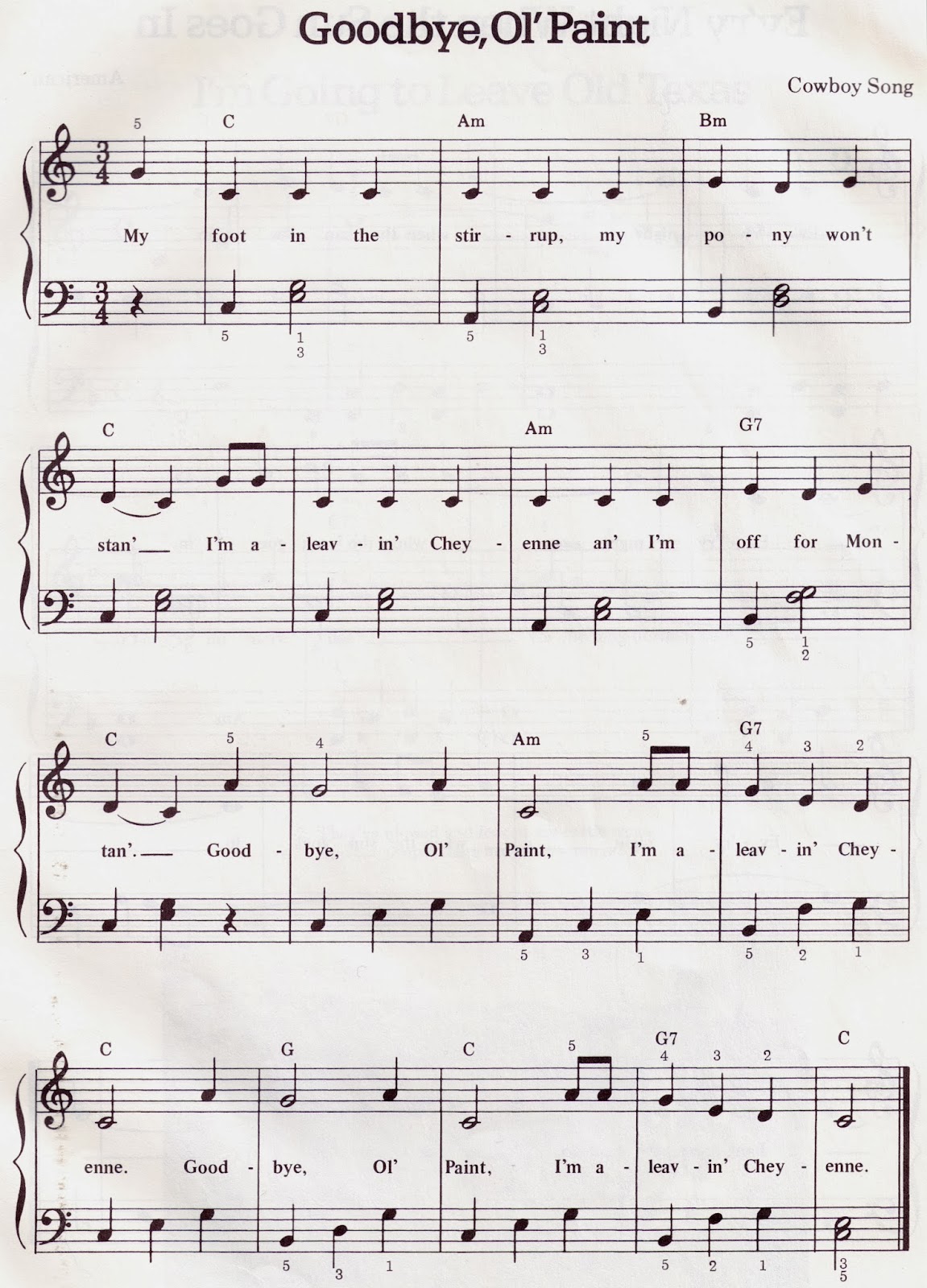
I'm a-leavin' Cheyenne, I'm off to Montan'.
Goodbye, old Paint, I'm a-leavin' Cheyenne.

          Goodbye, old Paint, I'm a leavin' Cheyenne.
          Goodbye, old Paint, I'm a leavin' Cheyenne.

Old Paint's a good pony, he'll pace when he can,

Goodbye, old Paint, I'm a-leavin' Cheyenne;

And seat yourself by me as long as you may.
Go hitch up your hosses and give them some hay

My hosses ain't hungry, they won't eat your hay
My wagon is loaded and rolling away.

My foot's in the stirrup, the reins in my hand,
Good mornin', young lady, my hosses won't stand.


Monday, March 3, 2014

PYC Monthly, April 6, 1947 - Lots Going On

This beautifully preserved eight-page glossy Parish Youth Council Monthly is the last of the collection of St. Luke's youth publications saved by Clara Zdrojewski and now in the Argyle Family Historical Society Collections.  A couple more posts, and it will go into a carton to be called "full" and also "dealth with."

Then you are going to have to come visit me if you want it opened up again.

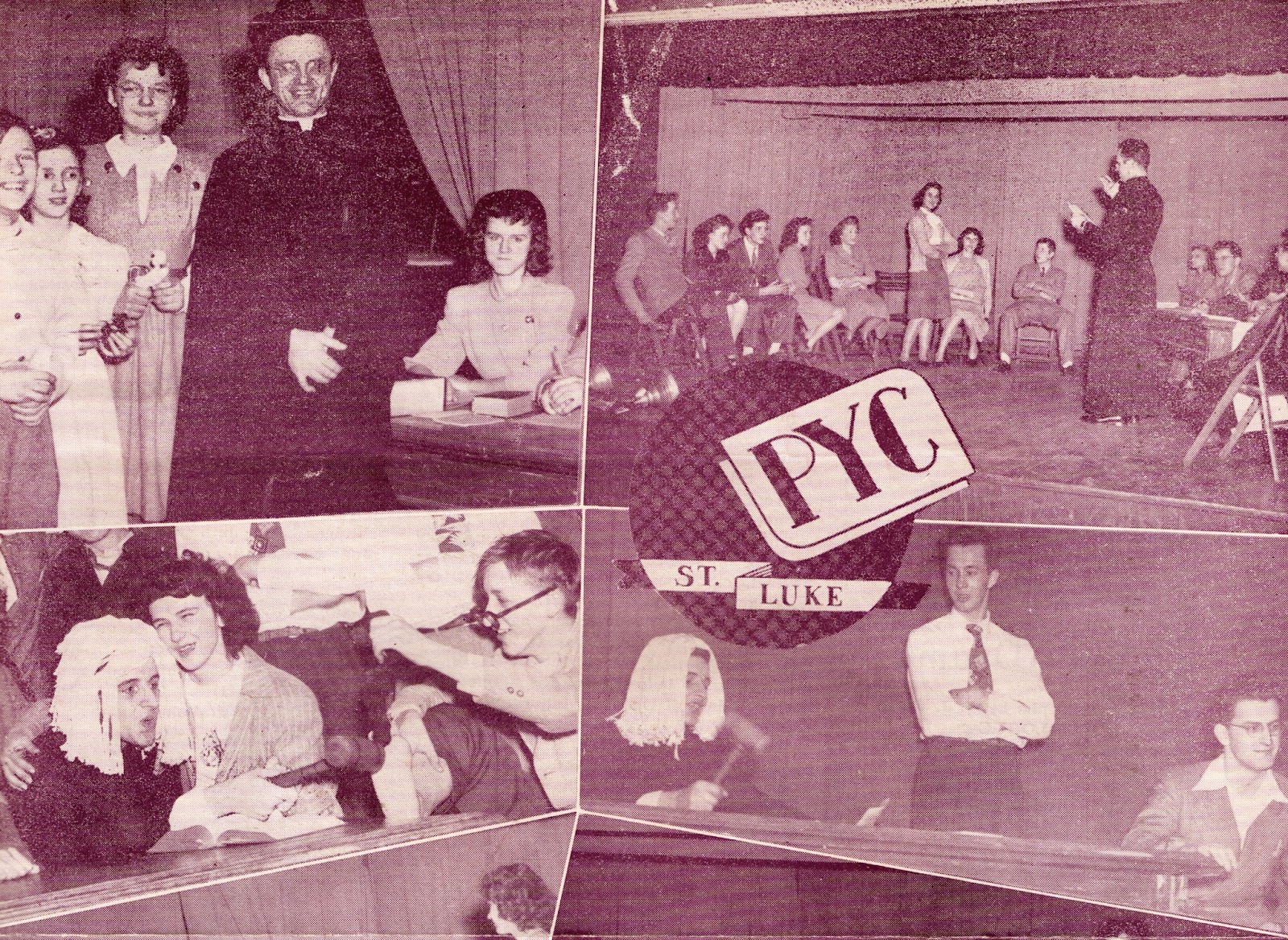
This style of photomontage
was evidently quite popular.
Pages are 9" x 12".

Isn't that a Monsignor-hat that Father Tomiak is wearing?
He is acting as quiz-show interlocutor at top.
Moot court appears in session below; Gene's in the dock.


Click to enlarge.
Several in-jokes here surely originating in
Norman and  Zdrojewski.


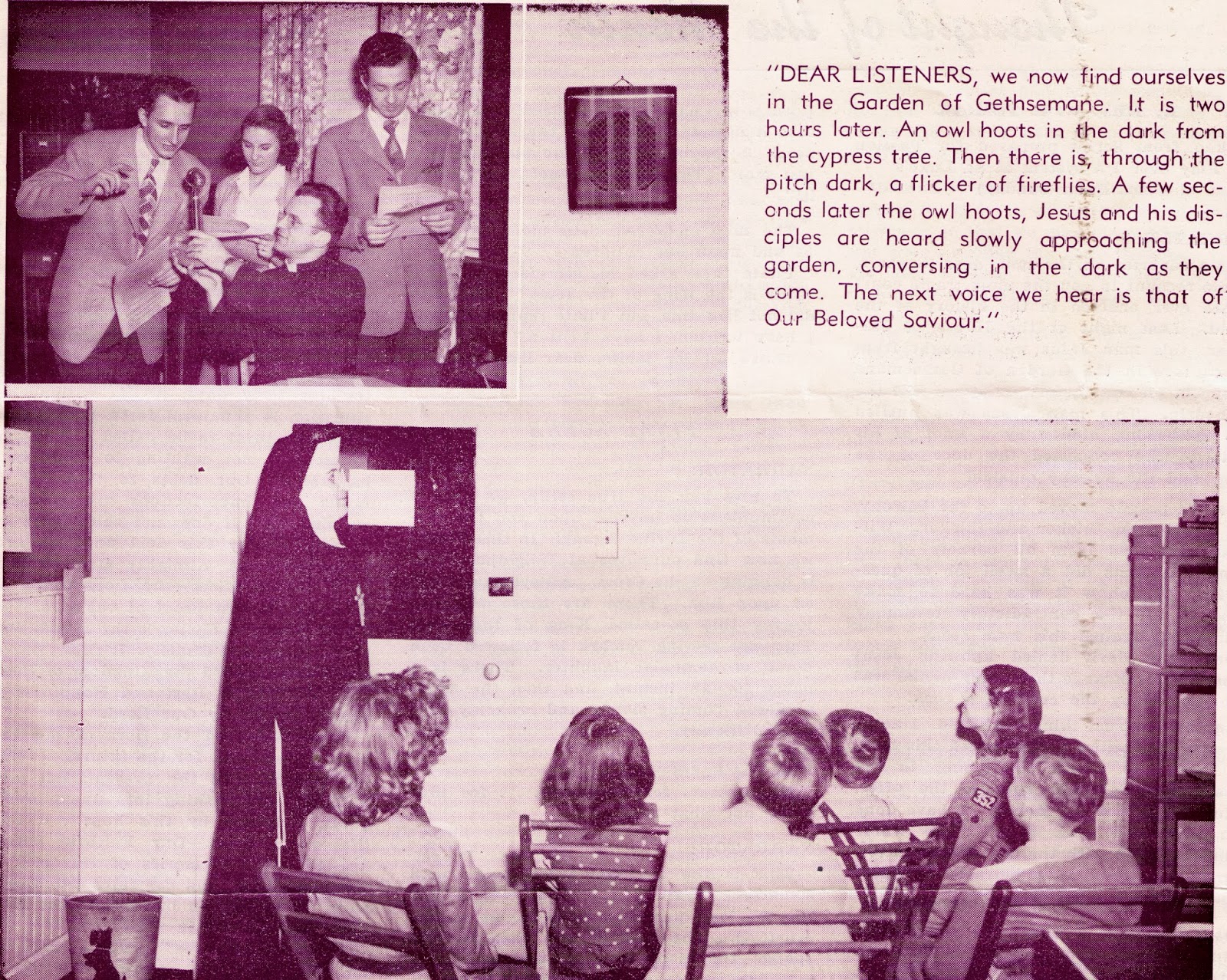
Here we go again with combination electronics
in cabinetry - this time for a raffle.

Gene Norman, at top left, speaks into the microphone.
They're doing a dramatization of the Garden of Gethsemane scene.
Passion Play, upgraded from medieval town square or hillside
to a Sunday-School public-address system!
See the speaker set into the classroom wall?


Bottom Center:
Appreciation:  Many thanks to Father Tomiak for showing
the pictures of scouting, camping, St. Anne de Beaupre
and other scenes.  Also appreciation to Mr. Eugene
Zdrojewski for allowing the children to see the pictures
taken in India and China.  Naturally, we extend same to
Sister Tarsilia for running the films for us.

 These "pictures taken in India and China" may refer, in part,to the 16mm color film that Gene brought back, and certainly refer to the scrapbook full of prints:


U Chicago, OSS training school.

Into southwest China.

The pages measure 10" x 14".  I can without damaging the book undo the binding, take the pages out, scan top and bottom halves in my own scanner, and rebind the book. Such scanned images would be a little larger than the photos.  Then I would put up those scanned images plus the whole page photos, like the two above.

Now tell me, is that going to be good enough?

Or do I take the book to Ithaca sometime and use a University scanner with a bigger flatbed?  That would take longer. There are about 40 pages.

Julie


Sunday, March 2, 2014

Conturbare Cave

"Conturbare cave,
Non est placare suave.

Diffamare cave,
nam revocare grave."


This was the personal motto of John Cantius; he wrote it on the wall of his cell, and tried to govern himself by it.  Let's  see:

"Of aggressive contention* beware,
It is not sweetly pleasing."

        (*wrangling; obnoxious, quarrelsome arguing; the tiresome go-round)

"Of defamation beware"   (Hence "Avoid defamatory remarks.")
since revoking them is gravely difficult."


Apparently, he contributed to the eventual development of Newtonian mechanics in physics, by studying and teaching the "Theory of Impetus" of Jean Buridan, making the road smooth for Copernicus a little later.

This is in addition to his religious study, pastoral work, unofficial Justice of the Peace for the peasants round about, and advisor on agricultural matters.

In this painting, for which I can find no provenance, he is shown in Krakow, with St. Mary's in the background, consoling a lass with a broken water vessel.  Is that a basket of laundry in the background? Is this really about washday, or all a metaphor for sin, contrition, and redemption?


We'll never know.  But I do know that compared to this paragon, I have been wasting my time.

Julie

Saturday, March 1, 2014

Posting Updated

There's an update on the previous post, incorporating Kotwas family data John sent.  To see the corrected version, Wedding and Graduation Season, 1946? - Updated and Corrected with Kotwas Family Members, is up on Gene and Clara's.

Dziękuję, Janek

Julianna