Thursday, April 24, 2014

OSS CBI Photobook 6

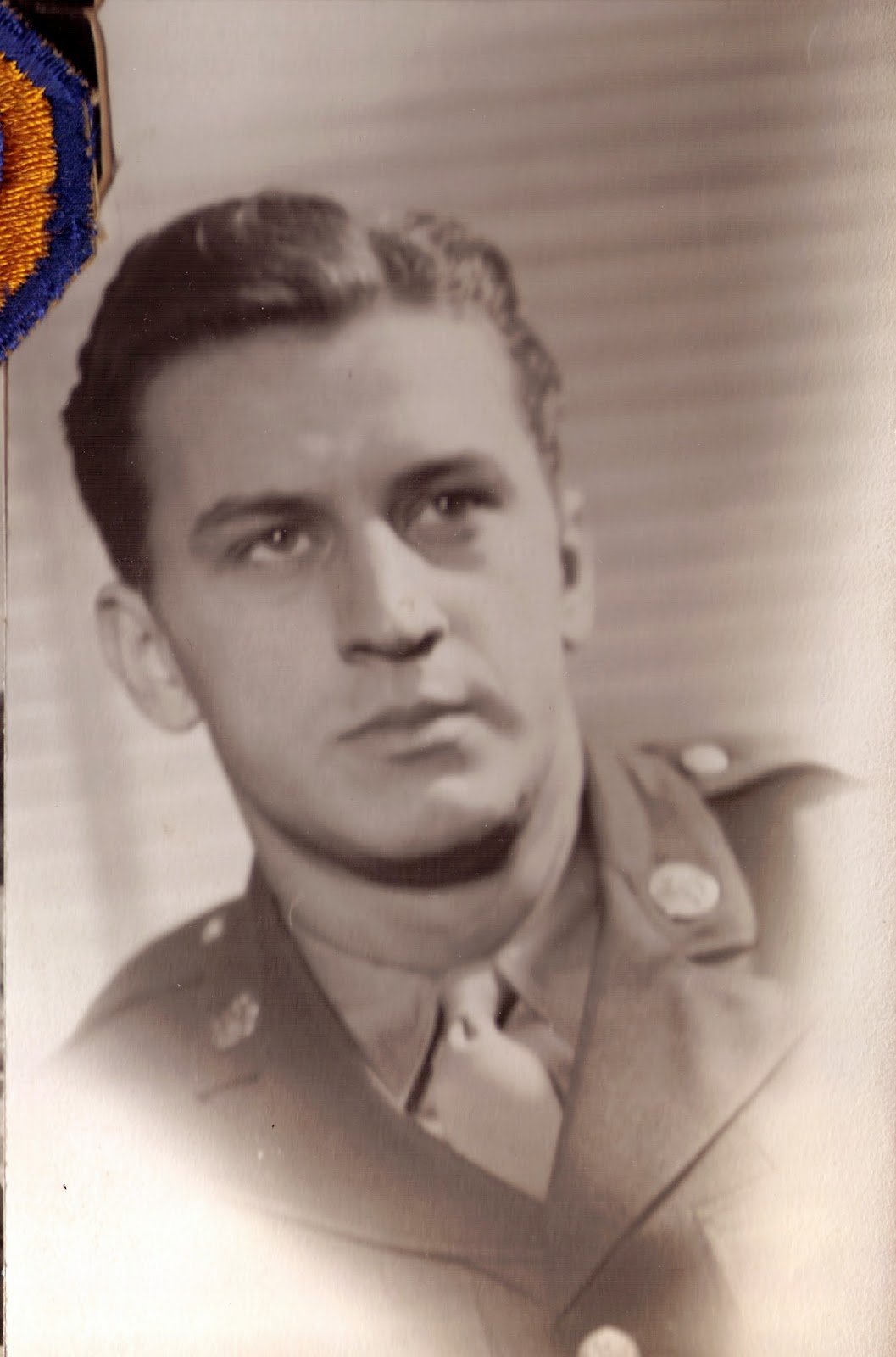
Gene pasted his A.S.T.P. patch
onto the page with the photomontage.


Photobook Page 6, scan of top half

Even having tried with both hands, I have failed
to figure out how this shot was set up,
except that it must include a mirror and a tripod.


Always messing with lighting,
flash units, timer, exposure -
both JPZ and EJZ
were enamored of the
technical aspects
of portrait photography.


Photobook, page 5, scan of bottom half


How do you create those ghostly fade-outs,
or whatever they are properly called,
in the margins?

Wednesday, April 23, 2014

Chicago Buddy Ralph Sebastian


"Ralph Sebastian
1345 Whatley Avenue
(Westville)
New Haven, Connecticut"


"Lots of luck Gene,
Sincerely, Ralph Sebastian"

The shoulder patch perhaps is A.S.T.P.

Julie

Tuesday, April 22, 2014

Army Buddy - Pfc. Arthur E. Kwapich

This photo was in the folder of Army papers
in the New Trove.

Does that look like Kentucky to you?

Maybe he was a friend from St. Luke's or from Orchard Lake
and mailed this photo to Gene at Fort Benning or U Chicago.

"14th Armored Div.
2nd Army
Camp Campbell, Ky."

The 14th Armored Division of the United States Army raced across France and Germany, fighting Panzers and liberating POW camps, forced-labor camps, and concentration camps.

What happened to Arthur Kwapich?


Julie

Monday, April 21, 2014

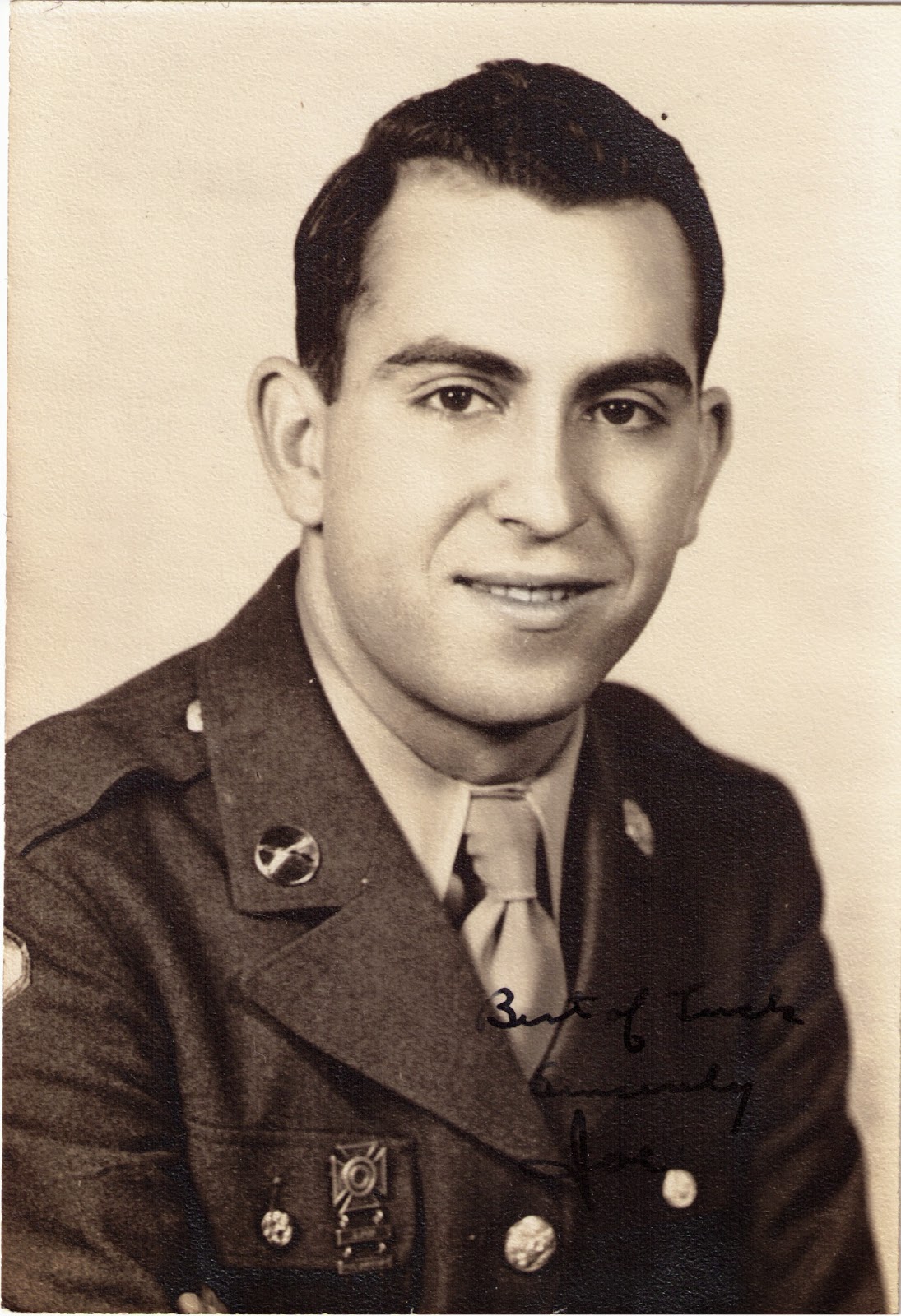
Chicago Buddy Joseph R. Messina

The New Trove included a framed photo of John Peter Zdrojewski,
framed exactly the same as the photo of Julia Zdrojewska
which was already here.

In the Army folder were photos of three buddies.

At right is Joseph R. Messina.
We know nothing about him.
We would like to.


He has two bars or clasps appended to his
Marksmanship medal.


". . . Studio, 203 No. Wabash Ave., Chicago, IL."

"172 Ocean Ave,.
South Beach, Staten Island, Zone 5
New York, N.Y."


Julie

Monday, April 14, 2014

OSS CBI Photobook 5

 Our detour back in time to review Basic Training being over, we resume our cruise through the four months in 1944-45 at the University of Chicago.  Our EJZ was a member of an A.S.T.P. class studying Japanese language.

This is Page 5 of the photobook
which we did know about as kids in Marilla.
The book was on a table in the living room.

Page 5, top half.

Those hats are called "garrison caps."
Gene has his tucked into his belt.

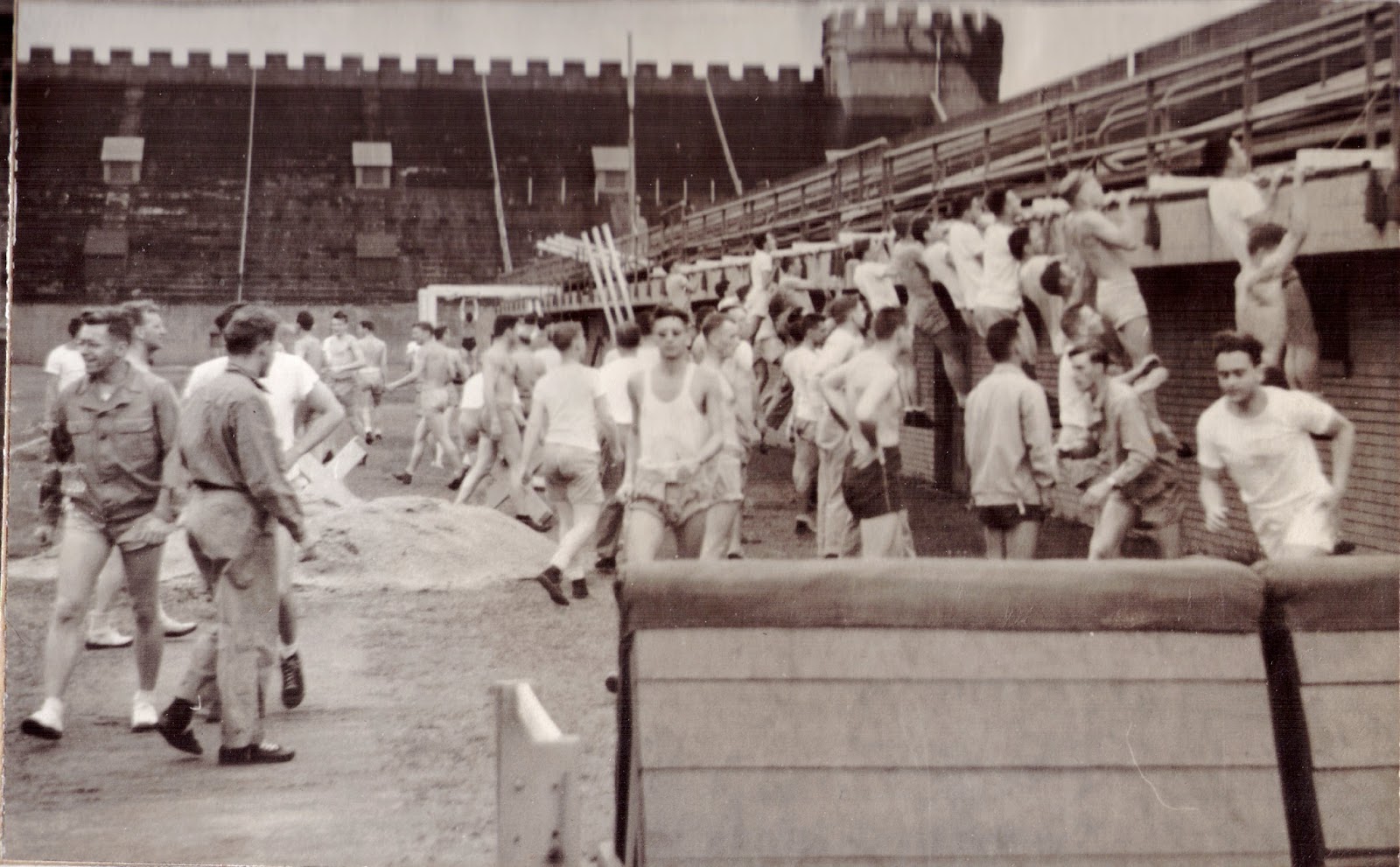
Page 5, bottom half.

Gene is second from right.
What happened to all these guys?

Mass pull-ups.
What's the thing in the foreground
that looks like a doghouse roof?


Julie


Sunday, April 13, 2014

Dog Tag


These things are part of the New Trove
that Marty rescued from obscurity
under the attic eaves of the Marilla house.

The folder held the papers we have seen, in previous posts,
from Basic Training at Fort Benning, Georgia.
The belt wallet held insignia and medals.
The little waterproof duffel had maps of Chinese terrain,
and related items, which we will get to
when we finish with the Chicago photos.

We never saw these things.  We did see the photo-scrapbook,
but the rest we did not even know about.
Now it's all collated and chronological and we study.


There was a black metal footlocker up in the attic, always.
Maybe this is the key to it.


Having consulted pages 104-105 of Finding Your Father's War Revised Edition:: A Practical Guide to Researching and Understanding Service in the World War II US Army, I'm pretty confident that, for example, line 2 consists of the following:

First: "42021053," Army Serial Number;

Second: "T43," the date of the first tetanus inoculation, hence the year of induction;

Third: "44," the date of the latest tetanus booster;

Fourth: "B," the soldier's blood type.

Also, on line 5, way over on the right, is stamped a lonely-looking letter.  It is "C," for Catholic.

The notch in the metal on the left side was to hold the tag properly in the stamping equipment.

Julie

Friday, April 11, 2014

Kodachrome, 1940s


A final item has emerged from the EJZ Army folder.


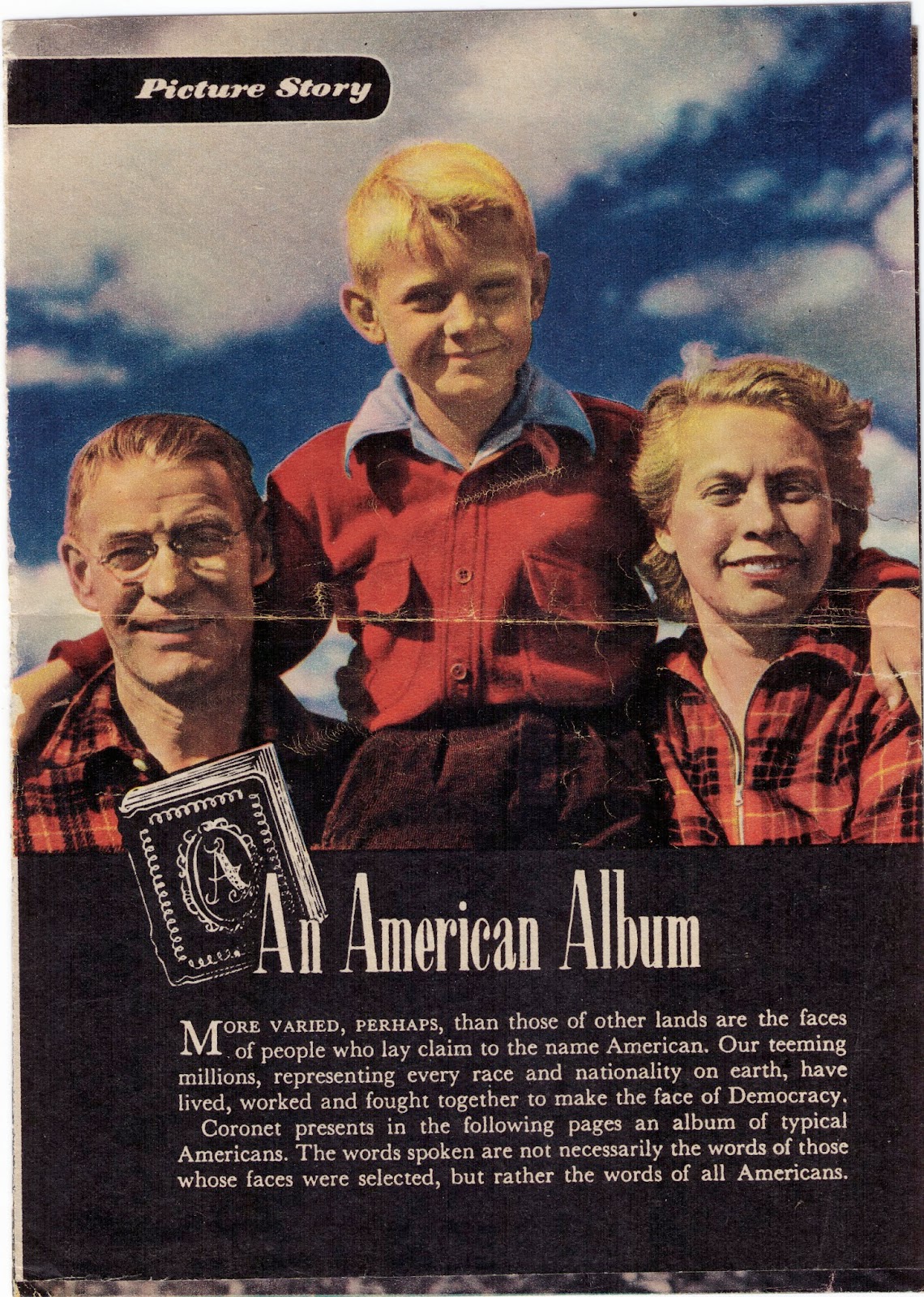
Eugene kept these seven pages from a Coronet magazine.

The photoessay starts off with "More varied, perhaps, than those of other lands are the faces of people who  lay claim to the name American."  From the perspective of our day, the faces in the series immediately strike us as less varied than what we expect, obviously.  But from the perspective of that time, it was a proud showing-off of American ethnic diversity.  Progress was incremental, and painful sometimes, but in 1943, racial and ethnic tolerance here was in very stark contrast to the situation in Europe. 


Just the other day I was reading a description of Nazi environmentalism - hey, doesn't everybody do that on Tuesdays? -  referring to their establishment of the first nature preserve in Europe, for example.  They did worship their "Sacred German Forest."  And in 1944-45 they were appalled at American black soldiers "desecrating" that forest with their presence.  Fortunately, the American black soldiers had plenty of ammo.


We would expect our EJZ, with his lifelong interest and family background in portrait photography, to have kept up with the latest technical developments.  Well, apparently, Kodachrome was brought onto the market in 1935:
". . . American Kodak introduced the first modern "integral tripack" color film and called it Kodachrome, a name recycled from an earlier and completely different two-color process. Its development was led by the improbable team of Leopold Mannes and Leopold Godowsky, Jr. (nicknamed "Man" and "God"), two highly regarded classical musicians who had started tinkering with color photographic processes and ended up working with the Kodak Research Laboratories. Kodachrome had three layers of emulsion coated on a single base, each layer recording one of the three additive primaries, red, green, and blue. . . "

"In 1941, Kodak made it possible to order prints from Kodachrome slides. The print "paper" was actually a white plastic coated with a multilayer emulsion similar to that on the film. These were the first commercially available color prints created by thechromogenic dye coupler method. In the following year, Kodacolor film was introduced. Unlike Kodachrome, it was designed to be processed into a negative image which showed not only light and dark reversed but also complementary colors. The use of such a negative for making prints on paper simplified the processing of the prints, reducing their cost."


Julie