Wednesday, February 22, 2012

Poznan Zdrojewskis: From the Old Country, Part 5

1970:  Sabina, son or son-in-law, mother, father.  Matka has a corsage and Ojciec has a boutonnier.

I'm so bad at recognizing the letters in this European script that I can only transliterate part of it.  Somebody help me.  You can go to Google translate and do organized iterations of spelling, as if you were deciphering a code in order to save the world.

"50-cio lecia . . . Jubilaci . . .Posnan', du. 12 csence 1970r."


"50th anniversary . . . celebration . . .Poznan', on (June?) 12, 1970."

"Czerwiec" is "June," so I can't say what this "csence" is.  But I'm guessing June, for two reasons.  First, most people get married in June.  Second, Wikipedia has a wonderful chart in the article entitled "Polish Months," and that's the closest one in spelling.


So they were celebrating their 50th wedding anniversary.

"od Wujostwa Zdrojewskich"


"to Uncle Zdrojewski"

Bing Bing!!  Does she mean Uncle, or Great-Uncle?  Is this Ludwig's younger brother, or Ludwig's nephew?  And could this be the Franciszek Zdrojewski, born 4.9.1900 in Chrosno, of whom there is no record in the family of his coming to America?

They celebrated by renewing their matrimonial vows at a special jubilee Mass at their church in Poznan´.


 "Kosciola" is " at the church."


 When I was little Mom and Dad took us to a 50th Jubilee Mass.  Could it have been Uncle Ray and Auntie Mary?  Could it have been at St. Adalbert's?


"Jubilaci z corka Sabina i synem Edmundeu."


"Jubilee with daughter Sabina and son Edmund."


Bing Bing!!  Son Edmund.

So this is the mother's handwriting.  Maybe both mother and daughter are named Sabina.


 "Rodziny" is "family."


". . .do domu"  is "to home."  They are on their way home from the Mass.

Tuesday, February 21, 2012

Poznan Zdrojewskis: From the Old Country, Part 4

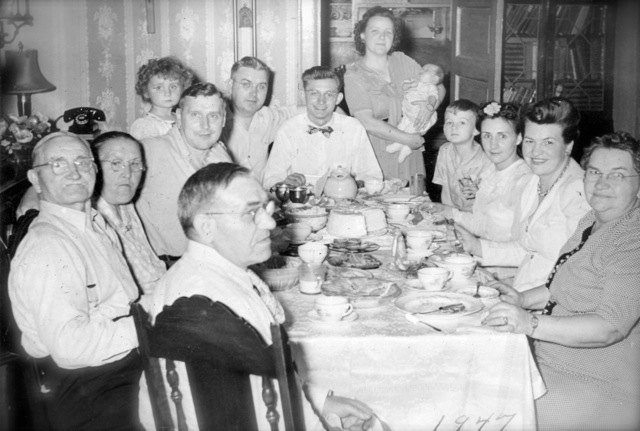
In the 1947 photo, below, we have either the son or the son-in-law, the mother, the daughter Sabina, and the father.  The father we guess to be a relative of Ludwig Zdrojewski.


Now we have the same family in 1970.  Son or son-in-law?  "Follow the noses;"  he looks like Matka, the mother, doesn't he?


Here is the daughter in 1965:


"Kochanemu Jankowi od Sabiny.  du. 12.8.65r."


"To beloved Janek from Sabina."

John Peter Zdrojewski is "Janek."

We're guessing that JPZ might be her great-uncle.


Often enough, as a child visiting on May Street, I would hear my Dziadzi, JPZ, talking very quietly to my parents, showing them letters and photos "sent by Sabina," or explaining that he "sent to Sabina" certain things, like tablets of notebook paper, that were plentiful for us but for them impossible to acquire.  This was in the 1960s.  The Iron Curtain was real.  I also remember them whispering gravely about "Gomulka."

Why did my parents and grandparents never speak to us directly about these things?  It wasn't because I was a girl;  they didn't speak to Marty about it either.  Did they, Marty?  Was it just too painful to talk much about?  


"Mamusia, ojciec i ja - Sabina    w 1969r."

"Mama, Daddy, and I - Sabina"


"Rodzice na wakacjach"

"Parents on holiday"


"Ojciec na rybkach"


"Dad fishing"    ("Ryba" is "fish.")

These photos are easily downloaded to your computer.  Just right-click on an image and choose from the little popup menu an item such as "Add to IPhoto Library" or "Download Image."

Julie

Monday, February 20, 2012

Poznan Zdrojewskis: From the Old Country, Part 3

We move to five photos from 1958-1959.  I don't see any of the Sabina nuclear family in them.  Are they in-laws?


Transliteration of the reverse of the photo:  Kochanemu Wojkow(?) i Cioci Ofianye(?) Teresa, Zdziszek. Renia i nasz wilk muszel . . . Vinisz??a, dura 8.II.58

Wojkow is likely a diminutive of Wojciech.  Muszelka are seashells.

"Our dear Wojkow and Auntie (????) Teresa, Zdziszek.  Renia and our wolf Muszel.

(?)  (?)   August 2, 1958


The second one is the same style and size of print, but the handwriting is different.

Stawek moj synek moya matka i siosta Hela.

"Stawek my son my mother and sister Hela."


The third one seems to be in a third hand, although the writer refused to use any of the same capitals or numerals as on the first two, so I can't feel sure.

Na wie??oi Pommioitke Kocham emu Wiy???? Ciosi i Kungmom ???? toi Pomietak . . .?no 16.3  59r.

"Our darling Pommioitke . . . "

"Kocham" is "beloved."


The fourth photo, stylistically similar, is of this young lady with the lovely lace collar.  The first word of the caption I can't even transliterate - can someone help me out here?  The second word is Marija,  which is "Mary."  Is this cousin Mary?


Fifth and final entrant in this series from the late 1950s is Alinka.

Who is she?

Looks like masculine handwriting.  Who wrote it?

Anyone with the remotest clue as to the identity of these people, or to the spelling or meaning of the inscriptions, is invited to Comment.

Any time you wish to review all the Poznan´photos, just go over to the right sidebar to the "Labels" section and click on what you wish to see.  Also, the Archives, farther down on the sidebar, list the titles of all previous posts.


Sunday, February 19, 2012

Poznan Zdrojewskis: From the Old Country, Part 2

I'm going to put up these photos chronologically.  This means that we won't see Sabina or Alinka for a bit, and in the meantime we will see people we don't know.  But we'll keep our historical perspective straight, and in a forward direction.  I'm Dr. Z., not Dr. Who.

Please remember that you can avail yourselves of the search function, sitting handy on the right sidebar of the webpage.  Can't think of a good search term to type into the search box?  Well, there is also a list of "labels" right there on the search bar.  I attach multiple "labels" to every post.  I do it  on purpose!  So you can search!  Yes - all posts in the series on these Poznan´ Zdrojewskis shall have the label "Poznan´."


1956:  a lot of Poland is still ashes and rubble, and the Communists have been in power ten years.  Stalin never succeeded in collectivizing the Polish farmers.  That's quite a difference from Ukraine, say, or the other captive nations, or Russia itself.  So why was that?  If anyone has read enough history to answer that question, that individual is invited to write up some ideas for a post, a comment, or a guest-post.

Anyway, look at the flat topography, mixed forests with lots of pine, and barns and outbuildings obviously designed for security.  The farmsteads look like fortresses, and against what?  Wind, snow, Mongols, Tatars, Russians, Prussians.  But eventually mechanized armies of the Third Reich and the USSR swept across those northern plains of Poland.


"1956r" means "1956 roku" - "the year 1956."

"Dziadek" means "Grandpa."  Marty and I were taught to say "Dziadzi."

"Joasia" must be a granddaughter.  Who are these people?

Imagine that Dziadek surviving two world wars, seeing the Polish Republic born and then enslaved, seeing millions of countrymen killed, and having living descendants and wondering what will become of them.  

Dissident literature often expresses the feeling of desperate isolation that people felt -  as if those in the West neither knew nor cared about them.  Once the Berlin Airlift was over, the West went home.

Who is this girl?  The farmstead looks the same.  She looks like she's all dressed up for her First Holy Communion.


Books of history, historical memoir, historical fiction, and Polish films, beginning of course with the films of Andrez Wajda, help in the understanding of what we see here: glimpses of the lives of our ancestors and of their descendants collateral to us.  I invite readers to write up book reviews and film reviews for posting.  We can help each other improve our understanding.

Julie


Saturday, February 18, 2012

Poznan Zdrojewskis: From the Old Country, Part I

A cache of photos fell out of a manila envelope onto the work table upstairs.  These had been mailed over the years to May Street by Zdrojewskis in or near Poznan.

Enough of them had names or dates noted on the back that it was possible to sort them by decade and by event.


The first two photos may show the link between Buffalo and Poznan Zdrojewskis.  Are the couple in the left photo pair related to the people in the right photo?  If so, how?


The two portraits below are unlike any other in the envelope.  They are older; I would say turn of the century, or end of the 19th. Note the Germanic name of the photographic studio; this is late C19 partition time, perhaps, or at least it is prior to the exodus of German-speakers from Poland in 1939.  Is the man Ludwig at a young age? Looks like him. Or is he a brother who stayed in Poland? Is the lady Victoria?  Or a sister? - they look so similar.

The two photos had been pasted into a photo album, then torn out.  Did "Alina" or "Sabina," ladies in the later Poznan pictures, mail photos to JPZ of JPZ's parents who went to America?  Or of his aunt or uncle in Poland?

The poses look like identity-paper mug shots, don't they?


 Below is the household roster from partition times.  If you click to enlarge, you can see that there was a household member named "Franciszek" who was born in 1900.


The family portrait below is the one of the earliest in the set, being dated 1947.  Is the gentleman with the eyeglasses Franciszek?  He looks like he could be 47 years old in the photo.

Is he a nephew of Ludwig?  If so, he is first cousin to the six sons of Ludwig and Victoria, and his descendants are cousins to their descendants.


The reverse shows that the photo was printed on postcard stock.  Someone noted the place and date: Poznan´ dnia (day, date) 30th July 1947.  

These individuals, plus others, will feature in subsequent posts on Poznan´ Zdrojewskis.

Monday, February 13, 2012

Julia Mostkowska Zdrojewska

There's a photo over the fireplace in the main office of the Coot Hill Family Historical Preservation Society.

                 
                          The elk antler is from Wyoming, but the photo is from Buffalo, New York.

The frame is of wood, carved to resemble braided leather, I would say.  This is a scan of the framed photo, glass and all.  The ghostly appearance of the image is appropriate to the fact that this is my paternal grandmother, whom I never met, but after whom I was named.

The backing came off easily.  Here's the straight scan.  From the clothing can we guess a date around 1920?  Note the round collar in velvet, and the belt that sits low on the hips.

She married JPZ, John Paul Zdrojewski, in - what year??  JPZ, my Dziadzi, told me that the proposal went like this (in what language was not specified):

He: "Julia, do you think you might marry me?"

She:  "Well, I think I like you well enough to marry you."


The color changes a bit toward the red when I click "Enhance" in IPhoto.  That's not the true color of the print, but it does lighten it up to show more clothing detail.

She and JPZ had Eugene in 1923, and Casimir  (what year, please??), and Melania.  Melania died at about age 12, most probably of scarlet fever.

Nowadays, photos of the lost first wife and the lost daughter would remain on display, honored by both the husband and the second wife.  But in those days, they put everything away and never spoke of it.  I've never seen a photo of Melania.


The photo was printed on postcard stock, then addressed, but not franked.  Somebody  decided to keep it and frame it instead.


Remember this photo from the earlier post, "Zdrojewski Identification Contest"? (Click on that; it's a link.) I think the lady on the left is Julia.  The top photo in that post is Julia also.  Look closely, and you will see she is wearing the same coat and hat.  I think my friend Laurie Harvey is right, and the noses clinch the identification.  I think that Grandpa Ludwig stands here with his daughter-in-law Julia Mostkowska Zdrojewski, and perhaps a sister of Julia's.

She looks that same as she does on the boat in the Orchard Lake graduation film.

My Grandma Julia died of a heart attack in 1943.  My Dad, Eugene, was away from home, in Army boot camp in Fort Benning, Georgia.  I never heard that they let him come up for the funeral.


Saturday, February 4, 2012

Zdrojewski Identification Contest

If you obtain this post as email, please click on the link at the tippy bottom of the email message.  It will take you to the website.  Then you simply click on the word "Comments" at the bottom of the post, then type in the text box that then appears.  Thanks!

JPZ and who?  Where?
JFZ figures that the lady is Julia Mostkowska Zdrojewski.  See John's comment, below.


Would someone please write a caption for this?  Who's that by the mirror; he looks like Casey! but as JFZ points out, this grouping is all Kaminskis.    Cecelia is on the right with  son Paul and daughter Celine.  I bet the beautiful lady with a glass in one hand and Celine in the other is Celine's grandmother; Cecelia's mother.  Who are the others? The youth behind Cecelia looks like my son Andrew; the whole thing freaks me out. I like those wall sconces.  I like the party atmosphere.

Anthony Zdrojewski was the third son of Ludwig and Victoria.  These are his wife, Anna ("Auntie Anna") and one of their daughters, Mariane.

Tony and Anna had two daughters - who was the other one? - and a son Ray.

The dining room at 175 May Street.  Ludwig, Victoria, Uncle Frank smiling!,Celine, John Peter, Casey, Eleanor with Electronics Johnny, little boy Paul, Cecelia, Aunt Julia??.  Next, the lady in the darker dress, seated at the corner, and : gent seated at the front end of the table: Eleanor's parents, Joseph and Louise Kotwas.  See JFZ's Comment, below.
  I remember so many details of that house, such as the gigantic padded rocker in the kitchen.  Check out the terrific telephone.  John, did you tell me once that your Dad phoned you at college every Friday night at 8pm?  Or am I making that up?

Identify these people and win a prize!  Fur coats and shoes.  The shoes are coming back in style, aren't they; but the fur has to be fake in the US in order to be correct.

"News from Poland," Radio News at thenews.pl

Annie Zdrojewski wrote a while back with a news flash about Bogdan Zdrojewski.  What, you don't remember Bogdan?  Well, Bogdan Zdrojewski is the Polish Minister of Culture, that's what.  His office last July released a publicity item in which he praised the chosen design for the new Polish History Museum to be built in Warsaw.

"Culture Minister hails Polish History Museum design"

This site has some fun stuff, as I found by looking around a bit.  There's an announcement of casting efforts for a bilingual production of Romeo and Juliet, to be produced in London. The idea is to demonstrate the opposition of the House of Montague with the House of Capulet by having Romeo's family speak Polish and Juliet's speak English!  What a great way to dramatize communications problems - although probably in the original tale the two houses understood each other perfectly well and hated each other for other reasons - but that is no matter.

Very striking, to me, is hearing the radio announcer speak.  I nearly fell out my chair.  His first language is obviously Polish, and his second is BBC-style British English with all those "plummy vowels."  It's not what one heard on the East Side of Buffalo back in the day!  So I recommend heartily the link below;  one then clicks the little black-and-white audio icon just under the main title of the news item.

"Polish Romeo and English Juliet"


Julie