Monday, January 21, 2013

Film Note: "Behind Closed Doors" and "Ashes and Diamonds"

Laurence Rees studied Kremlin archival material from the 1930s and 1940s when it became accessible after 1991.  His 2008 television series World War II: Behind Closed Doors: Stalin, the Nazis and the West drew on the archived notes of translators and diplomats in attendance at pre-war, wartime, and post-war meetings, at the Kremlin and elsewhere, of Stalin, his henchmen, Hitler's top henchmen, Churchill and his jesters, and FDR or Truman and their jesters.

The six parts of the Rees series all include some old documentary footage, some brand-new interviews with astounding people, and a good deal of re-enactment.  In this case the re-enactment is done well - very well indeed.  Each such scene is clearly demarcated; you know what you are looking at.  Simultaneously each scene rings with truth.  The actors are superbly chosen and know what they are doing. The claimed new material is really new material; it clarifies a great many things.

One of those things concerns the means, method, and machinery Stalin used to ensure that his puppets would be elected in the first national elections in Poland after the war.  It was new to me, and it is a shock.

I won't give away what it is; wait until you get to Episode 5.  Once you're there, after a review of the history and a viewing of the first four episodes, your stomach will turn properly.  I wouldn't want to impede that.

Ashes and Diamonds (1958) is Andrzej Wajda's film set in that nightmare period. Rees's work explains and clarifies its historical context.  The final scene, with the Polish puppet citizens dancing a robotic Polonnaise in a circle in a dingy hall, becomes more comprehensible - again, sickeningly so - with this new understanding of how the moves were made.

Quick summary, Yalta:

Churchill: "Do we have . . . your solemn promise . . . that there will be free elections . . . in Poland . . . very soon after Victory?"

Stalin:  "Sure, sure."

Molotov:  (chortle)

Stalin: "If they don't do their job well, we will shoot them."

Churchill: (cigar falls out of mouth)

FDR:  "Ha!  Ha!  Ha!  Well, maybe not all of them, Marshal Stalin.  Fewer than all."

Molotov: (chortle)


Quick summary, Teheran:

Churchill:  ". . .free elections . . . in Poland . . ."

Stalin:  "Sure, sure!"

Truman:   "                   "


Sunday, January 13, 2013

Sewing Class, Part 2: Aesthetics

The transition from sewing mechanics to costume design began with discussion of six characteristics of a well-designed costume: harmony of color; balance; emphasis; proportion; rhythm; harmony of line and decoration.


Balance can be "formal," (with mirror symmetry);
or "informal";
or sadly lacking with laughable result.


One part is to be emphasized - have more interest -
than the rest,
yet be related to the entire garment.


Is the ribbony bit centered or scattered?  I worry.


Click to enlarge.  "Good proportion is the pleasing relationship of parts."
"The flowing Grecian costume was simply girdled at the waistline
thus breaking up the long dress into two parts . . .
Thus in order to have a pleasing effect the division must fall
somewhere between one-half and two-thirds
of an area."

"Fig. 1 is pleasing because (the) mind is able to recognize
approximitly (sic) the relation of the parts
to each other and to the large oblong.
But because the mind does not decete (sic) the exact
proportion at once the attention is stimulated
and held
and interest is the result."

Flash to c1970: Four senior girls are standing on the front steps of Iroquois Central High School, Elma, New York, waiting in the chilly air for their parents to pick them up at 9am.  They have been sent home to change their clothes!  Why, were they immodest? Noooo.  Were they sporting gang uniforms? Noooo.  Were they strutting around in historical-criminal regalia?  Noooo.   They were wearing Empire-style long gowns - you know, like Jane Austen characters wore, except with higher necklines and homier homespun fabric. They had made their "granny dresses" themselves, and looked like Colonial-era American lasses.

So what was their offense?  Silly question: it was being out of conformity.  It made a big impression on me.  Great teaching job, Iroquois!

So anyway, too bad they could not quote classical Greek principles of proportion, like the one above, to the Principal.


"Fig.5.  an illustration of the Greek Law of Proportion.
The Greek Law of Proportion is:  Two lines or areas
are comparable, interesting and desirable (sic)
when one is between half and 2/3
the length or area of the other."

(1970 example: "granny dress,"
with or without "granny glasses.")

"The human figure is an example of fine proportion
and the costumes which have been considered beautiful
through all ages regardless of fashion
are those which have been formed
to the natural divisions of the body."

"Rhythm is present in a design when the eye is led easily
from one part of it to another.  Rhythm is an easy connected path
along which the eye may travel in any arrangement
of lines, colors, objects or light and dark effects.
In a perfectly plain space there is no movement
but the moment a pattern is placed upon the plain space rhythm is created.
This movement may be organized and easy and thus rhythmic
or it may be restless and distracting and lacking in rhythm."

Web designers, are you paying attention?


Repetition, at left;
Gradation, at right.

Opposition, at left;
Radiation, at center;
Transition, at right.


"Harmony is an agreeable combination of parts
making a connected whole . .
A well designed dress needs little decoration but whatever decoration it has
should appear to be a needed part of the dress
not something added to it after it was finished."


Fig. 1.  Vertical lines and divisions make a space appear taller and narrower.
Fig. 2. Horizontal lines make a space appear shorter and wider.
Fig. 3. A narrow panel makes a space appear taller and narrower.
Fig. 4. A wide panel makes a space appear wider.
Fig. 5. Vertical inward sloping lines decrease width.
Fig. 6. Vertical outward sloping lines increase width.
Fig. 7. Horizontal sloping lines add width."


There is more in these course notes.  For example, attributes of color are discussed: hue, value, intensity, and color harmonies.  Types of fabric and of weave are described in detail.  But for these, as well as for the appropriateness of dress and the clothing budget, you will have to come and visit me.

Wear what you like.

Just be ready to defend your choice on the basis of timeless aesthetic principles.

Mum


Thursday, January 10, 2013

Sewing Class, Part 1: Mechanics

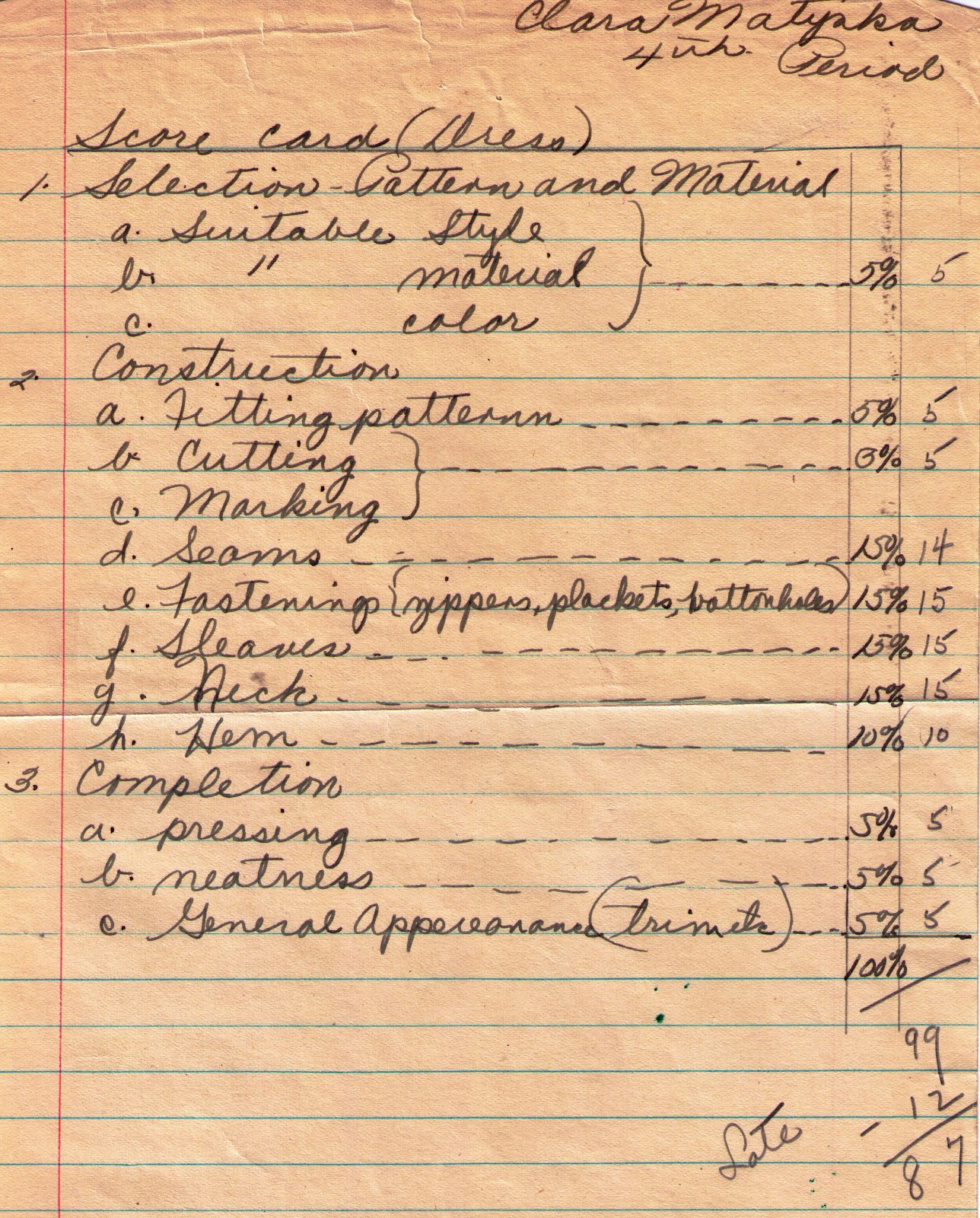
Clara Matynka, our CAMZ, took a sewing class in school, either in 8th grade (1943) or 9th grade (1944.)  Her class notes, after sixty years in attics, shall now be largely on the internet so her grandchildren can see them.  This is known in biology as "alternation of generations."  What it is called in family life, I cannot say.


Now you must attend and understand, Best Beloved, that "Gittere" is pronounced "GIT-tree."  This is as in:

"Hey, where we having Thanksgiving dinner?"

"On Gittere, hey."


Look at this!  Clara scored 99 out of 100 points for quality of workmanship in her dressmaking project.  Then Mrs. Landsman deducted 12 points for lateness!  Matka Boska!

I class Mrs. Landsman with my own Mrs. Merrill, about whom I shall say no more.


The course started off with a consideration of the anatomy and physiology of a sewing machine, as is proper.  The Singer diagram was dated 1914, interestingly;  after forty years the basic parts were recognizeably the same.  As to how it works in the loopy bit below stage, I myself still have no idea, not being as smart as Isaac Singer.

Then came the study of the cartography, or surgical anatomy, of garment patterns.

Then came practice in suture patterns, in a big section named "Seams."

The instructor did not just say "There are many kinds of seams," nor did she make them watch movies that just said the same thing, like my own teacher did a generation later.  The students sewed each kind, and turned in a sample of each kind.  Any subject can be approached in slacker mode, or with rigor.


Hem at the top; double and single lines of stiching;
at the bottom, hand-basting of ravel edge.


Plain seam, pinked;
Plain seam, overcast;
Plain seam, edge stitched;
Plain seam, "bound" with "seam binding";
French seam.


Add caption


Fell seam;
Mock French;
Lapped seam.


"Lesson 6: Bias" explains in plain language what I have never heard, nor intuited for myself: how flat cloth can be made to fit a curved, three-dimensional human body.

"Material is woven of two threads:
1. Lengthwise or warp (stronger thread)
2. Crosswise or woof (weaker thread)

A bias is cut diagonally across these two threads.

The advantage of using a bias is that it stretches and fits around a curved edge making a flat smooth finish."


These four hand-worked buttonholes were graded at 80%.


Next time, having considered mechanics, we shall proceed to aesthetics.


Monday, January 7, 2013

Polish Texans


While researching Kolędy for recent posts, I had the wonderful luck to come across Polish Texans.  What a group!  They have their genealogy information done up in a useful way; they put up vintage photos organized by theme; they link to dance troupes and put up articles on history, culture, and tourism.

Somehow they do the whole Christmas-and-Kolędy thing without snow.

The dismaying truth is that, over the last several months, Polish Texans have thrown a series of terrific parties, all of which I have missed.  These would include the Polish Festival at Barbarian Invasion Day at the Texas Renaissance Festival in Plantersville.

Read all about it at Polish Texans.

Read all about it at Polish Texans.

I wish the Polish Texans a restful and inspiring winter season, and plan to check their upcoming events calendar with prudent frequency.

Julie

Sunday, January 6, 2013

"Mędrcy świata, Monarchowie"

"Mages of the world, Monarchs" is the kolęda for Epiphany, written in the seventeenth century.

A Polish Army choir posted this performance, in which they make it sound the way it is supposed to sound.  A women's choir put up this moving performance.


Szymon Czechowicz painting,
from the previous post.


All four verses are essential to make sense of the thing; all four are given here and also here.

1. Mędrcy świata, monarchowie,
Gdzie śpiesznie dążycie?
Powiedzcież nam, Trzej Królowie,
Chcecie widzieć Dziecię?
Ono w żłobie, nie ma tronu,
I berła nie dzierży,
A proroctwo Jego zgonu,
Już się w świecie szerzy.

2. Mędrcy świata, złość okrutna,
Dziecię prześladuje.
Wieść okropna, wieść to smutna,
Herod spisek knuje:
Nic monarchów nie odstrasza,
Do Betlejem śpieszą,
Gwiazda Zbawcę im ogłasza,
Nadzieją się cieszą.

3. Przed Maryją stają społem,
Niosą Panu dary.
Przed Jezusem biją czołem,
Składają ofiary.
Trzykroć szczęśliwi królowie,
Cóż wam nie zazdrości?
Cóż  wam my damy, kto nam powie,
Pałając z miłości?

4. Tak, jak każą nam kapłani,
Damy dar troisty:
Modły, pracę niosąc w dani,
I żar serca czysty.
To kadzidło, mirrę, złoto
Niesiem, Jezu szczerze,
Co dajemy Ci z ochotą,
Od nas przyjm w ofierze.


Is there a good English translation available anywhere?  So far, such has eluded me, and I would be grateful to anyone who could provide one.  For now, here is an English version that I ran through, first, Google Translate, then my personal grammatical logic function, and then finally through my in-memory Baltimore Catechism doctrinal filter:

1.Worldly Magi, Monarchs,
Where go you at such speed?
Tell us, Three Kings,
You wish to see the Child?
It is in a manger, not on a throne,
And bears no scepter -
A prophecy of His death
Just as it is in the world rife/Just as death is rife in the world.
  
2. Magi of the world: anger cruel (there is)
Child-stalking.
News terrible, it (is) sad,
Herod conspiracy (is) plotting;
(Yet) No Monarch is deterred!
To Bethlehem hurry,
(The) Star the Savior proclaims,
(Consequently) Hope they enjoy.
  
3.Before Mary (they) are together,
Bear(ing) (You) Lord gifts,
Before Jesus (they) bow their heads,
making offering.
Thrice happy Kings,
Who would not envy you?
Well!  You are not jealous?
Well, to you we will give (? - show?)
to whom will tell us/the One who tells us,
burning with love.

4. Yes, as we are made priests,
We will give gifts threefold:
Prayer; the bearing of duty's labor;
and the fervor of a pure heart.
This frankincense, myrrh, gold,
Signifies Jesus, truly,
Since we take on the sacrifice//recognize/acknowledge
the Sacrifical Victim.


Czechowicz, detail

The crown and scepter of King Melchior are on the ground.  The image and idea of worldly kings giving homage to a universal God is the basis, and historically is the means of conveying, the concept of equality of man in the eyes of universal moral authority.  From that Judeo-Christian religious concept developed the religiously-neutral ethical-legal principle of equality before the law.

You can look at this painting and see why tyrants loathe the Judeo-Christian tradition.


Kaspar + Melchior + Balthazaar

Objawienie Pańskie ("Revelation of the Kings") is the Feast of the Epiphany of Christ to the Magi.
On January 6, the tradition is to write in chalk on the doors of the house
the initials of those three Magi,
to commemorate them and ask their blessing in the coming year.


From a third-century sarcophagus.
Those Phrygian caps they are wearing show up often in
subsequent depictions.


Mosaic, c565, the Basilica at Ravenna.
The kings are always shown to be of three generations.
See their star?


Melchior, the Persian, is the grandfatherly one.
Balthazaar, the Arabian, is of middle age.
Kaspar, a Prince of India, is the youth.


Fra Angelico and Fra' Filippo Lippi, C15,
admittedly have the Kings in the foreground,
but by golly they have the ox and the ass
on center stage.


Murillo, C17.
Melchior is kneeling;
Balthazaar stands to the left;
Kaspar stands to the right.
At top left, Murillo shows us
armed soldiers and crossed timbers,
seemingly to foreshadow the death of Christ.
Frankincense and myrrh were substances used
in the treatment for burial of the bodies of kings.


Szymon Czechowicz, of Warsaw, C18,
"Pokłon Trzech Króli."
The arrangement is similar to that of Murillo,
but the prefigurations of death are left out
and the star, the "gwiazda," shines forth instead.

Tissot, C19, "Journey of the Magi."
Or you could say "Podróż Magów."


20 K + M + B 13