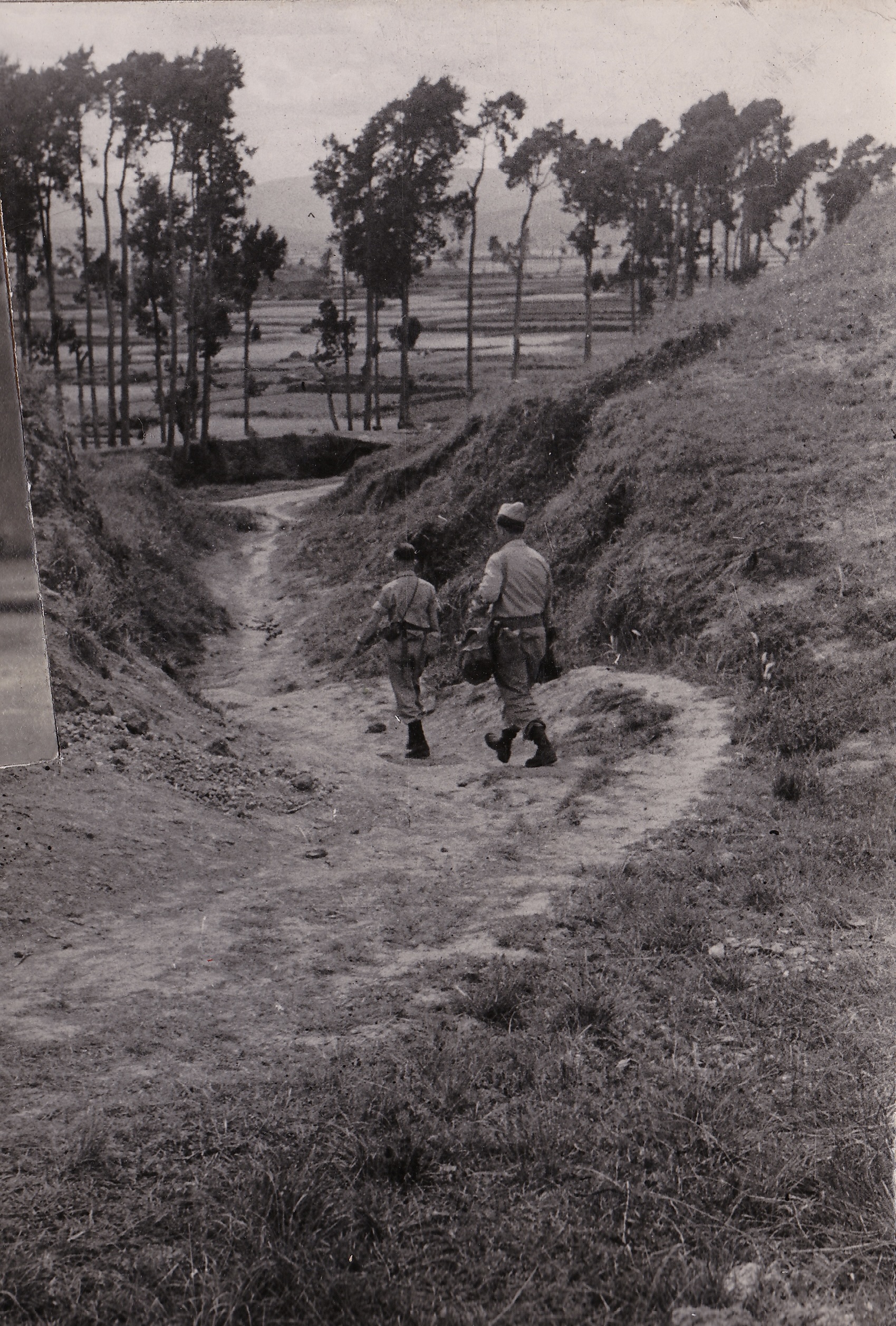
Here is a links roundup for review of the background relevant to this book:
Sunday, March 31, 2024
OSS Special Operations in China, Close Reading 3, Kunming to Chengtu to Hsian to HsinHsiang to a Drop Zone
Those two guys are, to my mind, extreme examples of the kind of self-directing fighting man for which the US Armed Forces have always been famous. I think it was Stephen Ambrose who described the US Army squad or platoon and its largely autonomous mode of operation as essential to victory in Europe. The brass knew to what level to direct them; the knew to give them a goal and let them go to it.
Hsian, aka Sian/Xsian, Mills describes as "surrounded by a massive stone bastion . . . [that] formed a rectangle two miles wide and three miles long around the city, with a deep moat dug recently just outside the wall in case the invading Japanese Army should advance that far to the west." (MMB 31-32.)
The Ping-Han Railway, single-track according to the map legend, ran north-south from Beijing (Peiping) to Hanzhou:
Paul Cyr, of St. Johnsbury, Vermont, Commanding:
Albert Robichaud, Lewiston, Maine schoolteacher:
Berent E. Friele, of New York, New York:
Below is a photo from MMB52, scanned and tweaked. I kind of have my doubts about the caption. I am thinking "Major Cyr; Boris Chu, Interpreter; B. E. Friele, Radio; Jerry Welo, Photographer." It would be nice to find another photo somewhere of Jerry Welo, for further confirmation of these IDs. If you find one, let me know, all right?
What happened after they hit the ground? When did the rest of the team arrive? Did anybody write anything down? Until next time - keep reading!
Wednesday, March 27, 2024
OSS CBI Photobook 17
Above: scan of top half of page 17.
Saturday, March 26, 2022
Cyprian Norwid: Ashes and Diamonds
Cyprian Kamil Norwid, (1821-1883), Polish poet and exile, wrote what is known to us now as the "Ashes and Diamonds" poem.
I'll transcribe it in four sort-of verses and interleave some translation. Following that will be a 1958 film clip and a 2008 song video.
Coraz to z ciebie jako z drzazgi smolnej
Wokoło lecą szmaty zapalone
Gorejąc nie wiesz czy stawasz się wolny
Czy to co twoje ma być zatracone
Extant translation for which attribution is hard to find:
"So, often, are you as a blazing torch
With flakes of burning hemp falling about you, flaming.
You know not if the flames bring freedom, or death,
Consuming all that you must cherish."
My translation, more literal and less beautiful - translation of poetry is a fascinating game:
"Increasingly, with you it’s like a blazing torch (tarry splinter)
Around you fall burning shreds
Burning, you know not whether they will become freedom
Or whether all that is yours is to be annihilated;"
Czy popiół tylko zostanie, i zamęt -
Co idzie w przepaść z burzą.
Czy zostanie na dnie popiołu gwiaździsty dyjament?
Wiekuistego zwycięstwa zaranie?
Extant translation for which attribution is hard to find:
If only ashes remain, and want, chaos, and tempest,
You shall be annihilated.
Or will the ashes hold the glory of a starlike diamond?
The Morning Star of everlasting triumph?
My translation, more literal and less beautiful:
Whether ashes only remain, and chaos -
What goes over the cliff in the storm.
Or whether there remains in the bottom of the ash a starlike diamond?
The dawn of everlasting triumph?
For verses 3 and 4, I can only offer my own translation:
Wiary dziś życzę Tobie, że zostanie
Bo na tej ziemi jesteś po to właśnie
By z ognia zgliszcza
Mógł powstać dyjament
Wiekuistego zwycięstwa zaranie
Czy wiesz, że jesteś po to właśnie?!
Faith today I wish you, that it remains,
For on this earth you are for exactly this:
So that from the fire-ashes
could arise diamond:
The dawn of everlasting triumph.
Do you know that you are for exactly that?!
Połóż rękę na sercu,
Otwórz oczy szeroko, i skacz!
Powiedz: Teraz lub nigdy
Zamiast: Będzie co ma być
I nie czekaj aż głód spełni
Twoje cierpienie! Tak!
Put hand on heart,
Open eyes wide, and jump!
Say: Now or never!
Instead of: There will be what will be.
And do not wait until hunger completes
Your suffering. Yes!
Andrzej Wajda's 1958 film Ashes and Diamonds is set in Warsaw just after WWII, at the height of the political and "kinetic" battle for Poland, between the Communists and the patriots wishing to re-establish the independent Republic. It has a famous scene in which the doomed protagonist and the lady find this Norwid poem inscribed on stone in one of the thousands of bombed-out and burned buildings in the city. The hero is in that all-too-familiar situation: with flames and ashes of his world swirling all around, he has to decide whether to fight, or go along to get along. If he fights, what will ensue, for him and for his country? He cannot know; he just fights anyway.
That scene starts at the 9-minute mark of the 12-minute video below. Vade Mecum is an artistic biographical video of the life of Norwid, who was ignored in his lifetime but very much heard today.
And here is Stan Borys singing the first two verses, with visual imagery apt once you know the background. (The exception in my case would be - I don't know from that turtle or whatever it is.)
What Stan Borys sings is Verse 1, then 2; 1, then 2; 1, then 2, after which he hums with the storm winds.
Czy zostanie na dnie popiołu gwiaździsty dyjament?
Saturday, January 2, 2021
More Finds for the Map Collection
G&C Maps Page has been spiffed up with new additions.
One comes from the very good overview article Second Sino-Japanese War, which provides discussion, illustration, maps, links to video, and references.
"Japanese Empire's Territorial Expansion" clearly shows the location and year of each move, beginning with the 1874 taking of the Ryukyu Islands, which include Okinawa, and moving on and up through the 1931 invasion of Manchuria and 1939 of Haiman. This illustrates the historical setting of what the US and Allies considered the China Theater of the Pacific War of WWII.
What a relief it was to find a couple of good, readable river maps. This map of the Yellow River (Huang He) shows very clearly the course of the river, its tributaries and basin, basic regional topography, important cities, and surrounding regions. Hsian/Xian, at the junction of the Wei and Jing tributaries, was the OSS center of forward operations in the history we are considering.
One city, part of our story, that is not on this map is Kaifeng. That would be the mysterious Kaifeng-on-the-Dollar-Bill, of which we may or may not ever figure out the meaning.
Kaifeng is located east of Zhengzhou, right at the place where the Yellow River bends to the northeast.
The source of this map is an essay that goes into a lot of detail, on historical courses of the river, for example, or the deliberate 1938 KMT flooding of the Yellow River valley to deter Japanese troops.
A map of the Yangtze has similar advantages in clarity, showing just enough detail of the course, drainage basin, geographical relation to the Yellow and the Pearl Rivers, geographical relation to Tibet, India, Burma, and the coast. It shows us Kunming and Hsian/Xian, clearly and on the same map.
Last but not least, a 1959 set of topographical maps of eastern and southern China is available for download from the University of Texas Libraries. The master map looks like this:
From the landing page, I clicked on Hsian from the list of major place-names, zoomed in a bit, and took a screenshot of the ancient city and the rivers nearby:
This kind of reading and map study is useful in reminding us of the who-what-when-where of the broader stage and action in which fits our JACKAL story, to which we return.
Sunday, December 27, 2020
Reprise Post: Kolęda - "Gdy się Chrystus Rodzi"
"Kolędy" are the hymns of of the European Christmas Season, which runs from December 4th through Epiphany, January 6th. This is intriguing and mysterious, since the "calends" are the first days of the months in the ancient Roman calendar.
This choir, "Harmonia," performs with a traditional up-tempo refrain.
A choir from Poznań renders the carol in constant, serene tempo.
Gdy się Chrystus rodzi i na świat przychodzi,
ciemna noc w jasnościach promienistych brodzi.
Aniołowie się radują
pod niebiosa wyśpiewują:
Gloria, gloria, gloria
in excelsis Deo!
Mówią do pasterzy, którzy trzód swych strzegli,
aby do Betlejem czym prędzej pobiegli,
bo się narodził Zbawiciel
wszego świata Odkupiciel:
Gloria, gloria, gloria
in excelsis Deo!
O niebieskie duchy i posłowie nieba,
powiedzcież wyraźniej, co nam czynić trzeba,
bo my nic nie pojmujemy,
ledwo od strachu żyjemy:
Gloria, gloria, gloria
in excelsis Deo!
Nascitur cum Christus et mundo apparet,
Caeca nox fulgore radiante claret.
Angeli in caelis visi
Cantat hymnum paradisi:
Gloria, gloria , gloria,
In excelsis Deo.
Bethehem quam primum ut proficiscantur:
Natus enim est Salvator,
Mundi machine Creator.
Gloria, gloria, gloria,
In excelsis Deo.
Quidnam faciamus, nobis revelate.
Imperiti nil pollemus,
Metu capti vix vigemus.
Glioria, gloria, gloria,
In excelsis Deo.
Saturday, December 26, 2020
Reprise Post: Kolędy (Polish Christmas Carols) - "Dzisiaj w Betlejem"
Wesoła nowina
Że Panna czysta, że Panna czysta
Porodziła Syna
Chrystus się rodzi
Nas oswobodzi
Anieli grają
Króle witają
Pasterze śpiewają
Bydlęta klękają
Cuda, cuda ogłaszają
Dzieciątko piastuje
I Józef święty i Józef święty
On ją pielęgnuje
Panna Syna rodzi
Przecież on wkrótce, przecież on wkrótce
ludzi oswobodzi
od wschodu przybyli
I dary Panu, i dary Panu
kosztowne złożyli
przywitać Jezusa
Króla nad królami, Króla nad królami
uwielbić Jezusa
(there are) merry news
That the pure Maiden, that the pure Maiden
Has born a son
Christ is born
He's going to deliver us
The angels are playing (music)
The kings are bidding welcome
The shepherds are singing
The cattle is kneeling
Wonders, wonders do they announce
Is nursing the child
And Saint Joseph and Saint Joseph
He's taking care of Her
The Maiden is bearing Her son
After all He'll soon, after all He'll soon
deliver the people
arrived from the east
and they gathered precious
gifts for the Lord, gifts for the Lord
and bid welcome to Jesus
King of Kings, King of Kings
to adore Jesus
Thursday, December 24, 2020
Reprise Post: Chopin, Christmas, and "For Our Freedom and Yours!"
Lulajże, Jezuniu, “Lullaby,
Little Jesus” is a traditional Polish Christmas carol dating from the
nineteenth century, or who knows, perhaps earlier. Here is a lyric in original and in translation; very homey, yes?
OUR YOUR
Tuesday, December 22, 2020
Polish Wooden Churches Restored
As part of a revamping of the Links listing in the right sidebar here, I have added a link to The First News, a magazine-style site pitched to potential tourists with inclinations to visit Poland.
A recent article discusses the completion of a project to restore ten wooden churches that date from medieval times. The photographs of exteriors and interiors are intriguing. All ten restored structures form a new wooden-church tourist trail in Wielkopolska, which is "Greater Poland," an ancient historical region that includes Poznań. The map below is from the article:
Zdrojewski and Matynka ancestors came to America from Wielkopolska. The dialect map below is from the linked Wikipedia article, which also has images of historic maps as well as of coats of arms of the various historic families. These coats of arms are obviously the best ones!
| Map of Polish dialects by Aotearoa - Own work, CC BY-SA 3.0, https://commons.wikimedia.org/w/index.php?curid=11836448 |
Monday, December 21, 2020
Reprise Post: Advent Carol: "Czekam na Ciebie"
Today's reposting is a third edit of the original 2013 kolęda post.
From Nuty Religijne we can obtain the score with Polish lyrics:
ciche błaganie, ku niebu śle.
Twojego przyjścia, czeka świat cały.
Sercem gorącym przyzywa Cię.
I wait for You, my little Jesus,
Silent supplication to the sky send.
For your advent, the whole world is waiting.
Fervent hearts call You.
Spójrz, tęskniony na tej ziemi,
przyjdź, o Jezu, pociesz nas!
Szczerze kochać Cię będziemy.
Przyjdź, o Jezu, bo już czas.
Look upon this Earth with its longing,
Come, O Jesus, comfort us!
Truly we will love You.
Come, O Jesus, because it is already time.
Usłysz Maryjo głos Twoich dzieci,
Tyś naszą Matką na każdy dzień.
O daj nam Słońce, które rozświeci,
grzechu i błędu straszliwy cień.
Hear, Mary, the voice of your children.
Thou art our Mother, every day.
Give to us the Sun, that its light
Will enshadow sin and terrible error.
daj nam Zbawcę, Dziecię Twe.
My dla Niego żyć pragniemy,
Jemu damy serca swe.